
Try neck relaxation using a tennis ball
Modern life brings many conveniences, but it also carries an unpleasant legacy – a stiff neck and painful back. Hours spent at a computer, constantly looking down at a phone, and stress that settles directly into the muscles of the neck and shoulders are an everyday reality for most people today. But what if there were a solution that costs almost nothing, fits in your pocket, and can be used anywhere? A tennis ball is precisely that kind of surprising helper, whose capabilities many people aren't even aware of.
Myofascial release – a technique of targeted pressure on overloaded muscle groups – is nothing new in the world of physiotherapy. Experts have been using it for decades, with the goal of releasing so-called trigger points. These are spots in a muscle where muscle fibres contract into a painful knot and refuse to release without external intervention. A tennis ball, thanks to its size, firmness, and slight elasticity, has proven to be an ideal tool for a home version of this therapy. It's neither too hard like a golf ball, nor too soft like a foam roller – it's just right.
Try our natural products


Why the neck specifically, and how to do it
The neck is the area that suffers the most. The muscles at the back of the neck and upper back bear the weight of the head – which weighs approximately five kilograms. When a person tilts their head forward over a phone or screen, the effective load on the cervical spine can, according to research published in Surgical Technology International, increase to as much as 27 kilograms at a 45-degree angle. That is an enormous strain on a small group of muscles, which then react exactly as one would expect – with pain, stiffness, and restricted mobility.
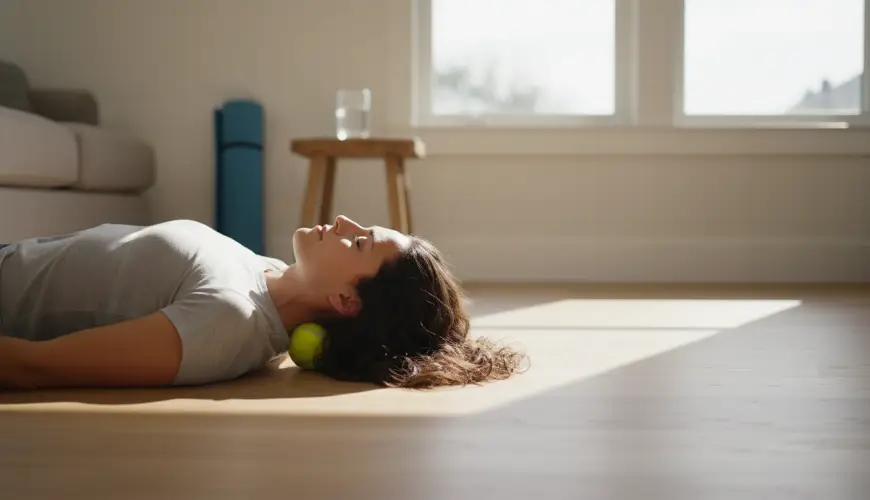
Working with a tennis ball in the neck area requires only a little patience and the right technique. The basic procedure involves lying on your back and placing the ball under the base of your skull – roughly where the skull ends and the neck begins. The position should be such that the ball is not pressing directly on the spine, but rather on the musculature on either side of it. Then simply allow the body to relax, breathe slowly and deeply, and let the weight of your own head gradually sink into the tense muscle. There is no need to actively push or move – passive release is the key here.
After a while, roughly thirty seconds to two minutes, you can begin to very gently move your head from side to side or nod it slightly. This movement helps the ball "work through" a larger area of the muscle and find the specific spots that are most sensitive. When you encounter such a point – you'll recognise it by a more pronounced pressure or mild tenderness – it's worth staying there for a moment. Physiotherapists call this approach "sustained pressure" and it is the fundamental principle of trigger point release.
Alongside the basic lying-down position, there is also a standing variation, which is practical, for example, in an office. The ball is placed between the base of the skull and a wall, you lean back against it and gently move your body so that the ball glides along the neck musculature. This technique is more discreet and doesn't require lying on the floor – yet it is surprisingly effective.
Imagine Martina, an accountant from Brno who spends eight hours a day at a computer. After months of headaches and a stiff neck, she began dedicating five minutes each morning to exercising with a tennis ball. "I expected it to do nothing," she says. "But after the first week, I realised I was waking up without that typical stiffness that had accompanied me for years." Her story is not an exception – it is an experience shared by thousands of people who have incorporated this simple technique into their routine.
Other parts of the body where the ball works wonders
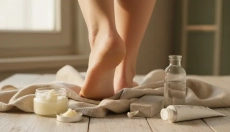
But a tennis ball is far from limited to the neck. The entire body is filled with places where tension likes to hide, and the ball can reach them surprisingly effectively. One of the most popular areas is the feet. Walking, standing on hard surfaces, or wearing unsuitable footwear causes overloading of the plantar fascia – the connective tissue band on the underside of the foot. Simply stand on the ball and slowly roll your body weight over it from heel to toes. The sensation is intense at first, but relief follows shortly after. Experts from the American Physical Therapy Association recommend this technique as a complement to the treatment of plantar fasciitis.
Another rewarding area is the glutes and the piriformis muscle region. This muscle lies deep beneath the gluteal musculature, and its overloading can cause pain radiating down the leg – a condition sometimes confused with sciatica. The technique involves sitting on the ball placed under one buttock, crossing the leg over the knee of the other, and gently moving until you find a sensitive spot. Maintain the pressure for one to two minutes. Many people who spend the entire day sitting describe this technique as immediately liberating.
The upper back and the area between the shoulder blades is another place where tension likes to take up residence. The procedure is similar to that for the neck – the ball is placed between the back and the floor or a wall, and the body moves slowly so that the ball travels along the muscles beside the spine, not directly on it. The area between the shoulder blades deserves special attention, as it is where many people develop pronounced knots caused by one-sided strain or poor posture.
A less common but highly effective application is releasing the forearms and palms. People who type a great deal or work with a mouse suffer from overloading of the forearm flexors. The ball can be placed on a desk and the forearm rolled over it with gentle pressure – this is a simple form of self-massage that can help prevent carpal tunnel syndrome, or at least alleviate it.
As physiotherapist and author of a book on myofascial release Thomas Myers says: "Fascia is the connective tissue that wraps around every muscle in the body – and if we neglect it, the entire system begins to function worse." Regular care of the fascia using simple tools such as a tennis ball is therefore not a luxury, but prevention.
When working with the ball, there are a few basic rules worth keeping in mind:
- Never press directly on the spine or joints – the ball always belongs on the muscular tissue beside them.
- The pain should feel pleasant – the so-called "good pain", not sharp or shooting.
- Don't overdo the time – two to three minutes on one spot is sufficient; longer pressure can irritate the muscle.
- Drink water – releasing the fascia supports the movement of fluids in the tissues, and hydration facilitates this process.
- Consistency is key – five minutes a day will produce significantly better results than an hour once a month.
A tennis ball has one more advantage that is more relevant today than ever before – it is accessible. While professional massage devices or visits to a physiotherapist can be costly, a tennis ball can be purchased for just a few coins. This makes it a democratic tool for body care, genuinely available to everyone regardless of income or place of residence.
It is of course important to mention that the ball is not a cure-all. Chronic pain, post-injury conditions, or neurological issues require professional care. If pain persists or worsens, it is always appropriate to see a doctor or physiotherapist. Self-massage with a ball is an excellent complement to body care, not a substitute for medical treatment.
It is interesting to observe the growing interest in simple, natural methods of body care at a time when we are surrounded by technology. People are increasingly looking for ways to take care of themselves without complex devices or expensive procedures. In this context, a tennis ball symbolises something deeper – a return to basics, to awareness of one's own body, and to the understanding that prevention is always easier than treatment.
All it takes is one ball, five minutes a day, and a little attention paid to your own body. The results that follow may surprise even the greatest sceptics.