

Try home alternatives to unhealthy snacks
Who could resist crunchy chips while watching a favourite series, a sweet bar at half past two in the afternoon, or a handful of salty nuts while working from home? Treating yourself to something tasty is a completely natural part of human life, and there's no reason to eliminate it entirely. The problem arises, however, when industrially processed snacks become a regular part of one's diet – and in the modern age, this is happening more and more easily. The good news is that homemade alternatives to popular unhealthy snacks are not only possible, but in many cases tastier, cheaper, and surprisingly simple to prepare.
It's not about giving up the joy of eating. It's more about making a conscious decision about what we put into our bodies – and discovering that a healthier choice doesn't have to mean a compromise on taste.
Try our natural products

Why are industrial snacks so addictive?
To understand why homemade versions are a better choice, it's useful to first understand what makes industrial snacks so hard to resist. Food manufacturers invest enormous resources into researching the so-called "bliss point" – the point at which a combination of salt, fat, and sugar triggers maximum reward in the brain. This phenomenon was described by journalist and author Michael Moss in his book Salt Sugar Fat, in which he showed how the food industry systematically develops products designed to make it as difficult as possible for consumers to eat them in moderation.
The result is chips enriched with dozens of additives, biscuits filled with hydrogenated fats, or bars with a sugar content comparable to confectionery. Reading the ingredients on the packaging of a standard bag of crisps or wafers can be quite an eye-opener – the list of ingredients is often longer than the recipe for a homemade version of the same product.
That said, it doesn't mean you need to give everything up. It's enough to move some of the preparation into your own kitchen.
Crisps, popcorn, and savoury snacks – done differently
Perhaps the most popular category of unhealthy snacks is salty, crunchy things – crisps, pretzels, savoury sticks, or corn snacks. This is precisely where the scope for homemade experimentation is greatest, and the results are often surprisingly good.
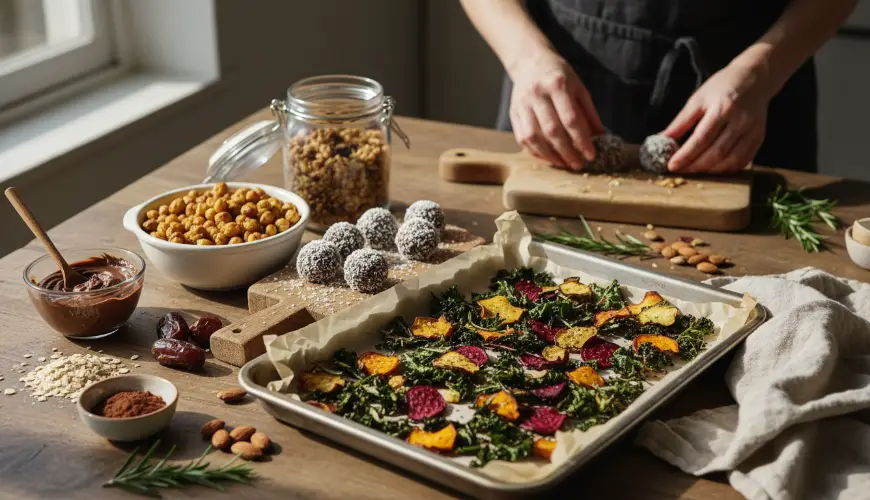
Baked vegetable crisps are a classic example of how to transform a favourite snack into something that truly benefits the body. Beetroot, parsnip, courgette, kale, or sweet potato sliced into thin rounds, lightly brushed with olive oil and seasoned with salt, paprika, or rosemary – after twenty minutes in the oven, you have a crunchy snack packed with fibre, vitamins, and natural flavour. Kale chips in particular have gained their own fan base and are sold in some countries as a premium product at prices that would make home preparation seem laughable.
Homemade popcorn is equally straightforward. While microwave popcorn bags are typically saturated with artificial flavourings and excess sodium, making popcorn from corn kernels in a pot with a little coconut or rapeseed oil takes literally five minutes. It can be seasoned with salt and dried herbs, nutritional yeast for a cheesy flavour, cinnamon and honey, or chilli and lime – the possibilities are virtually endless.
For those who can't do without savoury sticks or pretzels, there is a simple homemade version made from wholegrain dough flavoured with seeds, herbs, or sesame. Preparation takes about half an hour and the result keeps in a sealed container for several days. It also contains a fraction of the sodium found in industrial alternatives and no preservatives.
An interesting option is also roasted chickpeas or chickpea snacks. Cooked or tinned chickpeas, rinsed and dried, seasoned with your favourite spices, are roasted in the oven at high temperature until they develop a crunchy texture. The result resembles peanuts or corn snacks, but also delivers a solid dose of plant-based protein and fibre. This type of snack is particularly popular in Mediterranean and Middle Eastern cuisines, where roasted chickpeas have a long tradition.
Sweet snacks without industrial sugar
The sweet side of the snacking world is perhaps even more complex. Chocolate bars, wafers, cream-filled biscuits, and gummy sweets are among the most popular snacks of all – and at the same time among those containing the most added sugar, hydrogenated fats, and artificial colourings.
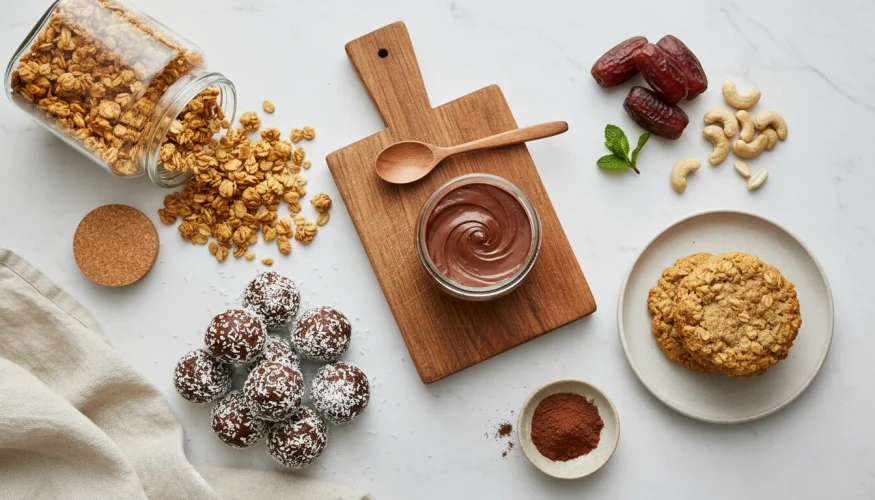
Homemade energy balls or date balls have become one of the most popular alternatives in recent years. The base is typically a mixture of dates, nuts, oats, and cocoa, blended together, shaped into balls, and left to set in the fridge. They require no baking, take about fifteen minutes to prepare, and taste surprisingly similar to commercial energy bars – without added sugar, without palm oil, and without unnecessary additives. What's more, everyone can customise them to their own taste: adding coconut, matcha, vanilla, freeze-dried fruit, or protein powder.
Homemade granola is another example of how to replace an industrially processed product with something far more wholesome. Commercial granolas tend to be surprisingly sweet – research by Action on Sugar has repeatedly shown that the sugar content of some granola brands exceeds even cereals aimed at children. Homemade granola made from oats, nuts, seeds, a little honey or maple syrup, and coconut oil is ready in half an hour and can be stored in a sealed jar for several weeks. As a snack, a base for yoghurt, or a treat on its own, it's an excellent choice.
For chocolate lovers, an interesting alternative is a homemade chocolate spread. Commercial chocolate creams like Nutella list sugar as their first ingredient and palm oil as their second – cocoa and hazelnuts appear much further down the list. A homemade version made from hazelnut butter, quality cocoa, a little honey, and coconut oil tastes richer, contains real nuts, and can be prepared in five minutes in a blender.
Many people could tell their own story about homemade snacks. Take, for example, a mother of three from Brno who discovered that her children would eat commercial biscuits by the handful, but homemade oat biscuits with banana and dark chocolate chips disappeared from the table just as quickly – and yet contained only three ingredients and no added sugar. "I was surprised by how much they enjoyed things I'd made myself. I thought they'd only want what came from the shop," she said with a smile.
Practical tips for switching to homemade snacks
Switching from industrial snacks to homemade alternatives doesn't have to be radical or sudden. It's enough to start gradually – swapping out one product a week, trying a new recipe at the weekend, or preparing a batch of homemade snacks for the whole week in advance. Planning plays a key role: if there's a batch of date balls in the fridge or a jar of homemade granola ready to go, it's far less likely that you'll reach for an industrial alternative simply because there's nothing else to hand.
Equipment also matters. A good blender or food processor makes it significantly easier to prepare nut butters, energy balls, or date pastes. A mandoline or a sharp knife helps slice vegetables thinly enough for homemade crisps. Investing in basic equipment pays off quickly – not only financially, but also in the form of a better feeling about what we eat.
It's worth keeping a stock of basic ingredients at home from which a snack can be prepared at any time:
- nuts and seeds (cashews, almonds, flaxseeds, sunflower seeds)
- oats as a base for granola, biscuits, or energy balls
- dates or dried fruit as a natural sweetener
- quality cocoa for chocolate variations
- pulses – chickpeas, lentils, or edamame as a base for savoury snacks
- vegetables suitable for roasting – beetroot, sweet potato, kale, courgette
Switching to homemade snacks also has a dimension that goes beyond personal health. Fewer industrially processed foods means less packaging and less plastic waste, as well as a smaller ecological footprint. WWF in its reports repeatedly highlights that wrappers from single-use snacks are among the most commonly found types of litter in nature. Homemade snacks can be stored in glass jars or metal tins that last for years.
A healthy lifestyle doesn't mean a strict diet or deprivation. It means, above all, a mindful relationship with food – knowing what we eat, where it comes from, and how it was made. Homemade snacks aren't perfect, and even the best recipe doesn't always work out on the first attempt. But that's precisely where their charm lies: they are human, authentic, and full of whatever we ourselves put into them. And that is something no factory can replicate.