

Try eggs 7 ways from 7 countries around the world
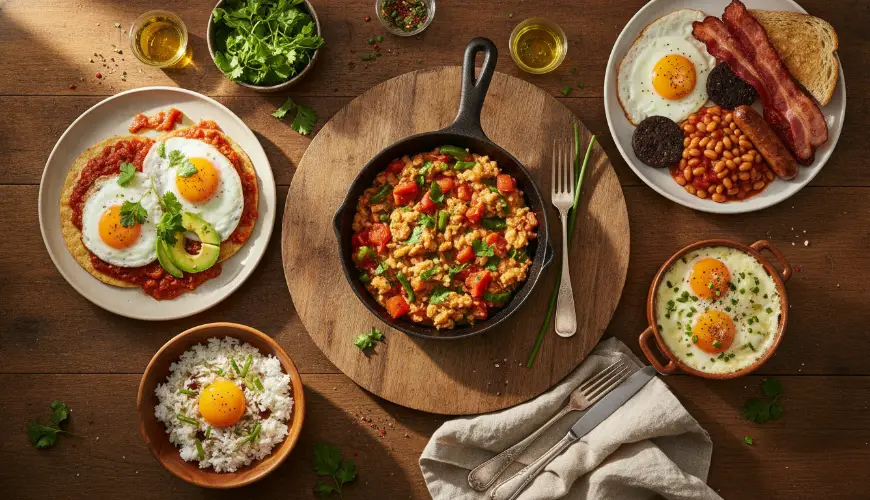
Few foods can do what eggs do. Breakfasts around the world would look completely different without them – and yet every culture has adapted this humble ingredient in its own way, with its own spices, techniques, and philosophy of what eating in the morning actually means. If someone is looking for breakfast inspiration for the whole week, they don't need to look far – just take a look at how chefs and households work with eggs from Mexico to Turkey to Japan.
Eggs are much more than just a quick solution for busy mornings. They are a source of quality protein, healthy fats, and a whole range of B vitamins, vitamin D, and choline, which is crucial for brain function. The Harvard School of Public Health states that one large egg contains approximately 6 grams of protein and a whole range of micronutrients at just 70–80 calories. It is no wonder, then, that eggs remain one of the most popular breakfast ingredients in the world – regardless of cultural or geographical boundaries.
Try our natural products





Monday to Wednesday: Mexico, Turkey, and Japan
Starting the week with energy and flavour is helped by Mexican huevos rancheros – one of the most well-known dishes in the local breakfast culture. It consists of fried eggs served on corn tortillas, topped with spicy tomato salsa and complemented by beans, avocado, or fresh queso fresco cheese. It is a combination that keeps you full all morning while offering a diverse palette of flavours – the acidity of tomatoes, the creaminess of avocado, and the gentle heat of chilli peppers. Anyone who has ever eaten this in a small family restaurant in Mexico City knows that breakfast doesn't have to be a dull affair.
From a completely different world comes Turkish inspiration. Menemen is a traditional Turkish dish made from eggs, tomatoes, green peppers, and onion, all stewed together in olive oil and seasoned with red pepper and cumin. It is prepared directly in the pan and served in it – without unnecessary transferring or garnishing. It is a dish that Turks eat in the morning and afternoon, in summer and winter, alone and in company. Menemen is actually a perfect example of how ordinary ingredients can be used to create something with depth and character. Add fresh bread, good tea, and morning calm, and it becomes a ritual.
The Japanese approach to breakfast is, by contrast, delicate and precise. Tamago gohan – a raw egg mixed into warm rice with a little soy sauce – sounds simple, even minimalist at first glance, but in Japan it is a dish with deep cultural value. The quality of the eggs is important here: Japanese eggs are raised with strict hygiene standards in mind, which make the consumption of raw eggs safe and common. The result is silky creamy rice with a delicate umami flavour that prepares both body and mind for the working day. This dish is a reminder that breakfast doesn't need to be spectacular – it needs to be right.
Thursday and Friday: India and France
Thursday morning deserves a little more spice. Indian egg bhurji is a loose equivalent of scrambled eggs, but seasoned with curry leaves, turmeric, fresh ginger, coriander, and green chilli pepper. Onion and tomatoes are added, and the result is a bold, fragrant dish sold by street vendors and luxury hotels alike in India. Interestingly, egg bhurji varies from region to region – in southern India, coconut milk is added, while in the north, more butter and garam masala are used instead. This variability is precisely what is fascinating about Indian cuisine: there are countless correct ways to make one and the same dish.
Friday then belongs to elegance. French eggs en cocotte – eggs baked in small ceramic dishes with a little cream, herbs, and possibly truffle oil or ham – are a demonstration of how the French approach food in general. Nothing is superfluous, everything is in its place. The eggs are baked in a water bath in the oven until the white is set but the yolk remains liquid and velvety. The result is visually and gastronomically convincing, yet requires no particularly complex equipment – just an oven, small dishes, and quality ingredients. As the famous French chef Auguste Escoffier said: "Good food is the foundation of genuine happiness." And eggs en cocotte are proof that this holds true for breakfast as well.
Weekend: Ethiopia and Great Britain
Two diametrically different traditions remain for the weekend. Saturday morning can belong to Ethiopian firfir with eggs – a traditional dish where pieces of fermented injera (a flatbread made from teff flour) are mixed with spicy berbere sauce and eggs are added, either boiled or added directly to the pan. Injera itself is a fascinating ingredient: fermented bread with a naturally sour flavour, which serves simultaneously as cutlery and a side dish. An Ethiopian breakfast is a communal, shared meal, full of colours and aromas – and yet completely natural and unforced.
Sunday breakfast can be nothing other than the British full breakfast, originally called the "full English". Fried eggs, bacon, baked beans in tomato sauce, toasted bread, sausages, grilled tomatoes, and mushrooms – all on one plate. The full English is a cultural phenomenon that has survived generations, dietary fads, and various nutritional trends. It is a meal that says: today we take our time. Today we are in no hurry. The British eat it at weekends, on holidays, after long nights, and as a festive gesture of hospitality. It is not an everyday meal – but as the crowning point of the week, it holds an irreplaceable place.
Why Eggs Still Lead
If one reflects on what all these dishes have in common, an interesting conclusion emerges: eggs are, in a sense, a neutral canvas onto which each culture paints its own picture. They are not just protein – they are carriers of cultural identity. The way a society prepares eggs in the morning says a great deal about its values, rhythm of life, and relationship to food as such.
From a nutritional standpoint, it is also worth mentioning that the quality of eggs matters. Eggs from free-range or organically farmed hens demonstrably contain higher levels of omega-3 fatty acids and vitamin E, as evidenced by, for example, a study published in the journal Poultry Science. Choosing an egg is therefore not merely an ethical question – it is also a question of the nutritional value of what one eats every morning.
The practical value of this global journey is entirely real. Imagine Tereza, a thirty-year-old teacher from Brno, who ate the same scrambled eggs with bread every morning and eventually grew so tired of breakfast that she started skipping it altogether. When she decided to try these recipes from different corners of the world one by one, she discovered not only that she began to enjoy breakfast again, but also that her entire relationship with the morning ritual had changed. Menemen prompted her to get up ten minutes earlier so she could prepare it in peace. Tamago gohan, in turn, taught her to perceive simplicity as a value, not a compromise.
Breakfast is the first decision of the day – and the decision of what to eat shapes not only our bodies, but also our minds and mood for the entire morning. Science confirms this: research from the University of Cambridge shows that a regular, nutritious breakfast improves concentration, stabilises blood sugar levels, and reduces the tendency to overeat during the day. And what better foundation for a nutritious breakfast than eggs – affordable, quick, versatile, and delicious?
The whole world agrees on one thing: mornings deserve more than just a cup of coffee. Whether it is spicy menemen with fresh bread, or delicate eggs en cocotte with herbs from the balcony – every day offers a new opportunity to start better. And all it takes is eggs, a little inspiration, and the desire to pause for a moment and savour the morning the way people around the world do – with care, with flavour, and with joy.