

Try recipes from fresh nettles
Stinging nettle (Urtica dioica) is one of the most underestimated plants that spring up practically everywhere in spring – along fences, at forest edges, in gardens and on wasteland. Most people know it primarily as an unpleasant herb that burns on contact, and try to give it a wide berth. But that is truly a shame. Nettle is, in fact, one of the richest edible plants that Central European nature has to offer, and in the kitchen it can surprise even the greatest sceptics.
Experienced herbalists and natural cooks know that nettle was for centuries a staple of the spring diet of rural populations. This is therefore no fashionable trend or whim – it is a return to a tradition with deep roots in Czech and Central European gastronomy. Moreover, it turns out that nettle surpasses many vegetables sold in shops in terms of its nutritional profile. It contains exceptional amounts of iron, magnesium, calcium, vitamin C and a whole range of antioxidants, as confirmed by expert analyses available, for example, in the USDA nutritional database.
Try our natural products





When and how to harvest nettles
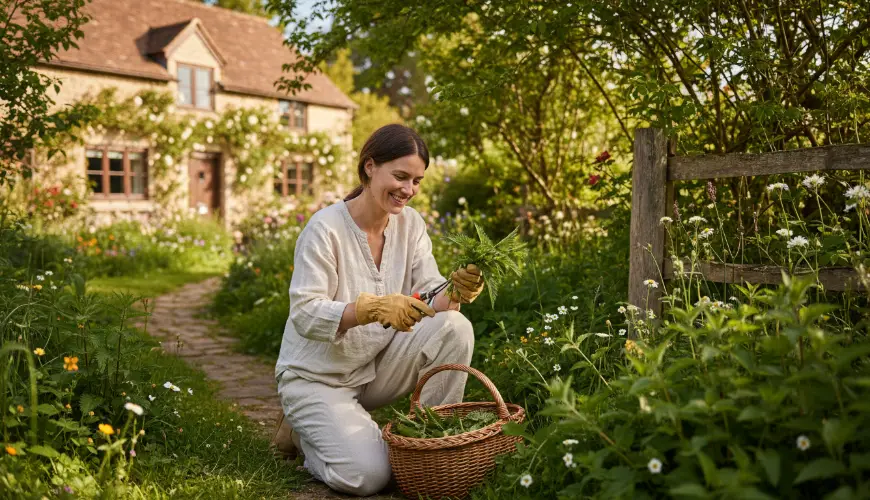
Before we get to specific recipes, it is important to know when and how to properly harvest nettles, as this affects not only the flavour but also the safety of preparation. The best time for harvesting is from March to May, when the shoots are young, soft and full of nutrients. Older nettles – especially those that are already flowering or setting seed – are less suitable for culinary purposes, as the leaves become coarser and their flavour and composition change. Ideally, harvest only the upper parts of the stems with a few pairs of leaves, in the morning after the dew has dried.
When harvesting, it is essential to wear gloves – that will surprise no one. Less obvious is that nettles should be harvested well away from busy roads, industrial areas or places where pesticides are used. A clean location is the guarantee of a quality ingredient. Once brought home, it is sufficient to rinse the nettles thoroughly in cold water. As soon as they are submerged in boiling water or heat-treated in any way, their stinging properties disappear completely – this is due to the breakdown of formic acid and histamine contained in the stinging hairs.
One thing that surprises everyone who cooks with nettles for the first time: their flavour resembles spinach, but is more pronounced, earthier and with a subtle herbal depth. This is precisely why nettle pairs very well in recipes with garlic, nutmeg, lemon or richer ingredients such as eggs, cream or cheese.
Step-by-step recipes using fresh nettles
Nettle soup with potatoes
Nettle soup is a classic that never disappoints. It is simple, quick and yet surprisingly filling. To prepare it for four people, you will need approximately 200 grams of freshly harvested nettle shoots, three medium potatoes, one onion, two cloves of garlic, a tablespoon of butter or vegetable oil, stock (vegetable or chicken) and salt and pepper to taste.
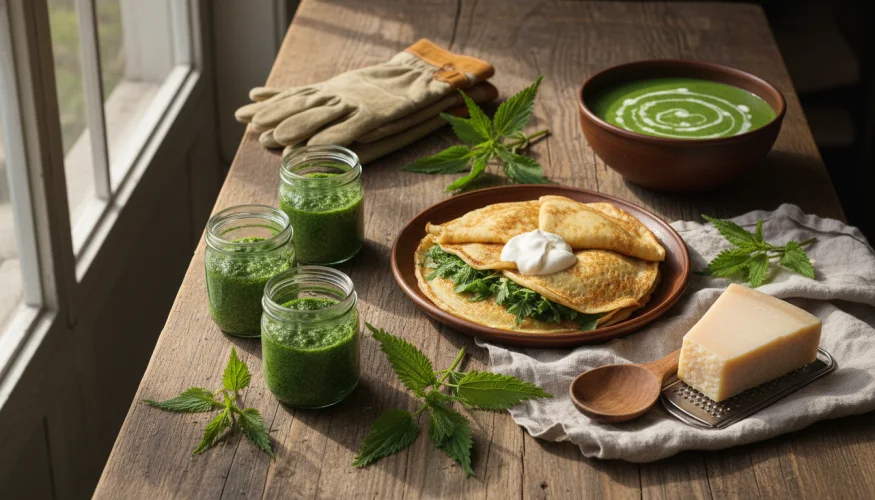
The process begins by sautéing the chopped onion and garlic in fat until golden. Meanwhile, peel and dice the potatoes, add them to the onion and briefly sauté. Then pour in stock – approximately one litre – and cook until tender, which takes approximately fifteen minutes. The nettles are added only at the end, as they only need two to three minutes in the boiling liquid. The entire soup is then blended until smooth and seasoned with salt, pepper and optionally a little nutmeg. The result is a deep green soup with a silky texture that tastes equally good hot or slightly chilled.
Nettle spaghetti with garlic and Parmesan
This recipe is proof that nettles get along well with Italian cuisine too. Preparation is quick – anyone who can cook pasta can manage it. For two portions you will need a handful of fresh nettles, 200 grams of spaghetti, three cloves of garlic, olive oil, freshly grated Parmesan, salt, pepper and optionally chilli flakes.
Cook the spaghetti al dente according to the packet instructions. Meanwhile, blanch the nettles – that is, submerge them for two minutes in boiling salted water – then immediately transfer them to ice water to preserve their colour. Once cooled, squeeze them thoroughly and roughly chop them. Heat olive oil in a pan, add the chopped garlic and allow it to turn lightly golden. Then add the nettles and briefly warm them through. Add the drained pasta directly to the pan, add a little pasta cooking water, and mix everything together into a smooth, slightly creamy consistency. Serve immediately, sprinkled with Parmesan and chilli if desired.
Nettle-filled crêpes
Nettles are also excellent as a filling for crêpes, combined with cottage cheese or ricotta. This dish works as a light lunch or as a more special dinner. Prepare the crêpe batter in the standard way from egg, milk and flour. For the filling you will need blanched and chopped nettles, cottage cheese or ricotta, a clove of garlic, salt, pepper and a little lemon zest.
Simply mix all the filling ingredients together. Fill the cooked crêpes, roll or fold them, and bake in the oven for approximately ten minutes at 180 degrees, ideally topped with a light béchamel sauce or soured cream. The result is surprisingly elegant – and few people will guess that the secret ingredient is an ordinary nettle from the garden.
Nettle pesto
Nettle pesto is perhaps the most versatile way to process a larger quantity of nettles at once. It is prepared similarly to classic basil pesto, but the resulting flavour is more pronounced and earthier. For one jar of pesto you will need two handfuls of blanched nettles, a handful of pine nuts or walnuts, a clove of garlic, olive oil, Parmesan, salt and lemon juice.
Blend everything until smooth – or roughly, if you prefer a more textured consistency. The pesto will keep in the refrigerator covered with a layer of olive oil for up to a week, or can be frozen in ice cube trays for later use. It works well with pasta, on toast, as a dressing for vegetables or as part of a sandwich.
An interesting example of how nettles can surprise is described by Jana, a thirty-year-old teacher from the South Moravian Region, who last year decided to harvest nettles for the first time on the recommendation of her grandmother. "I was expecting something bitter and strange, but the nettle soup completely won me over. Now I make it every spring and friends always ask what vegetable it is – nobody can tell," she says. Her experience is not unique – nettle has the quality that after cooking it tastes so natural and delicate that many people cannot even identify it as a "weed".
It is worth mentioning that nettle in the kitchen is not limited to main dishes. Nettle crisps can also be made from it – the leaves are coated in a light batter or simply brushed with oil and baked in the oven at a low temperature until crispy. They make an excellent healthy snack or a garnish for soup. Nettles are equally well suited to vegetable smoothies, where they add a significant nutritional boost without a dominant flavour – especially in combination with apple, ginger and lemon.
For those interested in a sustainable lifestyle and local food, nettle is an ideal symbol of what local nature can offer for free and without ecological burden. Harvesting nettles means reducing dependence on industrially grown vegetables, supporting seasonal eating and at the same time connecting with the rhythm of nature, which renews itself every spring. As the organisation Slow Food states, local and wild-growing foods are a key element of biodiversity and gastronomic culture.
To ensure that preparing nettles is truly safe and enjoyable, it is worth following a few practical guidelines. Always use gloves when harvesting and when washing raw nettles. Blanching or cooking completely eliminates the sting. Nettles can be stored in the refrigerator wrapped in a damp paper towel for up to three days, or blanched in the freezer for several months. When harvesting, it is advisable to avoid locations near roads and industrial zones.
As British chef and wild food advocate Hugh Fearnley-Whittingstall once wrote: "The nettle is the most generous plant nature offers – free of charge, every year, exactly when we need it most." And indeed – spring nettles arrive at a time when the body naturally craves a gentle detox and vitamin replenishment after winter, before the first garden vegetables appear at markets.
Nettle as an ingredient opens the kitchen door to a world where flavour, nutrition and sustainability meet in one pot. Whether one chooses a simple soup, a creative pesto or surprising pasta, the result is always worth it – and next time a nettle stings on a walk, perhaps the first thought will be not of pain, but of a recipe.