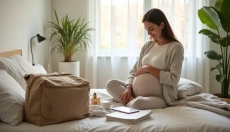

You can stay fit on maternity leave even without a gym if you break your exercise into short blocks
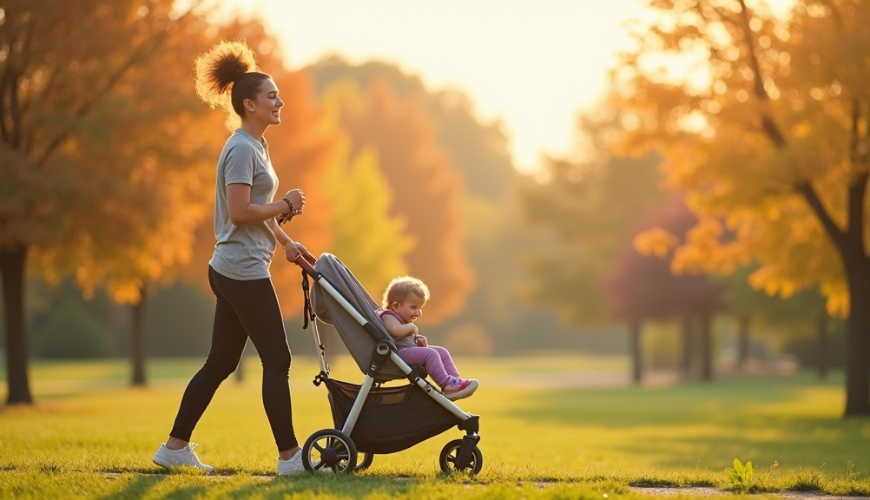
Being fit on maternity leave sometimes sounds like a slogan from an advertisement, but the reality of parenthood is often much more layered: lack of sleep, the cycle of feeding, breastfeeding or baby food, sore backs from carrying, and the feeling that "one should" still manage to do something for oneself. But this is where an important shift occurs – the goal is not performance or the pursuit of the ideal body, but mobility, health, and feeling good in the body. And also kindness to oneself, because a woman's body after childbirth deserves respect, time, and gradual adaptation.
Perhaps the rhetorical question arises: when the day is broken into short segments, where can space for movement be found? The answer is surprisingly practical. Movement doesn't have to only happen in the gym or in hour-long sessions. It can be pieced together from small, natural parts – walking, carrying, playing on the floor, stretching while cooking. And most importantly: it can be adjusted to how the body feels after childbirth.
Try our natural products





Fit and in shape during parental leave: what does it really mean
The term "fit" is often narrowed down to appearance. However, in the postpartum period, it makes much more sense to understand it as functional fitness: having enough energy for the day, managing stairs with a stroller, lifting a child without a "snap" in the back, feeling stable in the pelvis, breathing freely, and having a body that cooperates instead of protesting. This is the true form that every mom will appreciate – even the one who doesn't have the desire or capacity to "go full throttle."
A woman's body undergoes changes after childbirth that cannot be skipped. The abdomen and pelvic floor need time to recover, joints may be looser for a while (the influence of hormones can linger longer, especially with breastfeeding), and new movement patterns emerge: long hours with a baby in arms, breastfeeding leaning forward, putting a child to sleep in uncomfortable positions. That's why it's useful to redirect attention from "burning" to "strengthening and relieving" – finding stability, improving posture, and returning to natural movement.
It's also important to remind that there is no pressure on performance. A body that has created and birthed a child is not "broken" – it is just adapting. And adaptation is a process. If gentle regularity and smart little moves are added throughout the day, results often come unnoticed: breathing becomes easier, the back hurts less, walking is lighter, the body is more flexible. This is precisely the type of "fit" that is worth it during parental leave.
As a precaution: if there are symptoms like pain, significant problems with urinary leakage, a feeling of heaviness in the pelvis, diastasis (separation of the abdominal muscles) with functional issues, or problems after a cesarean section, a consultation with a physiotherapist, ideally specializing in the pelvic floor, is advisable. Authoritative and understandable information is offered, for example, by NHS (National Health Service) on postpartum exercise and returning to movement, as well as recommendations by ACOG (American College of Obstetricians and Gynecologists) regarding postpartum exercise.
How to exercise, move, and feel healthy: considering the body after childbirth without chasing perfection
When someone says "tips on how to exercise," many moms imagine intense workouts. Yet, the biggest difference often comes from small, sustainable things. The postpartum body usually needs three basic ingredients: breath, stability, and gradual strengthening. It sounds simple, but in practice, it means changing small habits.
It starts with breathing. Instead of holding your breath while lifting a child or carrying a car seat, it helps to consciously exhale and "tighten the core" gently, not tensely. This is often the difference between whether the back reacts or the movement goes smoothly. Stability is also built in completely ordinary positions: when standing at the counter, you can align the pelvis "under you," relieve the lower back, and lengthen the neck, as if someone is pulling the head from the crown. You don't need to look like a textbook example; it's more about returning to natural posture.
Then there’s strengthening – but not in the sense of "exhausting squats," but as a smart engagement of the body. After childbirth, it's useful to have a simple rule in mind: quality first, then quantity. If the lower back is arching during exercises, the belly is "bulging" forward, or there's pressure downwards into the pelvis, it's better to slow down and simplify. This sends a signal to the body that it can strengthen safely.
A big topic is also walking. It sounds trivial, but regular brisk walking is one of the most natural and gentle ways to be fit and in shape even during parental leave. It can be done with a stroller, with a carrier, or with a balance bike next to you. When you add occasional chest stretches (shoulders tend to roll forward with the stroller) and a few minutes of glute strengthening, the body starts functioning differently.
For a real picture: one mom from a typical neighborhood might have her day divided between kindergarten, shopping, and putting her child to sleep. Instead of the ambition "today I must do a 45-minute workout," she does something else: on the way back from kindergarten, she chooses a longer route through the park, on a bench she does three sets of very simple stand-ups and sit-downs (slowly, with support, without pain), at home while cooking, she stretches twice to "open the chest" by the door frame and in the evening, when her child plays on the carpet, she adds a few minutes of stability exercises. It doesn't sound like a fitness plan, but after two weeks, she often notices that she's less out of breath on stairs and her back doesn't pull as much. And that's precisely the type of result that makes sense.
One sentence that can be reassuring during this period is: "It's not about adding, but about relieving – and strength comes as a side effect." There's no need to force exercise through pain or exhaustion. The body after childbirth is learning to trust again.
When it comes to a specific direction, a combination often works well: walking + gentle mobility (spine, hips, chest) + light strengthening (glutes, back, deep stabilization system). And only when the body feels stable does running, jumping, or more intense training come into play – earlier for some, later for others. Comparing with others is a dead end here, as every pregnancy and birth leaves a different mark.
How to combine movement and duties in a typical mom's day: natural movement and involving children
Parental leave is paradoxically physically demanding, but not always "healthy." There is a lot of standing, carrying, and cleaning, but not much full-range movement. Therefore, it's useful to bring back natural movement into the day: squatting down to the child instead of bending at the waist, alternating sides when carrying, sitting on the floor and getting up again, stretching to the sides, taking a few extra steps instead of another "car transfer." It's not about perfection – more about ensuring the body doesn't stay in just a few positions all day.
A big help is also changing expectations. Instead of one long session, movement can be dosed in minutes. Five minutes in the morning, five minutes after lunch, five minutes in the afternoon. The body notices. And the mind often too, because short movements work as a "reset" – especially on days when the child is cranky or everything gets stuck on little things.
Involving children in movement can be surprisingly easy when it's turned into a game, not a project. Young children love repetition and simple rules. And when movement is linked to their world, "mom's time" stops being something that has to be fought for.
Tips for exercising and moving with children (without pressure for performance)
- Walk with a task: instead of "just" walking, you can play a game of finding three red things, five cones, or the largest leaf. Mom walks briskly, the child has fun.
- Animal play at home: bear walks, frog jumps (carefully, if the pelvic floor isn't ready yet), crawling through blanket tunnels. Adults choose the variant that's gentle, the child laughs.
- "Lifting" as practice, not strain: lifting a child from the ground can be done consciously – with an exhale, with a straight back, engaged glutes. It's an everyday gym, just with better technique.
- Dancing to two songs: two tracks in the living room are often more than nothing. And they also improve the mood of the whole apartment.
- Playing on the floor and standing up: sitting with the children on the carpet and getting up several times a day without hand support (or with support if needed) is excellent functional training.
Additionally, there's a small thing that's often forgotten: hydration and regular meals. Without them, energy drops quickly, and movement starts to feel like an enemy. A sustainable "fit" style on maternity leave depends on providing fuel to the body, not taking it away.
Movement can also be hidden in everyday household activities, but with a small twist: instead of frantic cleaning while bending over, try cleaning "healthier" – alternating hands, lunging to toys, squatting, straightening, and stretching. It's not about turning the household into a gym, but about not damaging the body in the process. If there's a carrier or wrap at home, it can also be a tool for natural movement – just watch that the shoulders don't collapse forward and that the load is alternated.
And what if there's no energy at all? Even then, there is a version of "fit": a few slow deep breaths into the ribs, gentle neck and chest stretches, a few shoulder circles. Sometimes the healthiest choice is rest. Especially in the postpartum period or during growth spurts when sleep is broken into chunks, pressure for performance is counterproductive. The body remembers when it's treated sensibly.
In parenting, a special effect also works: children learn by what they see. When movement is a natural part of the day, not a punishment or a "weight loss project," they take it as the norm. And that's perhaps the biggest win – not just being fit and healthy now, but also creating an environment at home where it's normal to go outside, stretch, walk, and be aware of the body.
Ultimately, "how to be fit on maternity leave" turns into a different question: how to feel good in all of it and have the strength for a life that's beautiful but demanding. The answer often doesn't lie in a perfect plan but in small decisions throughout the day – a few extra steps, a better stance with the stroller, a kinder pace, movement that restores flexibility and calm to the body. And when sometimes only a short walk and a few deep breaths in the evening are possible, that too is a form of care that adds up.