

Morning stretching for people with no time is a ritual that will energize you in the morning even wi
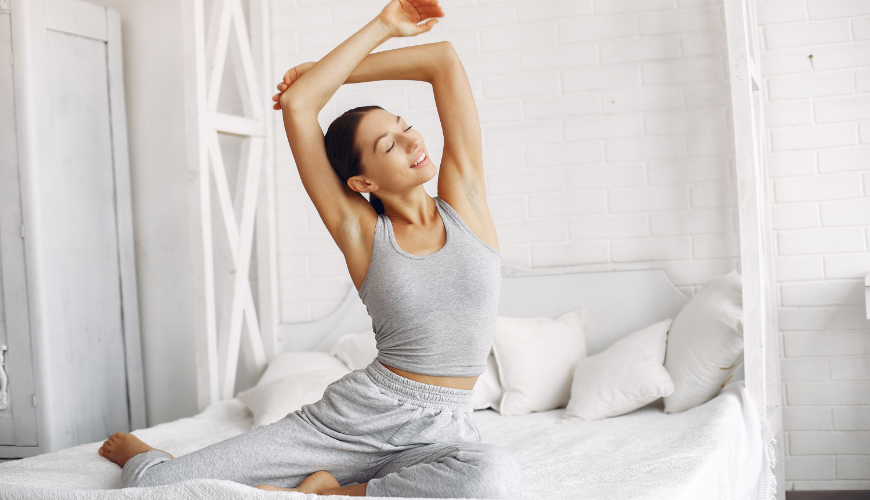
Morning can be ruthless: the alarm rings, the head still protests, a mug waits in the kitchen that won't wash itself, and the first meeting already blinks in the diary. At that moment, "exercise" sounds like another item on the list that can easily be crossed off. Yet the morning is surprisingly important for the body. Not because of performance or "burned calories," but because of how you feel all day — whether you're tense or move more freely, with less stiffness in your back and a clearer head. And this is where morning stretching for people with no time comes in: a few minutes that aren't a sports discipline but a brief switch of the body from sleep mode to day mode.
You might recognize the sentence "I don't have time to exercise, what do I do?" The good news is that you don't have to "exercise" in the traditional sense. It's enough to learn how to stretch in the morning and give your body energy so that it works in an apartment, in pajamas, and between brushing teeth and looking for keys. And even better: to make it not another obligation, but a small ritual that can be maintained long-term.
Try our natural products





Why a few minutes in the morning make such a difference
The body often feels like crumpled paper after a night: hips are "closed," the chest is tight, the neck stiff from the pillow position. It's nothing dramatic, it's normal. During sleep, we move less, and when you add all-day sitting, it's no wonder the back or shoulders complain in the morning. A short stretch acts as a gentle awakening of the nervous system and joints — without pressure on performance.
Interestingly, morning stretching doesn't have to be long to have an effect. More important than the length is regularity and choosing simple movements that "open" the most commonly overloaded areas: the cervical spine, chest, hips, and the back of the legs. When you add a few deep breaths, the body gets a clear signal: "We're starting the day." That's why movement recommendations often mention that even short doses of activity count — for example, the World Health Organization (WHO) has long emphasized the importance of regular movement and its health benefits.
And what about energy? It's often expected to come only after coffee. But energy can also be kick-started by movement that speeds up circulation, gets breathing going, and straightens posture. Sometimes it takes very little: straightening up, relaxing shoulders from the ears, extending the exhale. It's subtle, but the difference is often tangible within minutes.
There's one more thing: when you're stressed and rushed, the body automatically "tightens" — shoulders up, jaw clenched, breath shallower. Morning stretching is a simple way to break this pattern before the whole day unfolds. As they say: "The body remembers what we repeat to it." And the morning is the time when this message can be sent very gently.
How to stretch in the morning and give your body energy, even if there's no time
The biggest obstacle isn't usually physical, but logistical: where to "squeeze it in" in the morning so it doesn't increase stress. It helps to stop imagining it as a workout and start seeing it as a brief warm-up. Instead of aiming for "twenty minutes," a much more realistic goal is three to five minutes. And if even that doesn't work out, then one minute. Because one minute is still more than zero — and it builds a habit.
A simple rule works well: attach the stretching to something that already happens automatically. For example, after turning off the alarm, while waiting for water to boil for tea, or right after brushing your teeth. You don't have to decide "if," just "when exactly." And if the morning is really hectic, the stretching can be divided: two small sequences of one minute. The body will appreciate both.
It's also important to choose the pace. Morning isn't the ideal time for aggressive pulling into extreme positions. A slow, fluid movement is better, respecting the stiffness after sleep. A simple signal generally applies: stretching can be intense, but shouldn't hurt. Instead of "snapping," it's better to work with breath — with the exhale, the body relaxes a bit more.
And one more practical detail that has a big effect: stand up and straighten up. It sounds trivial, but many people function hunched over in the morning: phone, mug, bag, keys. A short stretch of the chest and back can change posture so that you feel less "pressed" to the ground and more prepared.
Real-life example: "Morning is chaos, but three minutes can be found"
Typical scenario: a parent of two, morning snacks, daycare, work. The sentence "I don't have time to exercise" is not an excuse here, but a fact. Yet a tiny window can be found: for instance, when putting on shoes in the hallway and the children are still looking for hats. Instead of nervously pacing, you can do a few shoulder circles, a slow forward bend with bent knees, and a short calf stretch against the wall. It's not a "workout," but the body suddenly doesn't leave for the day stiff. And paradoxically, it often saves time later — less back pain, you're less hunched over the computer, more willing to take a walk.
Tips for exercises that anyone can manage in a rush
Below is a short sequence that can be done in 3–6 minutes. It's designed to alternate between relaxing the spine, opening the chest, and moving the hips. It can be done without equipment. If the morning is really "tight," just pick three movements and you're done.
1) Awakening the breath and shoulders (30–45 seconds)
Stand hip-width apart, slightly bend the knees. Inhale to lift shoulders to ears, exhale to let them drop and consciously relax. Repeat 5–7 times. Then a few slow shoulder circles backwards, as if the shoulder blades want to gently "slide" into the back pockets.
This little thing is surprisingly effective: it releases the neck and straightens the upper back, often stiff from sleep and working at a computer.
2) "Cat" at the kitchen counter or on the floor (45–60 seconds)
For those who don't want to use a mat, lean on the kitchen counter or table, hands shoulder-width apart. Inhale to gently arch the back (chest forward), exhale to round it (chin slightly to chest). Slow pace, 6–8 repetitions.
This is a simple way to move the spine without impact and simultaneously calm the breath.
3) Stretching the back of the legs without "breaking" (45 seconds)
Stand with feet hip-width apart, knees slightly bent. Slowly bend forward, letting the head and arms "hang." It's not about reaching the ground. It's about the feeling of the spine relaxing and the back of the thighs stretching appropriately. Breathe 3–4 calm inhales and exhales, then slowly straighten vertebra by vertebra.
In the morning, tendons and muscles are often shortened, so bent knee is key: the stretch is safer and more pleasant.
4) Opening the chest in the doorway (30–45 seconds)
Stand in a doorway, forearms against the frame, elbows approximately at shoulder height. Gently step forward with one foot, the chest "opens." Hold for 20–30 seconds, then relax. If desired, try a different variation with elbows slightly higher or lower, as each person prefers a different angle.
This is a great counterbalance to sitting and hunching over the phone. The chest relaxes, breathing often deepens immediately.
5) Hips and lower back: step back with support (45–60 seconds)
Step back with one foot into a short lunge, hands on hips or resting on a chair. Pelvis facing forward, torso upright. There should be a stretch in the front of the hip of the back leg. Hold for 20–30 seconds, switch sides.
Hips are the "central station" of morning stiffness. When they relax, the lower back often feels relief too.
6) Calves "on the step" or against the wall (30–45 seconds)
Lean against the wall, place one foot back, gently press the heel to the ground, toes forward. Hold for 20 seconds, switch. For those who walk a lot or barely at all, calves can be shortened and this can transfer to the knees and back.
7) Mini-squat for energy (30 seconds)
Finally, 8–10 slow mini-squats: feet on the ground, knees following toe direction, movement only to a comfortable depth. It's not about strengthening, but about getting the blood flowing and giving the body the signal "we're awake."
If the morning is extra sleepy, this is often the quickest "boost" without caffeine.
The only list worth remembering
When time is minimal, remember a simple trio: spine – chest – hips. Once these three areas move in the morning, the rest of the body often joins in on its own.
Morning stretching can also beautifully connect with what Ferwer has long supported: sustainable, healthier habits that aren't built on perfection but on daily practice. Instead of big resolutions, small steps work. And just like in an eco-friendly household, small things often win (replace disposables with reusables, simplify routine), here too, power lies in simplicity: a few minutes of movement that can be done long-term, without special equipment and without guilt.
For those who want to boost morning energy a bit more, small things around often help: airing out, drinking water, letting daylight into the room. There's no need to make it a complicated "biohacking" process. Just create an environment where the body wakes up more naturally.
And when the thought "I don't have time to exercise, what do I do" appears again, it's worth translating it into a more realistic sentence: "I don't have time for long workouts, but I have time for two minutes for the body." Those two minutes often decide whether the day starts with stiff backs and tense shoulders, or with the feeling that the body got a small but important advantage at the start.