
# Dana K. White's Method for the Chronically Messy

Household organization is a topic that troubles millions of people around the world. There are countless books, courses, and methods for getting rid of unnecessary things and finally being able to breathe in your own space. However, most of them share one fundamental problem – they are designed for people who are naturally organized, and they don't help much for everyone else, the chronically messy, who after years of futile effort have concluded that tidying simply "isn't for them."
Whiteová herself describes how she lived for years in a household full of clutter and felt paralyzed by every attempt at change. She wasn't lazy or irresponsible – she simply didn't function the way conventional organizational systems assume. Her approach was therefore born from personal frustration and from a deep understanding of how people think when maintaining order is a genuine challenge for them.
Try our natural products
What does "chronically messy person" actually mean?
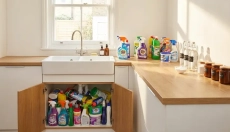
Before we dive into specific tips, it's important to understand who we're actually talking about. A chronically messy person isn't someone who occasionally forgets to clean the kitchen table. It's someone for whom clutter is the natural default state – things pile up even when they try, and as soon as the situation improves slightly, it very quickly returns to its original state. Many of them have piles of things at home that they know they don't need, but can't get rid of, because they are governed by feelings of guilt, sentimentality, or fear that they will one day need that particular item.
According to research published in the journal Personality and Social Psychology Bulletin, a cluttered and chaotic environment can significantly increase levels of cortisol – the stress hormone – particularly in women. Clutter is therefore not just an aesthetic problem, but has a direct impact on mental health and overall wellbeing. Whiteová knew this reality very well from her own experience, which is precisely why she decided to create a method that requires neither natural organizational ability nor endless motivation.
The key word in her philosophy is realism. She doesn't assume that a person will transform overnight. She doesn't require you to spend an entire weekend sorting things by category, nor to buy expensive storage boxes before you even begin. On the contrary – Whiteová says that organizational accessories are the last thing a chronically messy person should buy. First, you need to get rid of things, and only then think about systems.
How decluttering according to Dana K. White works in practice
At the heart of her method are several simple but surprisingly effective principles. The first of these is the so-called "container concept". Whiteová compares every space in the home to a container with limited capacity – a wardrobe, a shelf, a drawer, or an entire room. If the container is full, nothing new can be added without first removing something. This seemingly simple principle changes the way people think about purchases and about accumulating things in general. Instead of the question "where will I put this?", the question becomes "what will I remove to make room for this?" – and that is a fundamental shift in thinking.
The second key element is gradual progress and small steps. Whiteová is convinced that chronically messy people fail precisely because they try to do too much at once. Large cleaning sessions are exhausting, the results are short-lived, and motivation quickly fades. Instead, she recommends working in short intervals – even just five or ten minutes a day – and always focusing on one specific space or category of items. The goal isn't to achieve perfection, but to build a sustainable habit.
Imagine, for example, Lenka, a thirty-four-year-old mother of two children from Brno, who struggled for years with an overcrowded flat. Every spring she told herself she would finally tidy up, bought new storage boxes, and spent a weekend sorting – but after two weeks the flat was the same as before. When she came across Whiteová's approach, she tried something different: every day after breakfast she devoted five minutes to one specific drawer or shelf. No grand plans, no buying organizers. After three months, she said herself that for the first time in her life she had a kitchen table you could actually sit at and eat.
The third pillar is the question "where does this belong?" rather than "where should I hide this?". Whiteová emphasizes that things should have a fixed, logical place that makes sense in the context of everyday life. If keys are constantly lying on the kitchen counter, it's because that's simply where they naturally belong – and the solution isn't to buy a decorative bowl for the hallway, but to acknowledge where we actually use things and set them down.
Her perspective on sentimental items and things people keep "just in case" is also interesting. Whiteová doesn't advise being ruthless, nor does she promote a minimalist lifestyle at all costs. Instead, she offers specific questions that help with decision-making: If I saw this item in a shop, would I buy it again? Is this item preventing me from having a home where I feel comfortable? These questions help remove the guilt associated with throwing things away and replace it with a conscious decision.
Tips for getting started – even if it has never worked for you before
For those who recognize themselves in the description of a chronically messy person, the best approach is to start completely simply. Whiteová in her book Decluttering at the Speed of Life (published by Thomas Nelson) offers several practical steps that work even for those who feel completely overwhelmed.
The first step is to start with rubbish. Before you begin sorting and making decisions, go through the space and remove everything that is clearly rubbish – empty bottles, old newspapers, food packaging, broken items. This step requires no decision-making and immediately creates a visible difference that motivates further progress.
The next step is to focus on items that are clearly surplus – duplicates, things you haven't needed for years, or objects that simply don't belong in that space. Whiteová recommends always having a box or bag on hand designated for items to donate, so that the decision isn't postponed indefinitely.
It is also crucial not to move things from place to place. Chronically messy people tend to rearrange things without actually getting rid of them – the result is that the clutter simply migrates around the home. Whiteová insists that every item that leaves its original space must have a clear destination: either it gets a permanent place, or it leaves the home entirely.
As Whiteová herself says: "Organizing without decluttering is just moving the mess around." This thought is perhaps the most important insight of her entire method, because it names the mistake that most people make when they try to "tidy up."
An important part of her approach is also working with the emotions associated with objects. Many people are unable to get rid of items because they feel that doing so means rejecting memories, the person who gave them the gift, or a part of their past. Whiteová respects this sensitivity, but also offers a perspective: things in themselves are not memories. Memories live within us, not in objects. If ten identical mugs from various holidays are sitting in a box in the basement and you never look at them, they bring you no joy – they merely fill space and carry the weight of a decision you have yet to make.
Dana K. White's entire approach rests on the belief that a tidy home is not the privilege of organized people, but an achievable goal for anyone who is willing to change the way they think about things. It's not about having fewer things at all costs, nor about imitating Instagram interiors full of empty space. It's about having a home that works – where you can find things, where you feel good, and where your environment doesn't add extra stress.
For those who want to get started, the best news is that there's no need to wait for the right moment, enough energy, or a free weekend. All it takes is five minutes, one drawer, and the willingness to get rid of a single item that clearly doesn't belong there. And then to do the same thing tomorrow. It is precisely in this unassuming daily consistency that the power of the method lies – one that finally makes sense even to those for whom no other method has ever worked.