
How to properly care for a wooden cutting board, knives, and pans
Kitchen utensils are among the things we use every day, yet we pay surprisingly little attention to them. A wooden cutting board, a quality knife, or a favorite pan – these are all tools we can't imagine preparing food without. But precisely because we take them for granted, we often neglect their maintenance. And then we're surprised that the knife doesn't cut, the pan sticks, and the cutting board looks more like an archaeological find than a kitchen tool. Yet it only takes a few minutes a week to care for these items, and the reward is equipment that reliably serves for years, if not decades.
The question of how to care for a wooden cutting board, knives, and pans so they last for years isn't just practical – it's also a question of our attitude toward the things that surround us. In a time when sustainability and reducing waste are increasingly discussed, it makes sense to learn how to treat what we already have rather than buying replacements every year. Quality kitchen equipment isn't cheap, and its lifespan largely depends on how we treat it.
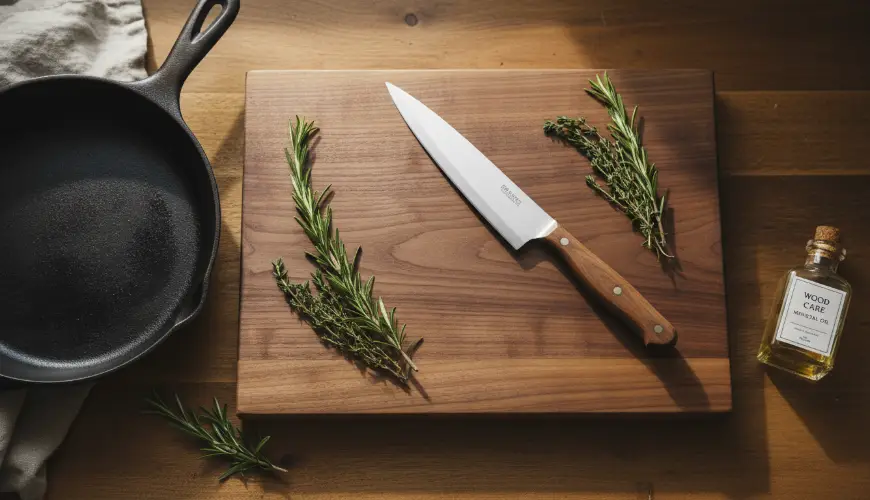
Let's start with something seemingly trivial – the wooden cutting board. Many people consider it just a piece of wood that they simply place on the counter and occasionally toss into the sink. But wood is a living material that reacts to moisture, temperature, and mechanical treatment. The most common mistake is washing a wooden cutting board in the dishwasher. High temperatures and aggressive detergents cause the wood to crack, warp, and lose its natural durability. All it takes is rinsing the board with warm water after each use, possibly with a little mild dish soap, and drying it thoroughly. It should never sit in water or remain wet on a drying surface – moisture is wood's number one enemy.
But what turns routine maintenance into true care is regular oiling. Once every month or two, it's enough to rub the board with a thin layer of mineral oil rated for food contact, or a mixture of beeswax and oil. The oil penetrates the wood's pores, protects it from drying out, and simultaneously creates a natural barrier against bacteria and odors. Anyone who has ever seen a beautifully patinated cutting board in a chef's kitchen knows what we're talking about – such a board looks better with each year of use because someone takes care of it. According to recommendations from the United States Department of Agriculture (USDA), it's also important to have separate cutting boards for meat and vegetables, which extends the lifespan of both while also reducing the risk of cross-contamination.
Interestingly, a quality wooden cutting board – made from walnut, maple, or cherry, for example – is surprisingly safe from a hygiene standpoint. A study conducted at the University of California, Davis showed that bacteria on a wooden surface naturally die off, while on a plastic cutting board with deep grooves, they can multiply even after thorough washing. This is an argument that surprises many, because there's a widespread myth that plastic is more hygienic. In reality, what matters most is the condition of the cutting board – if it has deep cuts and cracks, it's time to replace it regardless of the material.
Try our natural products
-1-m.jpg)
-1-m.jpg)
-1-m.jpg)
-1-m.jpg)
-1-m.jpg)
How to Properly Care for Kitchen Knives
From the cutting board, there's a natural transition to knives, because these two tools are closely related. A quality knife suffers on a bad cutting board, and conversely – even an average knife cuts better on a good wooden board than on a hard glass or stone surface. Glass and ceramic cutting boards are among the biggest killers of knife sharpness. They look elegant, but their hard surface dulls the blade literally within just a few uses.
Knife care starts with proper storage. A magnetic strip on the wall, a wooden block, or a protective blade guard – these are three basic ways to protect a knife. Have you ever tossed knives into a drawer among other utensils? Then you know how quickly small nicks and dents appear on the blade. A knife in an overcrowded drawer loses its sharpness faster than you'd expect, and there's also the risk of an unpleasant cut when searching for the right tool.
When it comes to sharpening itself, there's an important difference between regular honing and actual sharpening. The steel or ceramic honing rod that many people know from kitchen knife sets doesn't serve for sharpening in the true sense – its purpose is to straighten the microscopically bent edge. Regular honing with a steel before every cooking session is a simple habit that dramatically extends the intervals between actual sharpening. Sharpening on a stone or professional regrinding only needs to be done once or twice a year, depending on the intensity of use.
And then there's the question of washing again. Just as with wooden cutting boards, there's one clear rule for quality knives: never put them in the dishwasher. Hot water, chemical detergents, and impacts against other dishes damage both the blade and the handle. Knives with wooden handles suffer doubly – the wood absorbs water, cracks, and over time loosens from the rivets. Hand washing with warm water and immediate drying takes a few seconds, and the knife will repay you with years of flawless service.
A real-world example: a well-known chef from Brno tells the story of his favorite Japanese knife, which he's been using for over fifteen years. He bought it for what was then several thousand crowns, which seemed like a crazy expense. But thanks to regular honing, hand washing, and occasional sharpening on a water stone, the knife is still as sharp today as the day he bought it. In that time, his colleagues went through dozens of cheaper knives that collectively cost many times more. As the old saying goes: "We're too poor to buy cheap things."
Pans and Their Longevity
The third pillar of kitchen care consists of pans, and here the situation gets more complicated because different materials require different approaches. The most common are pans with non-stick surfaces, cast iron pans, and stainless steel pans. Each has its own specifics, but there are also universal rules that apply across materials.
Let's start with non-stick pans, because these are the ones people most often destroy. Overheating is the main cause of non-stick surface degradation. Teflon or ceramic coating isn't designed for heating empty – high temperatures without food and fat damage the surface and reduce the pan's lifespan to a fraction of what it would otherwise last. Another classic offense is using metal spatulas and spoons. A single scratch from a metal utensil and the non-stick surface begins to gradually fail. Wooden, silicone, or bamboo utensils are the only correct choice for this type of pan.
Cast iron pans are an entirely different story. They're practically indestructible if properly cared for, and many families pass them down from generation to generation. The key to success is so-called "seasoning" – creating and maintaining a protective layer of polymerized fat on the surface. A new cast iron pan is coated with a thin layer of vegetable oil and placed in the oven at high temperature – this process creates a natural non-stick layer that improves with each subsequent use. Cast iron pans should not be scrubbed with aggressive cleaners or steel wool – after cooking, it's enough to rinse with hot water, or gently scrub with coarse salt, dry, and lightly coat with oil. Some purists claim that water should never touch a cast iron pan at all, but that's more of a myth – brief contact with water doesn't cause harm; what matters is drying the pan immediately afterward so it doesn't start to rust.
Stainless steel pans represent the golden middle ground – they're durable, easy to maintain, and can withstand higher temperatures. Their biggest disadvantage is the tendency for food to stick to the surface, but this can be managed with proper technique. The pan needs to be heated first, then fat is added, and only then food is placed in it. This simple procedure, known as the "hot pan, cold oil" method, significantly reduces sticking while also protecting the pan's surface.
Regardless of the type of pan, one universal rule applies that many people violate: never pour cold water into a hot pan. Thermal shock can cause the bottom to warp, even with quality pans. Let the pan cool down first and only then wash it. It's also worth storing pans so they don't scratch each other – ideally with a soft material liner between them or hung on hooks.
When we think about it, caring for kitchen utensils really isn't rocket science. It's a set of simple habits that become automatic over time. Hand washing instead of the dishwasher, regular oiling of wood, honing knives before cooking, properly preheating pans – none of this takes more than a few minutes. And the result? Kitchen equipment that not only works better but also has its own story. A cutting board with a beautiful patina, a knife that sits in your hand like an old friend, a pan where pancakes never stick.
Ultimately, it's about more than just practicality. Taking care of the things that serve us is a sign of respect – for the craftsmanship that made them, for the natural materials they were created from, and not least for our own wallets. In an age of disposable consumption, the ability to keep things functional and beautiful for many years is perhaps the most sustainable choice we can make in the kitchen. And who knows – perhaps one day your cast iron pan or walnut cutting board will be passed on to the next generation as a family heirloom whose value is not only financial but also sentimental.