

Sleep improves when you create a healthy sleep environment in the bedroom.
Sleep is often taken for granted – until a period comes when a person takes a long time to fall asleep, wakes up feeling broken, or rises in the morning with a sense of having "half-slept" through the night. In fact, the environment in which one sleeps often plays a silent accomplice or a quiet helper. Healthy habits are important, but a healthy bedroom environment can surprisingly make a big difference: from air quality to light to what touches your skin all night long. And anyone who has ever wondered, what helps healthy sleep, often finds that it's not about one miraculous piece of advice, but a few small changes that add up.
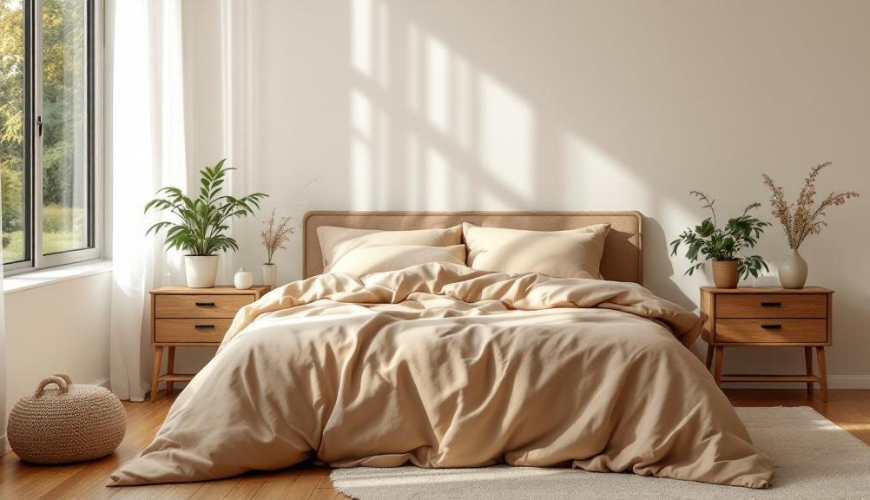
It might even be a pleasant idea: the bedroom doesn't have to be a sterile "sleep lab." On the contrary – how to make a cozy and simultaneously healthy bedroom is a bit like tuning a home to be calm, welcoming, and at the same time, not hindering the body's nighttime regeneration. Just take a moment and look at the bedroom through the eyes of someone entering it for the first time: How does the air feel? Is it quiet? Is anything glaring? Does the room feel cluttered?
Try our natural products






A healthy sleep environment starts with air, light, and temperature
When discussing how to create a healthy sleep environment, it usually starts with things that are "invisible" but immediately perceived by the body. The air in the room, its humidity, temperature, and cleanliness determine whether someone wakes up at night thirsty, with a stuffy nose, or, conversely, sleeps peacefully.
Paradoxically, the bedroom is sometimes the least ventilated room in the home. During the day, the doors are closed, in the evening the curtains are drawn, and in winter, the heating is turned up – resulting in heavy air in the morning. Yet ventilation is one of the simplest tips for healthy sleep. A short, intense airing before bedtime (and even in the morning) does more than an aromatic spray. If the bedroom is on a busy street, it's helpful to ventilate during times of less traffic or use micro-ventilation and complement it with houseplants, which can make the space cozier (just be careful not to overdo it with a "jungle," as it can unnecessarily increase humidity and risk mold at night).
Temperature is the second big player. Most people find it easier to fall asleep in a cooler room – the body naturally lowers its temperature to switch into sleep mode. There’s no universal number, but many recommendations hover around 16–19 °C. More important than charts is the body's signal: if someone wakes up sweaty or, conversely, chilled, the bedroom environment isn’t suitable. In practice, a simple change often helps: lowering the heating at night, choosing a more breathable blanket, layering (preferably a thinner blanket and throw rather than one "blanket-for-all"), or darkening the windows so the sun doesn't wake you earlier than necessary.
And then there's light. A bedroom lit by bright white LEDs in the evening may seem "clean," but it often tells the body: it's time to be awake. Gentle, warmer lighting in the evening supports calmness and a natural transition to sleep. If someone is contemplating what helps healthy sleep, they are often surprised by how much of an effect a small thing like a lamp with warm light or the ability to dim intensity can have. Useful context on how light affects circadian rhythms is also offered by comprehensive information from the Sleep Foundation – not as dogma, but as a guide to why the body doesn't want to "switch" in the evening when it’s surrounded by midday brightness.
Noise falls into the same category. Not everyone has the option of complete silence, but subtle strategies exist here too: heavier curtains can muffle street sounds, a carpet softens footsteps and echoes, rearranging furniture sometimes helps more than expected. Some people appreciate white noise, others earplugs – the important thing is for the bedroom not to feel like a radio studio where every click wakes you up.
Bedroom as a "safe" space: materials, textiles, and order without switching to minimalism
When one mentions a healthy bedroom environment, many people think only of cleanliness. However, health in the bedroom isn't just about whether the bed is made. At night, a person spends long hours in contact with what they breathe and what touches their skin – bedding, sheets, pajamas, mattress, blanket. This is where it makes sense to think about materials and how they are maintained.
Breathable textiles can make the night more comfortable because they handle moisture and temperature better. Cotton (preferably with reasonable weight), linen, or Tencel are pleasant choices for those who feel warm at night. Others may appreciate warmer layers, but even those can be breathable. Regularity is also important – bedding and sheets deserve more frequent washing than sometimes admitted, especially if a pet sleeps in the bedroom or if someone has allergies. Allergies are often alleviated by a simple routine: ventilate, wash at the recommended temperature, don’t overdo it with decorative pillows that aren’t washed as often, and consider a protective mattress cover.
The mattress and pillow are a separate chapter because they involve both saving and spending at the same time. It’s not about having the "most expensive," but having those that suit the body and can be maintained. A pillow that has been flattened for years can disrupt the cervical spine, and one then looks for tips for healthy sleep in entirely different areas than necessary. A mattress that remains damp and poorly ventilated can be a problem for allergy sufferers and anyone who wakes up without energy. It helps to let the bed "breathe" in the morning (leave the blanket turned down before making it), occasionally rotate the mattress according to the manufacturer's recommendations, and not underestimate the slats, which allow air circulation.
Another big topic is scents – and this doesn't mean perfumed candles on every corner. Scents shouldn't overwhelm the air in the bedroom, but rather gently complement it. Strong perfumes or synthetic air fresheners can irritate the respiratory system in sensitive individuals. If anything, it should be used very sparingly and ideally in a way that doesn’t disturb. A simple rule applies: the bedroom should smell fresh, not "forcefully." As they say: "The best scent for a bedroom is fresh air."
And then there's order – not as an aesthetic discipline, but as psychological relief. A bedroom cluttered with things often creates unrest that one isn't even aware of. It's not about throwing out half the wardrobe, but about ensuring the bedroom isn’t a storeroom and office in one. A desk next to the bed might be a necessity in a small apartment, but "separating worlds" helps: closing the laptop, tidying papers, turning off indicators, covering the workspace with a simple throw. The body appreciates signals – and the bedroom is ideal when it signals calm.
A real example shows this best. In a typical apartment in a tenement building, the scenario repeated for a long time: falling asleep with the phone in hand at night, waking up with a heavy head in the morning, and feeling as if waking up constantly during the night. The changes weren't dramatic. A blackout curtain was added to the bedroom, a lamp with warm light replaced the overhead "spotlight" on the nightstand, and the phone started charging out of bed's reach. Along with a brief airing before bed and a rule that the bed wouldn’t be buried under clothes during the day. A few weeks later, it became clear that what was missing wasn't a "new life," but a healthy sleep environment: darkness, cooler air, fewer stimuli, and a bed that once again belonged to sleep.
A list that makes sense in practice
To prevent this from becoming endless theory, here is a short, practical overview that combines tips for healthy sleep with how to implement them in the bedroom within a few days:
The simplest steps for a healthy and cozy bedroom
- Ventilate before bed and in the morning, even if just for a few minutes (quickly and intensely).
- Dim and warm up the light in the evening (warmer bulb, lamp, dimming option).
- Darken windows so that street light at night and morning sun don’t disturb.
- Maintain a cooler temperature and choose bedding according to the season, not "one universal."
- Simplify textiles: fewer decorations, more items that can be washed regularly; opt for breathable bedding.
- Remove disruptors: chargers, blinking diodes, loud clocks; ideally, even the phone out of reach.
- Let the bed breathe: in the morning, don’t make it "tightly" for a while to let moisture evaporate.
What helps healthy sleep when life and reality meet (and the bedroom isn’t a hotel)
It's tempting to think that the right mattress is all it takes to win. But sleep is sensitive to details, and every household has its limits: small children, shift work, a neighbor who drills, or an apartment where it’s impossible to breathe in summer. That’s why it makes sense to find solutions that are realistic and sustainable in the long term – and that support health and well-being.
One of the biggest "subtle" factors is the evening routine. The bedroom can be beautiful, but if the body is still bathing in blue screen light and the mind is catching up on work an hour before sleep, falling asleep extends. Sometimes a small compromise helps: instead of a drastic phone ban, set a do-not-disturb mode in the evening, lower the brightness, switch to warmer colors, and spend the last 20-30 minutes without a screen. This often answers the question, what helps healthy sleep, when "everything can't be changed."
Coziness is as important as health. A bedroom that is "properly" ventilated and darkened but feels cold and impersonal won’t invite rest. Coziness can be created without heavy decorations: a pleasant texture of a throw, one quality blanket that doesn’t itch, muted colors, a few natural elements. A healthy bedroom isn’t about perfection, but about allowing the body and mind to relax.
Interestingly, all this often aligns with sustainability. Choosing textiles that last, can be washed, and aren’t "for one season" is better for the budget and the planet. Less perfuming and more airing means better breathing. A decluttered bedroom is quicker to clean. And dimming lights in the evening saves energy. A healthy environment doesn’t have to be a luxury; often it’s a return to simplicity.
Those who want to go a step further can be inspired by sleep hygiene recommendations from authorities such as NHS – tips to help you sleep or overviews from the CDC. Not to make the bedroom a graded project, but to clarify that small things like darkness, silence, cooler air, and regularity aren’t "old wives' tales" but recurring recommendations.
Ultimately, it all boils down to one simple idea: the bedroom is a space where the body has nothing to prove. If a healthy bedroom environment is created – clean air, pleasant textiles, fewer disturbances, and a bit of daily peace – sleep often improves without dramatic life changes. Isn’t it nice to know that the path to how to make a cozy and healthy bedroom is through a few smart details rather than a major renovation?