
# Where Are the Blue Zones of the Czech Republic and What Do They Have in Common The concept of **b
There are places where time seems to flow a little differently. Places where people live to an old age in good health, where seniors walk uphill, tend vegetable gardens and meet friends over a glass of homemade wine. This phenomenon is known worldwide as blue zones – areas with an unusually high concentration of long-lived people. Sardinia, Okinawa, Costa Rica and the Greek island of Ikaria are the examples most frequently cited in the media. But what about the Czech Republic? Does it too have places where people live longer and better?
The answer is not straightforward, but it is certainly not negative either. While the Czech Republic does not stand out in global longevity rankings – average life expectancy, according to data from the Czech Statistical Office, is around 76 years for men and 82 years for women – there are nonetheless regions and localities where these figures significantly exceed the national average. And what is even more interesting, behind these numbers lie specific ways of life, habits and values that can be emulated.
Try our natural products
What blue zones actually are and why they matter
The term "blue zone" was popularised by American journalist and researcher Dan Buettner, who, in collaboration with National Geographic, identified five regions of the world with the highest concentration of people over one hundred years old. In his book The Blue Zones, Buettner summarised that longevity is not merely a matter of genetics – to a large extent it is shaped by environment, community and everyday habits. As he himself put it: "The greatest secret of longevity lies not in pharmacies or gyms, but in everyday choices and in the people around us."
This perspective is key to understanding why it is worth looking for Czech equivalents of blue zones at all. The goal is not to find a place with magical water or a special atmosphere. It is about identifying environments that naturally support a healthy lifestyle – physical activity, social connections, quality nutrition and low levels of chronic stress. And such places do exist in the Czech Republic.
Longevity research consistently shows that a key role is played by so-called natural movement – not sport as performance, but movement woven into everyday life. People in mountain areas walk to the shops, work in the garden, climb hills to collect firewood. This type of unobtrusive physical activity has, according to studies published in The Lancet, a demonstrably positive effect on cardiovascular health and life expectancy.
Czech localities with above-average life expectancy
Looking at statistical data and demographic studies, the areas that emerge as particularly interesting are South Moravia, parts of the Vysočina Region, and specific micro-regions in the foothills of the Krkonoše and Šumava mountains. Precise comparisons are methodologically challenging because Czech data are not always available at the level of small municipalities, but the trends are clear.
South Moravia has long shown favourable health indicators. The wine-growing areas around Znojmo, Mikulov and Velké Pavlovice are home to communities where physical work in the vineyard or garden is part of the daily rhythm even in old age. Seniors here do not end their active lives upon retirement – on the contrary, tending vineyards, participating in village celebrations and strong family ties give them daily purpose and structure. Moderate consumption of quality red wine, a diet rich in vegetables and legumes, and a strong social community – these are precisely the elements that researchers identify as characteristic of the world's blue zones.
Similar features can be found in Slovácko, specifically in the White Carpathians region. The local population has maintained for generations traditions connected to nature – gathering herbs, growing their own vegetables, preparing fermented foods such as sauerkraut or beetroot. It is no coincidence that fermented foods are experiencing a scientific comeback: research from Harvard Medical School confirms their beneficial effect on the gut microbiome, which is increasingly being linked not only to digestion but also to immunity, mental health and longevity.
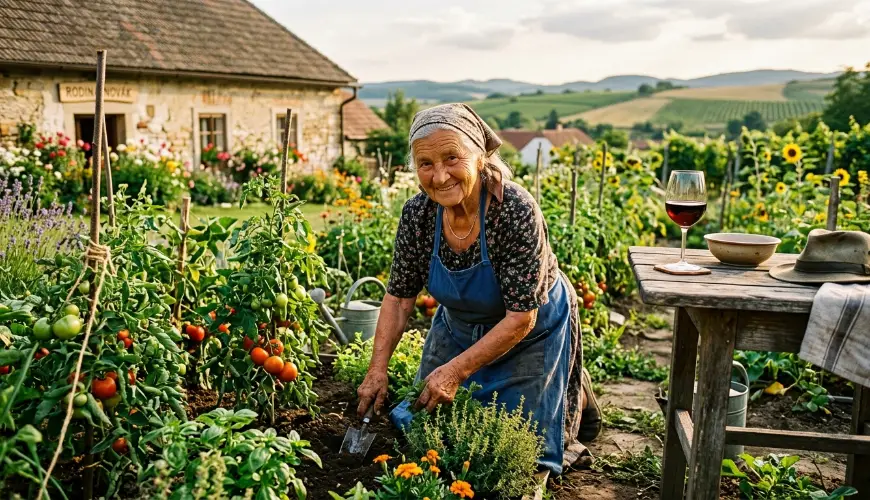
Consider a specific example: an eighty-year-old woman from Vlčnov in Slovácko gets up every morning before seven, goes to check on her garden, cooks soup from her own vegetables, meets friends for a chat in the afternoon and reads a few pages of a book in the evening. She does not stress, she does not overeat processed foods, and every day she walks several kilometres on foot – not because she is following some health plan, but simply because that is how she has lived her whole life. This is exactly what a "Czech blue zone" looks like in practice.
Another interesting region is the Vysočina Highlands, particularly the areas around Třebíč and Žďár nad Sázavou. This region tends to be overlooked in media coverage, yet its communities display strong characteristics typical of long-lived areas: low urbanisation, close neighbourly relations, work in nature and relatively low levels of air pollution. Clean air is no small matter – the World Health Organization ranks air pollution among the main factors shortening life expectancy in Europe. Areas with good air quality therefore have a structural advantage that manifests itself in long-term statistics.
The Šumava foothills and parts of South Bohemia present a similar picture. Low population density, work in agriculture or forestry, natural contact with nature and a community-oriented way of life – these are characteristics that have a positive impact on both the length and quality of life. Villages such as Prachatice or Vimperk and their surroundings may not be world-famous like Sardinia, but the way of life of their long-established residents shares a surprising amount with the Mediterranean blue zones.
An interesting perspective is also offered by the Krkonoše Mountains and the Podkrkonoší region. The mountainous terrain encourages residents towards natural movement, the tourist infrastructure keeps communities active even in winter, and the traditional craft culture (glassmaking, textile production) gave people meaningful work with their hands for generations. Working with one's hands, which requires concentration and yields a tangible result, is considered one of the factors contributing to mental well-being and the prevention of cognitive decline in old age.
What these places have in common and what we can learn from them
When we look at all the regions mentioned – South Moravia, Slovácko, Vysočina, Šumava and the Krkonoše – a clear pattern begins to emerge. This is not a matter of chance or genetic luck. It is a combination of factors that these communities share and that naturally support a healthy and long life.
The first common denominator is movement as part of everyday life, not as performance or obligation. The second is a diet close to nature – local, seasonal, with a high proportion of vegetables, legumes and fermented products. The third factor is strong social bonds – family, neighbours, a community that gives a person a sense of belonging and purpose. And the fourth, often underestimated element is a relationship with nature – regular contact with greenery, forests and open countryside, which science is increasingly and convincingly linking to reduced cortisol levels and better mental health.
It is remarkable how these principles resonate with current trends in healthy living. Interest in local and organic food, in fermentation, in mindful movement in nature and in a sustainable way of life is not merely a passing trend – it is an intuitive return to values that have never disappeared in Czech blue zones. People in Moravian villages or the Šumava foothills did not need research from Harvard University to know that homemade fermented sauerkraut is good for their health. They simply did it the way their parents and grandparents had always done.
It is interesting that similar principles are now being championed by urban planners and architects in the design of modern cities. The so-called "15-minute city" – a concept where a person has everything they need accessible on foot within 15 minutes – is essentially a modern version of what rural communities in the Czech Republic have been doing naturally for centuries. When a person has a market, a park, friends and work within walking distance, they move more, stress less and live longer. It is not rocket science, but it works.
Of course, it would be naive to idealise rural life and overlook its downsides – poorer access to healthcare, lower incomes and limited cultural amenities are real challenges. Nevertheless, the principles that work in Czech long-lived communities can be transferred to an urban environment. Community gardens, walking, local markets, strong friendships and a mindful approach to food – all of these are things that are available even to residents of Prague or Brno, if they consciously choose them.
Czech blue zones thus offer us a very practical message: a long and healthy life is not the result of expensive supplements, exclusive diets or strict exercise regimens. It is the result of small everyday decisions – getting off one stop earlier and walking the rest of the way, cooking a soup from fresh vegetables instead of reheating a ready meal, calling a friend instead of scrolling through social media, spending the weekend in nature instead of at a shopping centre. People in Moravian villages or the Šumava foothills do not make these decisions consciously as a health investment – they simply make them because that is how they live. And the results speak for themselves.