

Plogging or how to run and clean up nature
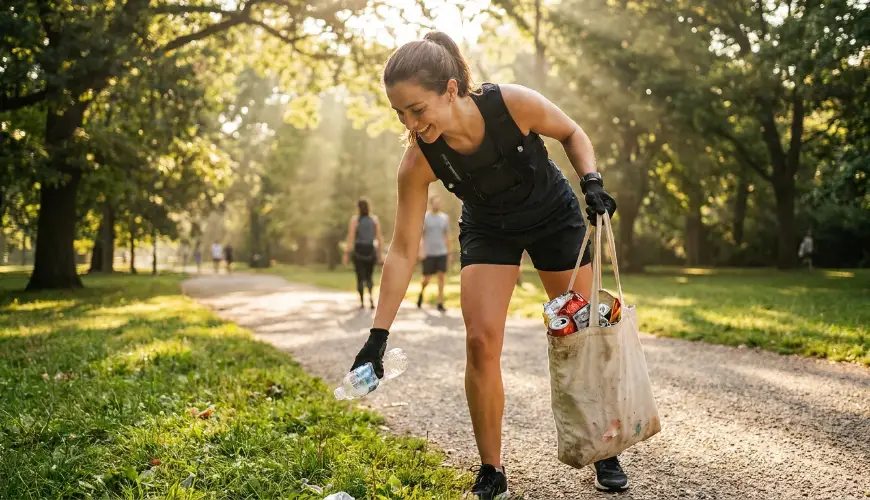
Imagine heading out for your usual morning run and returning home not only with a dose of endorphins, but also with a bag full of rubbish you picked up along the way. That is exactly what plogging is – a sports trend that has been conquering parks, forests and city streets around the world in recent years. It is not about any sacrifice or added burden. On the contrary, many enthusiasts claim that this combination gives them the feeling that their physical activity has a purpose that goes beyond their own fitness.
The word plogging was formed by combining the Swedish expression plocka upp (to pick up) and the English word jogging. The idea was born in Sweden around 2016, when Erik Ahlström started picking up litter during his runs around Stockholm. The concept spread quickly through social media, and today plogging has communities on every continent. According to estimates, by 2020 more than two million people in over one hundred countries had taken part in various plogging events. It is no surprise – this is an activity that requires no special equipment or entry fee, and yet delivers a double benefit.
Try our natural products


Why plogging is more than just a passing trend
Sceptics might argue that this is yet another eco-trend that will come and go just as quickly. But plogging has nearly a decade behind it now, and its popularity is growing rather than fading. The reason is simple: it works on several levels at once.
From a physical activity perspective, plogging is surprisingly more demanding than it might appear. The repeated bending forward, squatting and changes of pace involved in picking up litter engage muscles that remain largely unused during conventional steady-paced running. Alternating between running and quick movements down to the ground is essentially a form of functional training that works the entire body. Studies and fitness experts confirm that an hour of plogging burns approximately 50 more calories than the same duration of jogging without picking anything up. That is not a negligible figure, especially considering that the physical activity also delivers an environmental benefit on top of everything else.
From a mental health perspective, the concept of purpose-driven exercise plays an important role – that is, movement with a conscious intention. Psychologists have long pointed out that activities which carry a prosocial or environmental dimension increase overall wellbeing and a sense of meaningfulness. In other words, when a person knows that their morning run is contributing to a cleaner environment, motivation is easier to sustain than when exercising "just for themselves".
And then there is the social aspect. Plogging groups form organically – in parks, on social media, through apps like Meetup or Strava. People meet up, share routes, compete over the amount of litter collected, and photograph unexpected finds. Friendships and communities emerge, united by a shared concern for the place where they live.
As the Swedish founder of the movement, Erik Ahlström, once said: "We don't want to tell people what to do. We just want to show that a small action can have a big impact."
How to choose a plogging route and what to expect
One of the greatest advantages of plogging is its accessibility – anyone can put together a route virtually anywhere. That said, there are places where it makes sense to start, and tips that can make the first experience significantly more enjoyable.
The ideal plogging routes lead to places where litter actually accumulates. That might not sound particularly romantic, but it is true. Parks on the outskirts of towns, cycle paths along rivers, forest tracks near housing estates, or the shores of ponds and reservoirs – these are the places where litter gathers and where collecting it makes the most difference. By contrast, well-maintained city centres or closely monitored tourist trails tend to be in better shape.
A good practical example is Prague, where the plogging community regularly cleans routes along the Vltava, in Divoká Šárka or around Prokopské údolí. Similar groups exist in Brno, Ostrava and Olomouc. If someone does not want to join an organised group straight away, all it takes is opening a map, choosing a route of 5–10 kilometres, and heading out.
When it comes to equipment, nothing complicated is needed:
- Gloves – thin rubber or work gloves to protect against direct contact with waste
- A bag or sack – ideally a recyclable or reusable one
- Tongs or a litter picker – makes collecting easier without having to bend down deeply, particularly appreciated by those with back problems
- Appropriate footwear – standard running shoes with good grip, as plogging often takes you off the beaten track
The question that occurs to every beginner: what to do with the litter once the route is finished? The simplest approach is to bring the collected waste to the nearest bin or container. During larger events, organisers arrange in advance with local authorities for collection or the loan of containers. Many municipalities welcome such cooperation and actively support it.
When planning a route, it is also worth making use of online resources. The platform Litterati allows users to photograph and geolocation-tag collected litter, creating a global database of pollution. The Czech initiative Ukliďme Česko works in a similar way, mapping locations where litter is found and coordinating volunteer events across the country. Both platforms can serve as an excellent starting point for choosing a route and for getting involved in a wider community.
Plogging also has its own seasonal logic. Spring and autumn are the most productive seasons for litter collection – after winter, everything that snow had concealed appears on meadows and in bushes, and before winter it is a good time to prepare the natural environment for the cold months ahead. Summer plogging along bodies of water has its own particular character, as the areas around ponds and reservoirs accumulate waste from picnics and summer events. Winter plogging is less popular, but all the more physically intense – snowy conditions and slippery terrain add a whole new dimension to the activity.
For those who want to go even further, there is the option of combining plogging with other outdoor activities. Plogging by bike – sometimes called plogcycling – works on the same principle, just at a faster pace and over longer distances. Plogging while hiking, meaning collecting litter at a more relaxed walking pace, is accessible to families with children or older participants who would not manage running combined with repeated bending. Children, incidentally, take to this activity with surprising enthusiasm – for them it is an adventurous game with a clear outcome they can see with their own eyes.
An interesting example comes from Japan, where a similar tradition known as soji exists – cleaning public spaces as an expression of respect for the community. Japanese people regularly clean the areas around their homes, schools and workplaces, without any external pressure to do so. In this sense, plogging is nothing new – it is essentially a modern, sporting form of an age-old idea: that caring for shared spaces is a natural part of life in a community.
The community around plogging also naturally fosters a broader interest in sustainable living. People who regularly collect litter start to pay closer attention to what they are actually picking up. Plastic bottles, cigarette butts, fast food packaging – statistics consistently show these to be the most common types of waste found in nature. This daily contact with the consequences of consumer behaviour leads many ploggers to reconsider their own shopping habits, start using eco-friendly alternatives, or take an interest in a zero waste approach to their household. Plogging is therefore not merely a physical activity – it is also a way of cultivating a deeper relationship with the natural environment.
There is no need to be an environmental activist or to have a thorough knowledge of every sustainability certification. All it takes is a pair of gloves, a bag, and heading outside. Every piece of litter collected is a concrete, tangible result that cannot be questioned or overlooked. And it is precisely this simplicity and directness that is perhaps the greatest strength of the entire movement – at a time when environmental issues so often become lost in abstract figures and distant catastrophes, plogging offers something entirely different: an immediate, visible and joyful way to contribute to change right where you live and spend your time.
Next weekend, when you are thinking about where to head out for a run, it might be worth taking along one extra bag. You will see the results before you even get back home.