

Try walking on tiptoes and on heels for healthy ankles
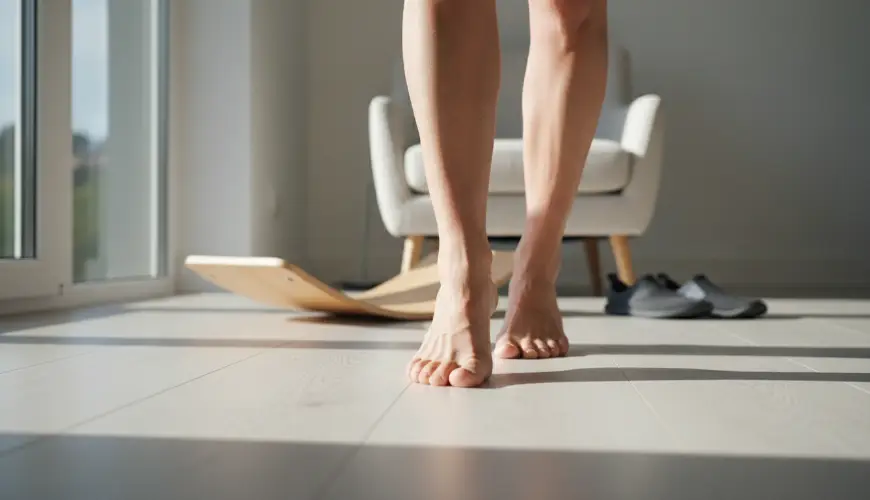
Ankles are one of the most overlooked joints in the human body. Every day they bear the full weight of the body, absorb impact with every step, and allow movement in all directions – and yet surprisingly little attention is paid to them until something goes wrong. Only when an ankle starts to hurt does a person begin to think about how to keep it in good shape. Yet there is one of the simplest and most natural ways to regularly strengthen ankles and improve their mobility: alternating walking on tiptoes and on heels.
This technique requires no equipment, special clothing, or gym membership. All you need is a few metres of free space and a little determination. Yet it is surprisingly effective – and the science behind it stands on solid ground.
Try our natural products


Why ankles are so important and what threatens them
The ankle is a complex joint that connects the tibia and fibula to the talus. It is surrounded by ligaments, tendons, and muscles that together provide stability and mobility. According to the American Academy of Orthopaedic Surgeons, ankle injuries are among the most common musculoskeletal injuries of all – in the US alone, approximately two million cases of sprained ankles occur each year. In the Czech context, the numbers are proportionally comparable.
The problem, however, does not lie only in acute injuries. The modern lifestyle – long hours sitting at a computer, walking in unsuitable footwear with rigid soles or high heels, minimal movement on uneven terrain – gradually weakens the muscles and ligaments around the ankle. The result is reduced proprioception, meaning the ankle's ability to "sense" its position in space, and thus a higher risk of falls or injury. Weakened ankles also negatively affect the entire musculoskeletal system – from the knees through the hips all the way to the back.
Add to this the fact that a large proportion of the population wears shoes that unnecessarily fix the ankle and limit its natural function. The ankle thus becomes unaccustomed to working independently and becomes dependent on external support. Once this support is absent – for example when walking on uneven surfaces – the joint is unprepared and the risk of spraining rises rapidly.
The solution, however, need not be complicated. Regular, targeted ankle exercises can reverse this trend. And alternating walking on tiptoes and on heels represents one of the most natural ways to achieve this.
How walking on tiptoes and heels works and what it specifically exercises
To be clear about what we are talking about: walking on tiptoes means moving forward with the heels lifted off the ground, with the body weight resting on the front part of the foot and the toes. Walking on heels is the exact opposite – the toes are raised and the body moves with support exclusively on the heel. Alternating these two modes of movement within a single exercise or walk creates a comprehensive workout for the entire ankle and calf area.
Walking on tiptoes intensively engages the calf muscles – particularly the gastrocnemius and soleus – as well as the Achilles tendon. This part of the exercise strengthens the propulsive force of the ankle, meaning the ability to push off the ground, which is crucial in running, jumping, and fast walking. It also trains balance, because the body's centre of gravity is higher and the stabilising muscles must work more intensively.
Walking on heels, by contrast, activates the muscles of the anterior shin – primarily the tibialis anterior – and the instep. This muscle group tends to be significantly weaker than the calves in most people, as it is not heavily engaged in everyday life. Strengthening it is nonetheless crucial for preventing so-called shin splints, as well as for overall ankle stability during movement.
The combination of both techniques thus creates a balanced load for all muscle groups surrounding the ankle. Physiotherapists refer to this approach as functional strengthening – exercise that mimics natural movement patterns and prepares the body for real-life situations in everyday life.
Let us consider a specific example: Jana, a forty-four-year-old teacher, sprained her ankle two years ago while descending stairs. After rehabilitation, her physiotherapist gave her a home exercise plan that included alternating walking on tiptoes and on heels. "At first I didn't believe that something so simple could help," Jana says. "But after six weeks of regular exercise, I noticed that I was much less afraid of stairs and my ankle felt more stable." Her experience is not exceptional – this is a standard component of rehabilitation protocols for ankle injuries worldwide.
Research supports this practice. A study published in the Journal of Athletic Training showed that strengthening the shin muscles and improving ankle proprioception significantly reduces the risk of repeated sprains in both athletes and the general population. And walking on tiptoes and heels targets both of these areas simultaneously.

How to properly incorporate this exercise into everyday life
Theory is one thing, practice another. So how can walking on tiptoes and heels actually be integrated into your day without having to plan it as a separate training session?
The simplest approach is incidental exercise – making use of moments that are already part of your everyday routine. Waiting for coffee, moving along a corridor at work, a moment at the sink while brushing your teeth – all of these are opportunities to quietly shift onto tiptoes or heels and take a few steps. This approach is also promoted by the World Health Organization, which emphasises that movement does not have to occur in blocks – accumulated small activities throughout the day have demonstrable health benefits.
For those who want to be more systematic, there is a simple way to incorporate this exercise as part of a morning or evening routine. The recommended duration is roughly five to ten minutes, with the ideal approach being to alternate stretches of walking on tiptoes and on heels every ten to fifteen steps. It is important to start slowly and focus on correct technique – the heels should be genuinely lifted off the ground when walking on tiptoes, not merely slightly raised, and the toes should be lifted as high as possible when walking on heels.
When doing this exercise, it is worth keeping a few practical guidelines in mind:
- Start on a flat surface – carpet or a wooden floor are ideal; hard tiles may be more demanding on the joints at first.
- Exercise barefoot or in minimalist footwear – thick soles dampen feedback from the surface and reduce proprioceptive training.
- Stop if you feel pain – mild muscle fatigue is normal, but sharp pain in the ankle or Achilles tendon is a signal to stop and consult a specialist.
- Gradually increase the difficulty – once basic walking feels easy, you can progress to an unstable surface, such as a balance board or a folded towel.
Adding an unstable surface significantly increases the proprioceptive demands on the ankle. The brain must process far more information about the position of the joint, and the muscles respond faster and more precisely. Physiotherapists recommend this step after approximately four to six weeks of regular basic exercise.
It is also advisable to combine walking on tiptoes and heels with other ankle exercises – for example ankle circles, lunges, or simple standing calf raises. A mini-programme assembled in this way will cover the full spectrum of movements the ankle needs, and the results will be more noticeable.
Walking on tiptoes and heels is suitable for the vast majority of people regardless of age. Older adults benefit from it particularly – improving ankle stability directly reduces the risk of falls, which according to the Centers for Disease Control and Prevention (CDC) are one of the leading causes of injury in people over 65. In children and adolescents, it helps build correct movement patterns and prevents sports injuries.
One aspect that is often overlooked is the psychological dimension of this exercise. Conscious focus on the way you walk, on the contact of the foot with the floor, on the work of the muscles – all of this is a form of movement meditation. At a time when most people walk on autopilot with their eyes fixed on their phone, deliberately paying attention to one's own movement is itself beneficial. As physiotherapist and author Pavel Kolář said: "Movement is medicine, but only when we perform it consciously and correctly."
Healthy ankles are not a given – they are the result of daily care that need be neither time-consuming nor financially costly. Walking on tiptoes and heels is proof that the best exercises are often the simplest. All it takes is to stand up, take off your shoes, and take the first few steps.