
# How to Compost on a Balcony in a City Apartment
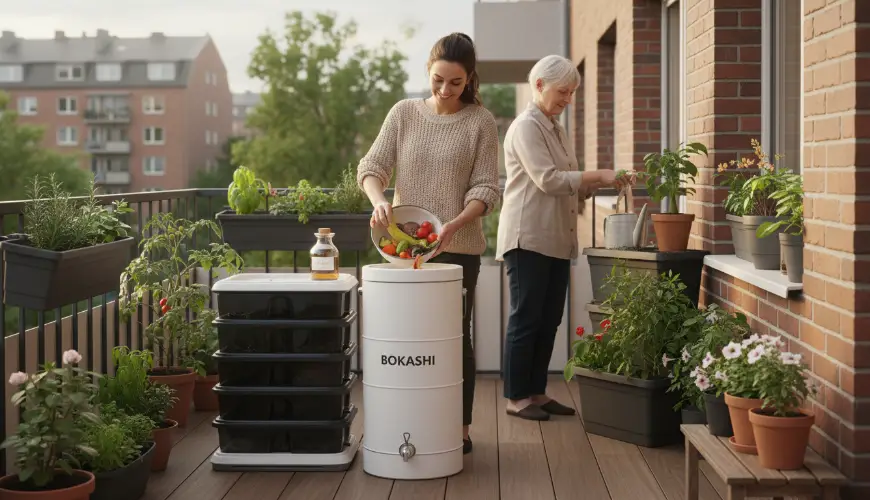
Just a few years ago, most people living in apartment blocks would have shrugged at the idea of processing kitchen waste right in their own home. Composting was, after all, something for gardeners, for people with their own land and plenty of space. But times are changing, and with them the approach of urban residents to waste, sustainability, and their own ecological footprint. Balcony composting has long ceased to be a utopia – thanks to systems like bokashi and vermicomposters, it has become an entirely realistic and practical matter even for those living in a small city apartment.
According to data from the Czech Statistical Office, biodegradable waste makes up roughly 40% of the contents of an ordinary bin. That is an enormous amount of material that wouldn't have to end up in a landfill or incinerator but could be transformed into valuable nutrients for flowers on the windowsill, herbs on the balcony, or houseplants in the living room. And this is precisely where two methods enter the scene that have been gaining an ever-growing following among city dwellers in recent years.
Try our natural products
Bokashi: Japanese fermentation that will change your view of kitchen waste
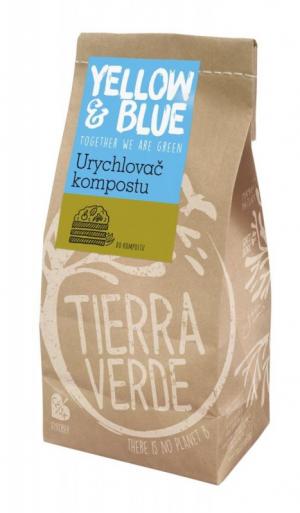
The word "bokashi" comes from Japanese and loosely translated means "fermented organic matter." The principle is surprisingly simple and at the same time ingenious. Instead of traditional composting, where organic material decomposes with access to air, bokashi works on the principle of anaerobic fermentation – that is, fermentation without access to oxygen. Kitchen waste is placed into a special airtight bucket, layered with bokashi bran containing effective microorganisms, and left to ferment.
What is so revolutionary about it? Above all, the fact that practically anything from the kitchen can go into a bokashi bucket. Unlike traditional compost, where adding meat, fish, dairy products, or cooked food is not recommended, bokashi can handle all of this. Lunch leftovers, citrus peels, coffee grounds, tea bags, even small bones – all of this can end up in a bokashi container. For someone living in an apartment, where a diverse mix of kitchen waste is generated every day, this is a huge advantage.
The entire process takes approximately two to three weeks. During this time, so-called bokashi leachate is released from the waste – a nutrient-rich liquid that simply needs to be diluted with water at a ratio of approximately 1:100 and used as an excellent fertilizer for plants. Once fermentation is complete, the contents of the bucket are ready for further processing. It can be buried in a flower pot with soil, added to a garden compost, or handed over to a community garden. It is important to know that the fermented material is not yet finished compost – it needs contact with soil, where it will only then decompose into humus.
The practical experience of Jana from Prague-Vinohrady, who has been using the bokashi system for three years now, shows how easily this method can be integrated into everyday life. "At first, I was afraid of the smell," she admits, "but I was surprised that bokashi actually smells a bit like pickled cabbage. I keep the bucket under the sink and none of my visitors even notice it." Jana estimates that thanks to bokashi, she has reduced the volume of her mixed waste by almost half, and her balcony tomatoes have never produced better.
The initial cost of a bokashi system is in the range of a few hundred Czech crowns for the bucket, plus the ongoing purchase of bokashi bran. For a city dweller who has neither a garden nor a composter in the yard, this method represents the easiest gateway into the world of home composting. The bucket takes up minimal space, doesn't smell, and requires no special maintenance – all you need to do is regularly drain the leachate and process the contents from time to time.
Vermicomposter: a small worm farm with a big impact
If bokashi is the path of fermentation, the vermicomposter represents the path of biology in the most literal sense. The foundation of the entire system is worms – specifically red wigglers (Eisenia fetida), which feed on organic waste and transform it into exceptionally high-quality vermicompost, sometimes nicknamed "gardeners' black gold." And yes, this small worm farm can function without any problems right in an apartment.
A vermicomposter is usually a multi-tiered container resembling stackable boxes. Kitchen waste is added to the upper tier – vegetable and fruit peels, tea bags, coffee grounds, eggshells, paper towels, or cardboard. The worms gradually process the material and produce vermicompost, which falls through to the lower tiers. In the bottom section, so-called worm tea collects – a liquid fertilizer of exceptional quality that plants absolutely love.
Unlike bokashi, vermicomposting has certain limitations regarding what can be offered to the worms. Meat, fish, dairy products, and heavily spiced foods do not belong in a vermicomposter – they could cause odor and attract unwanted insects. Citrus fruits and onions are acceptable only in small quantities, as their acidity doesn't agree well with the worms. On the other hand, if one follows these simple rules, the vermicomposter operates virtually maintenance-free and without any odor whatsoever. A healthy vermicomposter smells like a forest, like moist earth – which is actually quite a pleasant scent.
How many worms are actually needed? For an average household of two to three people, approximately half a kilogram of worms is sufficient, roughly five hundred individuals. That may sound like a lot, but worms take up surprisingly little space and are completely silent housemates. An entire vermicomposter can fit into a corner of a balcony, a storage room, under the kitchen counter, or even in a cellar. As stated by Ekodomov, a Czech organization dedicated to home composting, a vermicomposter measuring approximately 40×40×60 centimeters can process the waste of an average family without any problems.
One of the common concerns of future vermicomposters is the question: "What if the worms escape?" The answer is simple – they won't. Red wigglers are photophobic, meaning they avoid light, and if they have enough food and moisture in the composter, they have no reason whatsoever to leave their home. They are actually ideal house pets – they don't require walks, they don't make noise, and in return they produce the best fertilizer one can imagine.
Choosing between bokashi and a vermicomposter doesn't necessarily have to be an "either/or" decision. Many sustainable lifestyle enthusiasts combine both systems. Bokashi processes what the worms can't handle – meat, dairy products, cooked foods – and the vermicomposter takes care of the rest. This combination can cover practically all of a household's biological waste, which is something that just ten years ago would have sounded absolutely unimaginable in the context of urban living.
As British environmentalist and author of Sustainable Home David Batchelor noted: "The most effective environmental changes are those that take place in the kitchen – not because they are the biggest, but because they are the most frequent." And that is precisely where the power of home composting lies. It is not a one-time gesture, but an everyday habit that gradually changes a person's relationship to waste, food, and nature.
From a practical standpoint, it is worth mentioning the financial side of things as well. A ready-made vermicomposter can be purchased for approximately one to three thousand Czech crowns, or one can be made from ordinary plastic boxes for a fraction of that price. Worms can be ordered online or obtained from another vermicomposter owner – the community of people involved in vermicomposting in the Czech Republic is surprisingly vibrant and welcoming, for example on Facebook groups or forums dedicated to the zero-waste lifestyle. A bokashi starter kit costs a similar amount, and operating costs are limited to purchasing bokashi bran, which runs in the order of tens of crowns per month.
The ecological dimension of the whole matter is also important. When biological waste ends up in a landfill, it decomposes without access to air and produces methane – a greenhouse gas that, according to the U.S. Environmental Protection Agency (EPA), is approximately 25 times more effective at trapping heat than carbon dioxide. Every kilogram of kitchen waste that is processed at home instead of going to a landfill is therefore a small but real contribution to climate protection. And when one realizes that the average Czech household produces approximately 150 kilograms of bio-waste per year, it ceases to be a negligible number.
For those considering their first steps toward home composting, it is a good idea to start simply. There is no need to immediately invest in expensive equipment or study complex manuals. Just get a basic bokashi bucket or a simple vermicomposter, read a few articles or watch one of the many available video tutorials, and simply start. Mistakes are part of the process – even experienced composters didn't start out as experts. The important thing is to overcome the initial uncertainty and give it a try.
Cities are gradually changing. Community gardens are springing up on rooftops, herbs and tomatoes are blooming on balconies, and bokashi buckets and vermicomposters are quietly working in kitchens under sinks. This shift is not just a fashion trend – it is a natural response to the times we live in. Times when more and more people realize that even in a small city apartment, one can live more responsibly and in better harmony with nature. And perhaps that inconspicuous bucket under the sink or the box of worms in the corner of the balcony is the simplest first step a person can take.