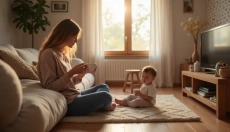

Children's independence can be naturally supported by giving them the space to try and make mistakes
The independence of children is one of those skills frequently discussed in families, yet it often leads to the most misunderstandings. Parents wish for their child to "handle it already," while the child craves the assurance that trying something on their own won't end in reproach or a hasty intervention. Meanwhile, everyday reality intervenes: mornings are rushed, energy dwindles by evening, stores are crowded, and there's a pile of laundry waiting at home. Still, there is a way to naturally and conflict-free support children's independence, ensuring it doesn't become a performance but rather a gradually growing ability for the child to take care of themselves, their belongings, and their relationships.
It might be useful to start with a simple question: when does a child learn independence the most? Paradoxically, it's often not when someone "orders" them to, but when they have the space to experiment, make mistakes, and experience appropriate responsibility in everyday situations. Children's independence: how to do it naturally – it sounds like advice from a manual, but it's actually more about changing the small habits of adults. It's about how we speak, set boundaries, and how much we believe that a child learns even when it takes longer.
Try our natural products


Independence is not loneliness: what a child really needs
In Czech, "independence" is sometimes confused with "loneliness" – and it's worth distinguishing between them. An independent child is not a child left to their own devices, but a child with a secure relationship and enough space. When we talk about "how to naturally support children's independence," it's not about them managing everything without help. It's about giving them the opportunity to try things with the knowledge that an adult is nearby but doesn't intervene unnecessarily.
Developmental psychology offers a useful framework: children learn independence in stages, and each stage has its typical "battleground" – for toddlers, it's dressing and "I can do it myself," for preschoolers, it's tidying up toys and simple responsibilities, for schoolchildren, it's school preparation and time management. In the background, the same thing is always happening: the child builds a sense of competence. According to numerous studies, communication style and family support for autonomy play a role; as a solid introductory overview, the American Psychological Association and its texts on parenting and child development can be useful.
It often happens that parents want independence but use tools that undermine it: quickly correcting, evaluating, comparing, "rescuing" from discomfort. The child then receives two messages at once: "You should know this" and "You won't manage it without an adult anyway." This creates friction, which outwardly appears as defiance, but inside is uncertainty.
Here, a simple rule can be relied upon: help as little as is safe, and as much as is needed. It sounds like a paradox, but when an adult learns to hold back for a moment and let the child think through the next step, something surprising often happens: the child manages. Not immediately, not always, but more often than one might expect.
And one more important point: independence isn't just "knowing how to tie shoelaces." It's also emotional independence – the ability to say what they need, handle frustration, ask for help when necessary. This part often becomes a source of conflict because adults sometimes expect adult reactions from a child's nervous system. Yet, it's true that a child calms down first with us and only later on their own. As one often-cited sentence goes: "Children don't need perfect parents, but good enough and available ones."
Children's independence: how to achieve it naturally and conflict-free in everyday life
Conflict often doesn't arise from a child's unwillingness to cooperate but from the clash of two speeds. An adult has a plan and time pressure, while a child has the need to explore and be involved. Natural support for independence starts where time pressure can be slightly reduced – not ideally, but realistically. Sometimes it's enough to prepare clothes the night before, other times to delay departure by ten minutes, or choose one thing the child does themselves while the rest is "handled" by the adult, so the morning doesn't end in yelling.
It works well when independence stops being treated as a test and starts being seen as a process. A child learns through repetition, not a one-off performance. If today they can't zip up, it's not proof of incapability, but information: the zip is hard, hands aren't steady yet, more time or a different approach is needed. An adult can help by offering a "bridge" instead of taking over: "You start, I'll hold." Or: "Can you show me how you'd try it?" Such a sentence often surprisingly reduces tension because the child receives both respect and support.
The environment also plays a significant role. A household can either facilitate or complicate a child's independence. When things are accessible, organized, and have their place, a child can rely on them. It's not about perfect minimalism, but a simple logic: hooks for jackets at child height, a laundry basket where a child can throw socks, a box for the building set that can be closed without complicated folding. Independence grows from small successes, not from big resolutions.
Interestingly, similar to an eco-friendly home, when the system is simplified, people use it. The same goes for a child. If tidying toys is based on ten categories and perfect arrangement, it becomes a struggle. If it's based on two or three clear places, the child has a chance to succeed without constant correction. And success is addictive.
This also includes how adults assign tasks. Children often respond better to specific, short instructions than to general rebukes. The difference between "Get dressed already" and "Now the shirt, then the pants, then come to the hallway" is enormous. Not because the child is "lazy," but because the child's brain is still learning to plan steps and keep a sequence of actions in mind. When an adult helps structure, it's not spoiling but teaching a skill.
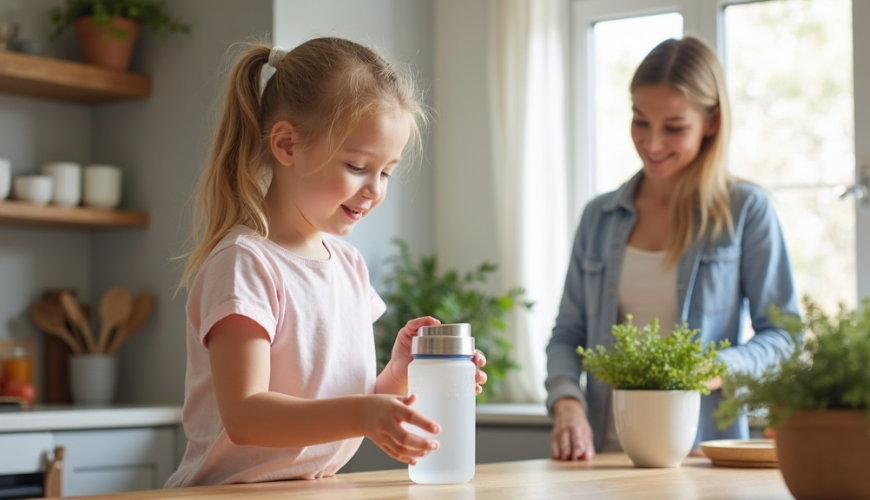
A real-life example shows how little sometimes suffices. In one family, the conflict over morning departure to kindergarten repeatedly occurred: a three-year-old wanted to pour water into the bottle themselves, but the adult was in a hurry and always "did it instead." The result was almost always crying and refusal to cooperate. When a single measure was tried – placing a small jug on the counter that the child could safely handle and allowing for occasional spills – the atmosphere changed within a week. The child gained their little ritual of competence, and the adult gained a morning without escalation. It wasn't about the water; it was about the feeling of "I can do it."
And what if a conflict does arise? It helps to separate the boundary from the tone. The boundary can be firm ("We leave at 7:40"), but the tone can remain calm ("I understand you want to try it yourself. We'll allow more time for that tomorrow."). The child learns that emotions are okay, but reality has a framework. This builds independence without a power struggle.
For the article to be truly practical, it's enough to ensure one thing: don't add independence as another task to an already full day. It's much more effective to "attach" it to routines that already exist. Morning dressing, unpacking things after coming home, preparing for the next day in the evening. Children like repetition – and repetition is the cheapest teacher.
A single list: small steps that make a big difference
- Choice of two options ("Do you want the blue or green shirt?") instead of an open question that overwhelms the child.
- Enough time for one "child's" task daily, that the child does on their own, even if it takes longer.
- Praise effort, not outcome ("I see how hard you tried" instead of "You are clever"), so the child isn't afraid of mistakes.
- Helping step by step ("You start, I'll help if you want"), not taking over the whole activity.
- Predictable rituals (same departure routine, same place for shoes), because they reduce stress and increase cooperation.
When independence hits a wall: emotions, boundaries, and "conflict-free" in practice
The desire to raise children "naturally and conflict-free" sounds beautiful, but it's worth translating. It doesn't mean a life without disagreement. It means a life where disagreements are resolved without humiliation, shouting, and pressure. A conflict is sometimes just a signal that needs have collided: an adult needs time and order, a child needs influence and recognition. When both sides are named, the pressure often eases.
Independence is also learned the least when a child is overtired, hungry, or overwhelmed. This isn't an excuse; it's biology. In such moments, it's better to lower demands and maintain the relationship. A child won't remember "they were supposed to be independent," but they will remember whether they were accepted or rejected in tension. And just feeling safe is the foundation from which independence springs.
Sometimes parents fear that being too accommodating will make the child "lazy." Yet, independence doesn't grow from pressure, but from assurance. A child allowed to try usually wants to progress. A child who is belittled or hurried either withdraws or starts to fight. In both cases, they move away from what the adult desires.
It also helps if adults can admit their own mistakes. When a sharper tone is heard in the morning, sometimes a short sentence suffices: "I said that too harshly. I'm in a hurry and nervous. Let's try again." This gives the child a crucial lesson for independence: relationships can be repaired. And one can take responsibility for their behavior without crumbling.
Wider context also plays a role: today's children grow up in a world full of stimuli and often things. Yet independence is sometimes paradoxically strengthened by fewer possibilities. When a child has twenty toys, cleaning up is chaos. When they have fewer, quality ones, cleaning is straightforward, and play is deeper. Similarly with clothing: when the wardrobe is overflowing, choosing is stress. When the selection is reasonable, the child decides more easily. Here, upbringing naturally intersects with the world of sustainability: fewer things, but thoughtfully, give children more space for their own competence.
And what about "solitude"? If it means the ability to be alone with oneself for a while, that's a skill related to independence. A child learns it gradually: first short moments of playing next to an adult, then in another room, later outside with friends. The goal isn't to isolate the child but to give them the experience that silence or boredom isn't an enemy. Often, boredom is the start of creativity. An adult can help by not immediately offering entertainment, but providing a framework: "Now everyone does their own thing, in ten minutes we'll start cooking." The child gains certainty in both time and space.
When all of this comes together, independence stops being a project and becomes a byproduct of a well-set household. The child gradually learns that things have their place, that mistakes can be fixed, that help is available but not automatic. And the adult discovers that "naturally and conflict-free" isn't about never raising one's voice, but about being able to breathe in the family even when something doesn't go right.
In the end, the most pleasant part is precisely the subtlety: independence isn't recognized by big declarations but by small things. By the fact that the child takes their cup to the sink, remembers their hat, can say "I need help" without embarrassment. And also by the fact that the adult sometimes holds on for a minute longer, even if they could do it faster – because they know that minute will eventually return as a child who believes in themselves.