
# How to Make Homemade Harissa Paste from Quality Ingredients Harissa is a spicy North African chil
There are flavors that instantly transport you somewhere else. One spoonful is all it takes, and suddenly there's the scent of scorching spices, distant markets, and kitchens where food is cooked slowly and with love. That's exactly the experience harissa offers – a paste made from hot peppers and spices that originates from North Africa and is gradually conquering kitchens around the world. It's not just a sauce. It's a way of thinking about food.
Although harissa is now sold in cans and tubes in almost every major supermarket, the homemade version is something else entirely. Making it at home means having full control over the intensity of the heat, the balance of spices, and the quality of the ingredients used. And the result? A paste that smells fresh, tastes vibrant, and keeps in the refrigerator for several weeks.
Try our natural products

What harissa actually is and where it comes from
Harissa has its roots in Tunisian cuisine, from where it gradually spread throughout the Maghreb – that is, to Algeria, Morocco, Libya, and further into the Middle East. The Tunisian version tends to be the hottest and most pure, while Moroccan harissa is often milder and more aromatic. The name comes from the Arabic verb "harasa," meaning to crush or grind – and that is precisely how this paste is traditionally prepared, in a mortar, with patience and hands that know their craft.
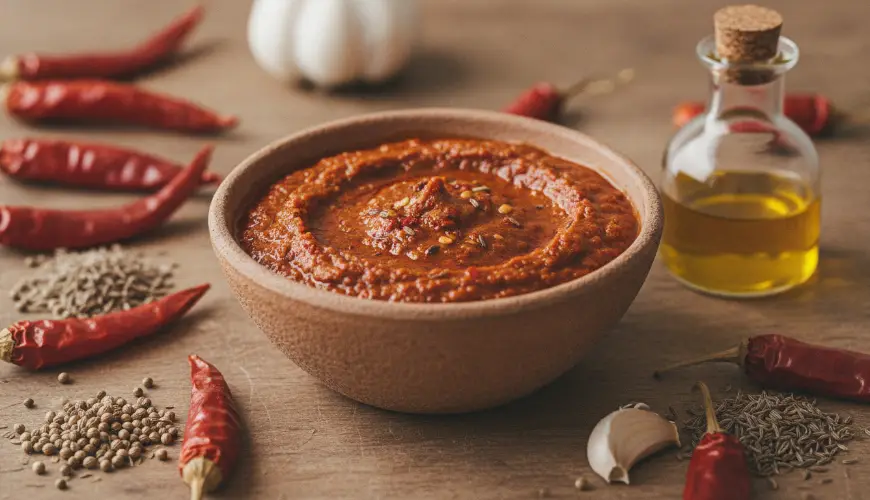
The foundation of every harissa is dried or fresh hot peppers, most commonly a combination of different varieties – from mildly hot to fiercely spicy. To these are added garlic, cumin, coriander, and sometimes caraway or smoked paprika. Olive oil binds the paste together while also preserving it. The resulting texture can be as smooth as cream or coarser, with pieces of spices and peppers – depending on tradition and personal preference.
It is fascinating to observe how this seemingly simple paste has become part of global gastronomy. French cuisine adopted it thanks to North African immigrants, and today harissa is an entirely commonplace item on French supermarket shelves. British chef Yotam Ottolenghi popularized it in the English-speaking world, and American magazines such as Bon Appétit have repeatedly named it one of the most important ingredients in modern cooking. In 2022, the Tunisian method of making harissa was even inscribed on the UNESCO Intangible Cultural Heritage list – recognition that this paste fully deserves.
Harissa is not just about heat. That is perhaps the greatest misconception surrounding it. Yes, it can be very spicy – but its true power lies in the depth of flavor created by the spices and the slow roasting of the peppers. When the heat combines with the smokiness of smoked paprika, the earthiness of cumin, and the freshness of garlic, the result is a flavor profile that is complex, layered, and utterly addictive.
Imagine a young woman named Tereza who first encountered harissa on a holiday in Tunisia. She was eating local flatbreads with eggs and a red paste she was initially afraid of. After the first bite, however, she stopped thinking and simply ate. After returning home, she spent weeks searching for a recipe that would at least come close to what she had tasted. It was only when she began experimenting with homemade production and stopped relying on the store-bought version in a tube that she achieved a result that truly satisfied her. Today, harissa is a staple in her refrigerator, and she adds it to practically everything.
How to prepare homemade harissa
The recipe for homemade harissa is not complicated, but it requires a little preparation and quality ingredients. This is where the secret of a good paste lies – what you put into it is what you get out of it.
It starts with dried hot peppers. The most commonly used are peppers such as ancho, guajillo, or chipotle for a smokier note, or dried bird's eye chili for intense heat. A good combination is to mix milder, aromatic peppers with hotter ones – the result is more complex that way. The peppers are first soaked in hot water for twenty to thirty minutes to soften, then deseeded, as the seeds can cause an unpleasant bitterness.
The spices are dry-toasted in a pan until they begin to smell fragrant – just a minute or two, but be careful not to let them burn. Cumin, coriander, and optionally curry or fennel seeds are briefly toasted this way and then ground in a mortar or spice grinder. This step is crucial, because freshly ground spices have a completely different intensity than those that have been sitting in a jar for months.
To the peppers and spices are added garlic – four to six cloves for a larger batch – salt, a little lemon juice or vinegar for acidity, and a generous amount of good olive oil. Everything is blended or crushed in a mortar to the desired consistency. Some people also add tomato paste for a sweeter note and thicker texture, while others stick to a pure pepper-and-spice version.
As Tunisian chef and writer Lotfi Akaichi wrote: "Harissa is not a recipe, it is a dialogue between the hand that creates it and the land from which it comes." And that is precisely the attitude worth bringing to homemade preparation – not as a precise scientific process, but as a conversation with the ingredients.
The finished paste is transferred to a jar, covered with a layer of olive oil that protects it from air, and stored in the refrigerator. This way, it keeps easily for three to four weeks. If you want to extend its shelf life, harissa can be frozen in small portions – for example in an ice cube tray – and taken out as needed.
A thousand ways to use harissa
This is where the real fun begins. Harissa is one of those ingredients with the ability to transform an average dish into something you look forward to eating. There's no need to use it in large quantities – often a small spoonful is enough to give an entire dish a new dimension.
The most classic use is as a dip or spread. Harissa mixed with yogurt or labneh creates a refreshing, mildly spicy sauce that pairs beautifully with toasted bread, vegetables, or as part of a mezze spread. Add a little honey and you get a surprisingly harmonious combination of sweet and spicy that works as a dip for cheeses or as a glaze for roasted meat.
Harissa excels in marinades. Simply mix two teaspoons of the paste with olive oil, garlic, and a little lemon juice and you have a marinade for chicken, lamb, or tofu that adds depth and color to the dish. Meat marinated overnight in harissa and then grilled or roasted in the oven achieves results that would otherwise require hours of cooking.
Harissa is also wonderful in soups and stews. A spoonful added to lentil soup, tomato sauce, or chickpea stew transforms the entire character of the dish. North African cuisine traditionally uses it in tagines – slow-cooked dishes with meat, vegetables, and dried fruit. The combination of harissa with cinnamon, ginger, and dried plums or apricots is one of those flavor combinations that sounds unusual at first taste but makes immediate sense.
For lovers of plant-based eating, harissa is a true treasure. Roasted vegetables – carrots, sweet potatoes, courgette, cauliflower – coated in harissa before going into the oven develop a caramelized, mildly spicy crust that transforms a simple side dish into the star of the table. Chickpeas sautéed with harissa, garlic, and a little tomato paste make a quick, filling, and exceptionally flavorful dinner that can satisfy the whole family.
Using harissa in pasta is also interesting. It may seem unconventional, but pasta with harissa, cream or coconut milk, and roasted peppers is one of those recipes that spreads across social media for good reason. Similarly, harissa mayonnaise works as a burger filling or salad dressing – just a tablespoon of harissa mixed with mayonnaise or a vegan alternative, and the result surpasses any store-bought dressing.
Harissa also finds its place in morning cooking. Shakshuka – eggs poached in a spiced tomato sauce – is one of the most popular North African dishes that practically calls for harissa. A spoonful of the paste added to the sauce along with peppers, onions, and tomatoes creates a base into which the eggs are nestled before the lid is placed on. The result is a hearty, fragrant breakfast or lunch that impresses both visually and in terms of flavor.
Online cooks and bloggers around the world share hundreds of ways to use harissa, and Serious Eats repeatedly ranks this paste among the essential ingredients of a modern pantry – alongside things like fish sauce, miso, or soy sauce. These are so-called umami boosters, ingredients that don't always play the starring role themselves, but have the ability to elevate the flavor of anything they are added to.
So why keep buying the industrial version when homemade preparation takes less than an hour and the result is incomparably better? Homemade harissa is also a significantly more sustainable choice – no metal tubes or preservatives, just clean ingredients, a jar, and a refrigerator. In the spirit of the sustainable approach to cooking promoted by a growing number of modern chefs and consumers, it is a small step with a significant impact on the quality of everyday food.
Whether you use it as a spread on your breakfast toast, as a base for an evening vegetable stew, or as a secret ingredient in soup, harissa has that rare quality: it changes the way you think about flavor. And once you've made it at home, it's hard to go back to anything else.