

How much vegetables per day is ideal when you want to eat healthier without complex rules
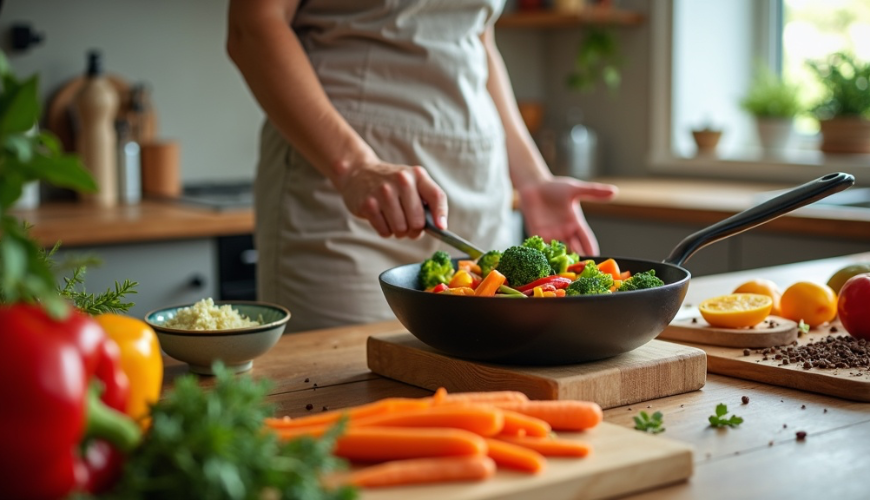
The question of how much vegetables daily has been returning with iron regularity in recent years. Some people feel they eat "just enough," others avoid vegetables because they are a hassle, and some associate them mainly with salad, which wilts after two days in the fridge and loses its appeal. Yet, vegetables are often the simplest way to shift your diet towards more lightness, variety, and long-term health—without counting calories and complex rules. And perhaps most importantly: it doesn't have to mean eating only carrots and cucumbers all day.
When discussing how to eat more vegetables daily, one practical thing is often forgotten: people aren't robots. In real life, days when there's time to cook alternate with days when you come home late, with work, kids, and duties running through your mind—and at that moment, a quick choice wins. That's why it makes sense to think not only about the ideal amount but mainly about how to ease preparation and how to smartly "smuggle" vegetables into everyday meals so it doesn't feel like a punishment.
Try our natural products






How much vegetables to eat daily and why it matters
General nutritional recommendations appearing across countries and institutions often revolve around the concept of "5 servings a day" (fruits and vegetables combined). As a solid guideline, roughly 400 grams of fruits and vegetables daily can be considered; a similar recommendation is mentioned by the World Health Organization (WHO). How much of that should be vegetables? In practice, it's useful to aim for vegetables to make up the larger part—because fruit is easy to eat (and sometimes "too easy"), while vegetables are often neglected.
For a typical day, this can be translated simply: at least 2–3 substantial servings of vegetables, ideally spread throughout the day. The servings don't have to be precisely weighed. It can be a bowl of salad for lunch, a cup of vegetables in soup, two handfuls of vegetables as a warm side dish, or half a plate of vegetables for dinner. For those wanting a more specific measure, the rule "half a plate of vegetables" at the main meal often works—not always, not at all costs, but as a guideline.
Why do it at all? The benefits of vegetables for health and diet are surprisingly broad and very practical. Vegetables provide fiber (satiety, digestion, more stable energy), vitamins, and minerals, as well as a diverse array of plant compounds. These are complexly described in textbooks but in the kitchen mean mainly one thing: the more varied the vegetables, the more varied the "equipment" for the body. Vegetables also naturally help accommodate more volume and nutrients in the diet and fewer "empty" calories—without feeling restricted.
And there's one more often overlooked effect: vegetables can enhance the taste of food. It's not just salad. When cauliflower is roasted well, when onions and carrots are caramelized as a sauce base, when a handful of spinach is added to pasta, the food becomes fuller, more fragrant, and "more finished." As one simple kitchen rule says: "When you don't know what's missing, add vegetables."
How to incorporate vegetables into your daily meals without pain
If one were to answer the question of how much vegetables to eat daily and how to incorporate them, the most honest answer is: find a way that fits the daily rhythm. Not everyone likes salad for breakfast, and not everyone craves raw vegetables in the evening. The good news is that vegetables can be "added" in various ways: into warm meals, snacks, spreads, soups, and side dishes. Often, it only takes starting with small, repeated steps.
A very practical trick is to stop viewing vegetables as a "separate task" and start seeing them as part of the meal. When cooking rice, add peas or broccoli. When making a sauce, start with onions, carrots, and celery. When there's bread with a spread on the plate, add a bowl of chopped vegetables. It's nothing revolutionary, but in total, it makes a huge difference.
Now, an example from real life that probably everyone knows. Imagine a typical Tuesday: rushing to work in the morning, a menu for lunch, meetings in the afternoon, and just "something" in the evening. This is when vegetables often fall by the wayside. But a small shift is enough: add a few cherry tomatoes and a pepper to breakfast bread, choose a menu with a side salad or soup, and in the evening, instead of a second roll, make a quick pan with vegetables and eggs. In total, this can be easily 300–500 grams of vegetables, without spending an extra hour in the kitchen. Vegetables didn't appear as a "project," but as three small choices.
If you find it helpful to have specific tips for incorporating vegetables into your daily meals, these simple principles often work (and it's unnecessary to follow them all at once):
- Add vegetables to meals you're already making: a handful of spinach in pasta, peas in risotto, grated carrot in sauce, grated cucumber or beet in spreads.
- Keep "crunchy vegetables" at home: carrots, kohlrabi, peppers, cucumbers—something that can be eaten immediately without cooking.
- Soup as a shortcut: vegetable soup (even creamy) can provide a large serving of vegetables in one bowl.
- Vegetables as the base, not a garnish: instead of "a piece of cucumber on the side," try making vegetables the main side dish—roasted vegetables, steamed vegetables, salad with legumes.
It's also important to stop stressing about "perfection." Sometimes every handful counts. Other times it doesn't work out. The goal isn't to win a contest for the greenest plate but to gradually create a routine where vegetables are a normal part of the day.
How to ease preparation and eat more vegetables daily even on busy days
The most common obstacle isn't taste but logistics: shopping, storing, cutting, cooking, washing dishes. That's why it's worth focusing on how to ease preparation—because when vegetables are "ready to use," they get eaten much more. And you can win here even without culinary talent.
It starts at the store. In addition to fresh vegetables, there are frozen, canned, or fermented options—and each has its place. Frozen vegetables are often underestimated, yet they are usually harvested at good ripeness and ready immediately. Into the pan, into soup, into sauce. When fresh runs out, the freezer saves the day. Similarly, sauerkraut or kimchi adds flavor and a serving of vegetables without chopping. And canned legume mixes with vegetables can solve a quick dinner in minutes.
At home, a simple "pre-preparation" ritual works: when you bring home groceries, wash, peel, and store some vegetables in containers right away. Not all, not for an hour. Just 10–15 minutes. Suddenly there's a box of carrot sticks in the fridge, peppers in another, salad in another. And when hunger strikes, you reach for what's ready. It sounds trivial, but this is often the difference between "I'll have something quick" and "I'll have something quick and vegetables."
Another shortcut is baking. When a large tray of vegetables is roasted once every few days (carrots, onions, zucchini, pumpkin, cauliflower, peppers), it creates a base that can be added almost anywhere: into couscous, into tortillas, with potatoes, in salads, with hummus. Roasted vegetables also appeal to people who might not like raw vegetables—they are sweeter, more fragrant, and "rounder" on the palate.
Proper seasoning also makes a big difference. Vegetables by themselves don't have to be boring, but they often remain uninspired. Lemon, quality oil, herbs, garlic, yogurt dip, tahini, a bit of cheese, or seeds can help. It's not about "covering" the vegetables but giving them a chance to shine. When people ask how to eat more vegetables daily, the answer sometimes is: make them so good that you crave them. Not just "because you should."
And what about children or picky eaters? Here, the "invisible vegetable" strategy often works: grated zucchini in patties, pumpkin puree in sauce, carrots in Bolognese, cauliflower blended into creamy soup. It's not cheating, more like a bridge. Gradually, visible vegetables can be added, but it's okay to start like this.
When you put it all together in one practical image, a day with a higher vegetable intake can look surprisingly normal: morning bread with spread and a bowl of chopped vegetables, soup and salad for lunch, afternoon snack of carrots with hummus, and a quick evening pan with frozen vegetables and tofu or eggs. It's not a diet, just that vegetables are "everywhere a little." And that's the most reliable way to reach how much vegetables to eat daily without stress and feeling like your entire life has to change.
For those who want support from authoritative sources, the general principles of the "Healthy Plate" from Harvard T.H. Chan School of Public Health, where vegetables (and fruits) form a significant part of the plate, are useful. It's not dogma, more a visual reminder that vegetables shouldn't just be decoration.
Ultimately, perhaps the most important question isn't just "how much vegetables daily," but "where to make room for them in the daily routine." Sometimes it's enough to shift vegetables from the role of obligatory side dish to a natural part of the meal: in soups, in sauces, in snacks, on the baking tray. And when you add one small certainty in the fridge or freezer, vegetables stop being a weekend project and become something manageable on an ordinary Wednesday—and that's when they have the greatest strength.