

# How to Disconnect from Work in the Evening and Truly Rest
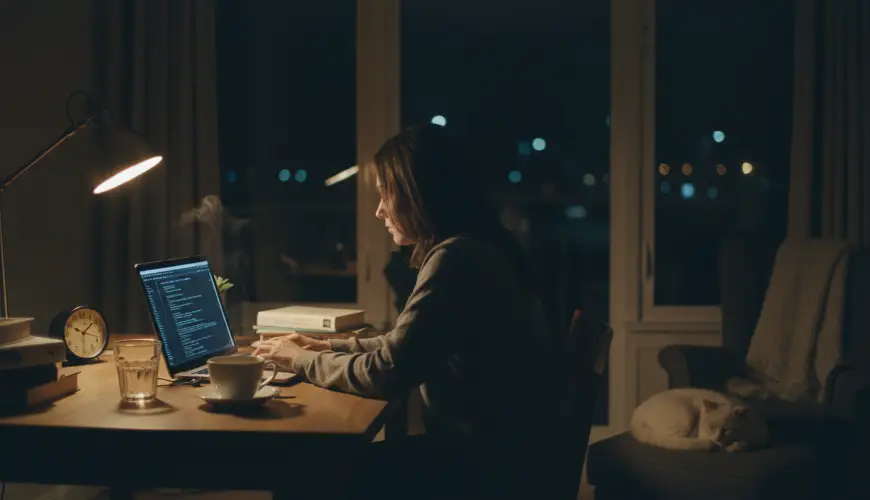
Working from home sounds like a dream at first glance. No commuting, your own pace, coffee from your own kitchen. But the reality of home office has its dark side, which everyone who has experienced it firsthand knows well: the boundaries between work and personal life gradually blur, until one day you find yourself sitting at the computer at quarter to eleven in the evening, answering an email that could have easily waited until morning. So how do you actually disconnect from work in the evening? And why are firm mental boundaries so important when working from home?
This isn't about laziness or a lack of professionalism. It's about a basic psychological need – the brain needs clear signals that the working day is over. In an office, this is handled by physically leaving, the commute home, the transition to a different environment. With home office, these natural transitions are absent, and if a person doesn't consciously create them, work-related stress begins to accumulate without any outlet. The result is chronic fatigue, irritability, and paradoxically even lower productivity – the exact opposite of what we hoped to gain from working from home.
Try our natural products




Why the brain can't stop on its own
Psychologists call this the "unfinished work effect" – the brain naturally tends to continuously ruminate over incomplete tasks. This phenomenon was first described by Lithuanian psychologist Bluma Zeigarnik in the 1920s and is today known as the Zeigarnik effect. In a home office environment, this mechanism is particularly insidious, because work tasks are literally within arm's reach – simply open the laptop lying on the dining table and you're immediately back at work.
Added to this is the pressure of modern work culture, which has confused availability with productivity. Being constantly online, responding quickly to messages, being reachable at all times – all of this has become an informal standard in many companies. Yet as the World Health Organization warns, long working hours and the inability to rest are demonstrably linked to an increased risk of cardiovascular disease and mental health disorders. Overtime is not a badge of honour – it is a health risk.
Let's take a concrete example. Jana works as a project manager at an IT company and switched to full home office in 2021. At first she enjoyed the flexibility, but after a few months she noticed that she had stopped being present during family dinners, because she was constantly going over in her head what she hadn't finished. She fell asleep with her phone in her hand, and the first thing each morning was a work email. "I stopped being able to tell when I was working and when I was resting. Both merged into one big grey nothing," she described her situation. She was not an exception – according to a survey by Eurofound conducted during the pandemic, working from home led to longer working hours and a deterioration in work-life balance for more than a third of employees.
Rituals that actually work
The key to disconnecting from work is not willpower or discipline in the traditional sense. It is rather a matter of intentionally created rituals and a physical environment that help the brain switch into a different mode. The brain responds to context – and if we give it clear, repeated signals, it will learn over time to associate them with relaxation just as reliably as it currently associates an open laptop with focused work.
One of the most effective tools is the so-called "end of the working day" ritual – a conscious, repeated sequence of activities that symbolically closes off work time. This might involve writing down the three most important tasks for tomorrow in a diary, closing all work-related browser tabs, physically putting the laptop away in a drawer or bag, and taking a short walk around the neighbourhood as a substitute for the commute home from the office. This simulated "commute home" – even if it only lasts ten minutes – has a surprisingly powerful psychological effect. Research published in the Harvard Business Review confirms that people who consciously created a transitional ritual show lower levels of work-related stress and better sleep quality.
The physical environment plays an equally important role. The ideal solution is to have a dedicated workspace that remains closed off or at least visually separated from the rest of the home after working hours. If space doesn't allow for this and you work at the dining table, even a symbolic gesture helps – packing work items into a box or bag that disappears from sight. Our eyes are constantly sending the brain signals about the surrounding environment, and if the laptop is on the table during dinner, the brain remains in a state of working readiness.
Another powerful tool is digital boundaries. Turning off work notifications after a certain hour is not a sign of unprofessionalism – it is a necessary form of hygiene. Most modern phones and applications allow you to set an automatic "do not disturb" mode for specific time windows. Apps like Slack or Teams offer an automatic reply function or availability settings that inform others you are offline. If a company treats these measures as unacceptable, that is valuable information about its culture – and simultaneously a signal that it may be time to start looking for a different working environment.
Mental strategies are just as important as technical measures. One of the most effective is the technique known as a "brain dump" – writing down everything on your mind on paper before setting work aside. It doesn't need to be a structured to-do list. A free flow of thoughts, worries, ideas, and unfinished matters is sufficient. This relieves the brain of the need to constantly "monitor" this information in working memory, allowing it to truly relax. It is a simple but scientifically supported way to break the cycle of rumination that would otherwise continue well into the night.
What you fill your evening time with also plays a major role. Passively consuming social media or news keeps the brain occupied, but does not regenerate it. In contrast, activities that require a degree of presence and physical engagement – cooking, gardening, outdoor movement, handicrafts, reading a physical book – help to genuinely shift attention away from work-related topics. Body and mind are interconnected systems, and movement is one of the fastest ways to change your mental state. Even a short walk after dinner can lower cortisol levels and prepare the nervous system for a calmer evening.
Setting boundaries with others – and with yourself
Disconnecting from work is not, however, purely a personal matter. It also requires communication – with colleagues, with managers, and sometimes with family. It is useful to openly communicate during which hours you are available and when you are not. This transparency prevents misunderstandings and at the same time normalises healthy work boundaries within a team. If a manager sends emails at ten in the evening, they are implicitly signalling that others should do the same – even if that is not their conscious intention. Company culture is shaped by behaviour, not just by rules in a handbook.
At home the situation is different, but equally important. Partners, children or housemates can unknowingly disrupt your concentration during the day, and at the same time not understand why you are "still working" in the evening. An open conversation about how home office works and what specifically helps you rest better can significantly improve the atmosphere at home. Healthy boundaries are not a wall – they are clear rules that protect both relationships and performance at the same time.
It is equally important to be honest with yourself. Why is it that you can't stop in the evening? Is it a genuine workload, or is fear behind it – fear of failure, of not being good enough, of others' judgement? Sometimes the inability to disconnect is a symptom of a deeper relationship with work as a source of value and identity. "I am productive, therefore I am" – this informal equation is very widespread in modern society and at the same time very dangerous. Psychologist and author Cal Newport, in his book Deep Work, points out that truly deep and valuable work requires not only focus, but also regular, quality rest – without it, creativity and the ability to solve problems gradually become depleted.
So it is not just about how to technically switch off the laptop. It is a conscious decision that personal time has value in and of itself – not as a reward for completed work, but as an essential part of a fulfilling life. A person who is able to truly disconnect in the evening arrives the next morning with a clear head, a better mood, and a greater ability to concentrate. And paradoxically, they do better work than someone who works twelve hours without a break.
A home in which one rests well is also a home that is consciously designed for wellbeing and recovery – quality lighting, pleasant materials, order free of unnecessary visual clutter. This is not a luxury, but functional design of everyday space. Such an environment itself helps the brain switch into a resting mode – and that is an investment that pays off every evening.