

# Cleaning blinds and roller blinds without removal is possible
Blinds and roller shades are among those pieces of home furnishings that are easily forgotten during cleaning – and yet they are precisely the ones that are first to collect dust, kitchen grease, and pollen particles coming in from outside. Anyone who has ever put off cleaning them indefinitely knows all too well how quickly a light graying turns into a layer of dust that resists even the most determined effort. Fortunately, there are ways to deal with this problem quickly, effectively, and without having to take the entire blind down and disassemble it.
Many people avoid cleaning blinds precisely because they picture a lengthy process of dismantling, soaking in the bathtub, and subsequent drying – an entire weekend devoted to a single window. In reality, however, regular care without dismantling handles the vast majority of situations, and the entire process can be reduced to a matter of minutes. The key is the right technique, suitable tools, and a little systematic thinking.
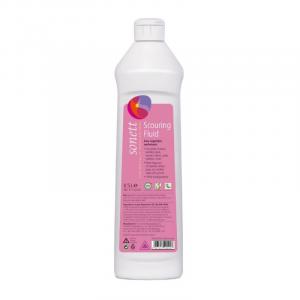
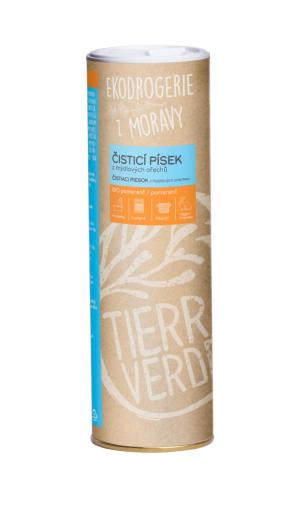
Try our natural products
Why Regular Blind Cleaning Is More Important Than It Seems
The dust that settles on the slats of horizontal blinds or on the surface of roller shades is not just an aesthetic problem. According to experts in indoor air quality, such as the U.S. Environmental Protection Agency (EPA), indoor dust can contain allergens, dust mites, bacteria, and harmful chemical substances from the outdoor environment. Blinds and roller shades act as a kind of filter – they trap these particles and release them back into the air with every movement. For allergy sufferers or families with young children, this can be a genuine problem.
Moreover, neglected blinds age faster. Dust and grease damage the surface finish of the slats, causing them to become brittle, and in the case of fabric roller shades, lead to changes in the color and texture of the material. Regular cleaning therefore extends the lifespan of the entire shading system and postpones the need for costly replacement.
It is interesting how easily this task can be built into a regular cleaning routine. Devoting just a few minutes to blinds every two weeks means that deep cleaning is then needed far less frequently. This is exactly the principle behind effective home care – not an intense and exhausting clean once a year, but light, regular maintenance that prevents problems from reaching a critical stage.
Imagine a situation that almost everyone knows: guests arrive unexpectedly and you suddenly notice how dusty and gray the blinds in the living room look. Dismantling is out of the question, but so is leaving them in that state. It is precisely in moments like these that you will appreciate knowing quick tricks that can save the situation in a quarter of an hour.
Practical Cleaning Techniques Without Removal
The foundation of any blind cleaning without dismantling is the dry method as a first step. Whether dealing with aluminum, wooden, or plastic horizontal blinds, always begin by removing dry dust before adding any moisture. Wet dust easily turns into a sticky layer that is much harder to remove.
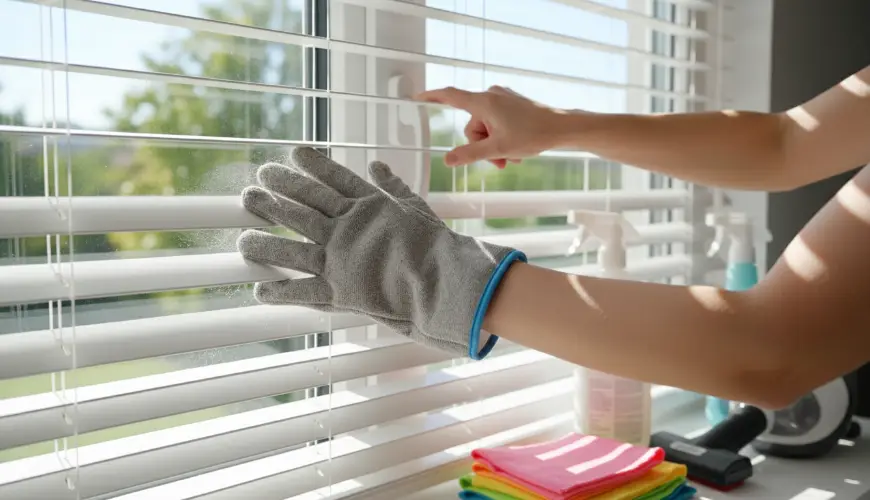
The simplest tool for dry dust removal is a classic electrostatic duster or special blind-cleaning gloves, which are now available in many home goods stores. These gloves allow you to pass along the slats in a single hand movement and, thanks to the electrostatic effect, attract dust rather than blowing it around. An alternative is a vacuum cleaner with a soft brush attachment – move it along the slats from left to right at a low power setting to avoid bending or damaging them.
When it comes to wet cleaning, microfiber cloths are the best tool. They are capable of capturing dirt without the use of aggressive cleaning agents and are gentle both on the surface of the slats and on the environment. Run a lightly dampened cloth along each slat individually – the movement should be smooth, from the center toward the edges, to prevent dirt from accumulating in the corner joints. For hard-to-reach spots or narrow slats, the old sock trick works well: slip an old sock over your hand, dip it in lukewarm water with a little dish soap, and work your way from slat to slat.
For kitchen blinds, where grease also accumulates, water alone is insufficient. Here, a solution of warm water with a little vinegar or a mild eco-friendly cleaning product works excellently. Vinegar is a tried-and-tested natural degreaser that leaves surfaces streak-free while also having disinfectant properties. A ratio of approximately one part vinegar to three parts water is sufficient – and greasy stains come off surprisingly easily.
Fabric roller shades and Japanese panels require a somewhat different approach. Their surface is more sensitive to moisture and mechanical stress, so it is recommended to clean them primarily dry – with a soft brush, a dry microfiber cloth, or again a vacuum cleaner with a gentle attachment. If a localized stain appears on a fabric surface, it is better to treat it immediately with a damp pad and gently press – never rub, as this could spread the stain or damage the fibers. For deeper cleaning of fabric roller shades without removing them, a handheld steam cleaner can also be used, which loosens dirt using steam while simultaneously disinfecting the surface.
Another excellent aid for cleaning blinds is special vacuum cleaner attachments shaped like tongs, which grip a slat from both sides at once and clean it in a single pass. This tool is particularly valuable for densely slatted blinds, where cleaning each slat individually by hand would take far too much time.
As the old cleaning rule goes: "Clean from top to bottom, from dry to wet." This principle applies perfectly to blinds as well – start from the highest slat and work downward, so that dirt does not fall onto already cleaned surfaces.
Tips for Long-Term Care and Prevention
Cleaning is one thing, but preventing the buildup of dirt can significantly simplify the entire process. There are several simple measures that help keep blinds clean for longer.
The first of these is an antistatic spray, which can be applied to the slats after cleaning. It creates a thin protective film that repels dust and slows its accumulation. Eco-friendly versions of these sprays are available on the market, free from aggressive chemicals and safe even for households with children or pets. A light wipe with a wax stick has a similar effect – this old household trick works surprisingly well, especially on aluminum blinds.
Another factor is ventilation. Regular airing of rooms does not directly remove dust, but it does help regulate humidity, which causes dust particles to adhere more readily to surfaces. Conversely, excessively dry air electrostatically attracts dust to plastic and aluminum surfaces – it is therefore advisable to maintain a relative indoor humidity of between 40 and 60 percent, as recommended by health authorities.
For those looking for sustainable household solutions, it is worth noting that eco-friendly cleaning products based on natural ingredients are not only kinder to the environment but are often gentler on blind surfaces as well. Aggressive chemical cleaners can gradually damage the surface finish of slats, causing them to become brittle or discolored. Vinegar, baking soda, and lemon juice are affordable, inexpensive, and surprisingly effective alternatives.
The frequency of cleaning depends on the specific conditions of each household. As a general guideline:
- Every two weeks – light dry dusting using a duster or vacuum cleaner
- Once a month – wet cleaning of slats with a damp microfiber cloth
- Two to three times a year – more thorough cleaning using a cleaning solution, especially in the kitchen or in high-traffic rooms
Blinds in the kitchen or in rooms where smoking occurs or where there are pets will naturally require more frequent care. In a bedroom or study with low traffic, a less intensive routine will suffice.
It is also worth knowing when it is time to turn to professional cleaning or actual dismantling. If slats are permanently deformed, heavily greased, or if fabric roller shades have deep stains that do not respond to standard methods, it is better to have them professionally cleaned or replaced. Some companies offer ultrasonic bath cleaning of blinds directly at the customer's home, without the need to transport them – this is a compromise between home care and full dismantling.
Caring for blinds and roller shades does not have to be a nightmare or a tedious chore. With the right tools, a little regularity, and knowledge of tried-and-tested tricks, this task becomes a routine that takes no more than a few minutes a week – and the reward will be not only a cleaner home, but also better air to breathe in it.