

Correct breathing during exercise affects performance and recovery
Few people think about how they breathe when exercising. Attention naturally focuses on movement, on the technique of performing an exercise, on the number of repetitions, or on the weight on the barbell. And yet it is precisely breathing during exercise that determines whether training will produce results or whether the body will suffer needlessly. It is one of the most underestimated aspects of physical activity – and at the same time one of the most important.
Try to recall your last strength training session or yoga class. Did you hold your breath at any point? Almost certainly yes. This is a natural, reflexive mechanism that has its physiological justification, but if it becomes a habit, it can do more harm than good. Understanding why this happens and how to consciously work with your breath can fundamentally change the quality of every workout.
Try our natural products





Why do we hold our breath during exercise?
Holding your breath during physical exertion is not a mistake or a sign of laziness. It is an evolutionarily ingrained bodily response that has its own name – the Valsalva manoeuvre. During this phenomenon, a person closes their vocal cords after inhaling and attempts to exhale against a closed airway. The result is a sharp increase in intra-abdominal pressure, which stabilises the spine and enables maximum force to be exerted. Strength athletes and weightlifters use this manoeuvre deliberately and in a controlled manner to manage extreme loads during maximum efforts.
The problem arises when this technique is applied unconsciously during everyday exercise, whether squats with lighter weights, push-ups, or Pilates. The body gets used to the shortcut – instead of teaching the muscles and breath to work together, it simply stops the breath and reaches for a quick fix. The result is short-term stability, but at the cost of elevated blood pressure, reduced oxygen supply to the working muscles, and unnecessary fatigue.
According to information from the American Heart Association, repeatedly holding your breath during exercise can lead to dangerous blood pressure fluctuations in susceptible individuals. In healthy athletes, this is generally a transient state, but in people with cardiac or vascular conditions, such strain can be genuinely risky. And that is why conscious breathing should not be the preserve of professionals alone.
Another factor that leads to breath-holding is concentration. During demanding movement, the brain redistributes attention, and breathing – as an automatic function – receives lower priority. Beginners therefore hold their breath more often than experienced exercisers, because they have not yet automated their movement patterns and must consciously control every detail of execution. Once technique improves, the breath naturally returns – but only if it was part of training from the beginning.
Stress and mental tension also play a role. A body in a tense state breathes shallowly and irregularly, which carries over into movement. Someone who arrives at a workout after a stressful working day will naturally find it harder to control their breath. It is no coincidence that yoga and meditation, which place breath at the centre of attention, have a demonstrably beneficial effect on the nervous system and overall wellbeing.
How to achieve the correct breathing technique in different types of exercise
Correct breathing during exercise is not a universal guide that applies equally to all situations. It differs depending on whether a person is running, strength training, practising yoga, or swimming. Understanding these differences is the key to ensuring that breath truly helps rather than getting in the way.
In strength training, the basic rule sounds simple but requires practice: inhale during the easier phase of the movement, exhale during the more demanding one. For example, during a squat, inhale while lowering the body and exhale while rising. During a bench press, inhale while lowering the bar to the chest, exhale while pressing upward. This rule helps maintain stable intra-abdominal pressure without needing to hold the breath entirely. Exhaling during exertion activates the deep stabilising muscles and protects the spine in a natural way.
During aerobic exercise, such as running or cycling, it is all about rhythm. The body needs a sufficient supply of oxygen, so deep, regular breathing is essential. Many runners adopt a technique known as rhythmic breathing – for example, inhaling for three steps and exhaling for two. This approach, popularised by coach Budd Coates in his book Running on Air, reduces the risk of side stitches and helps maintain an even pace. The key is to breathe into the belly, not the chest – diaphragmatic breathing delivers a greater volume of air with less effort.
In yoga and Pilates, breath is directly integrated into movement and cannot be separated from the practice. In yoga, the general approach is to inhale when opening the body – during backbends and chest-opening movements – and to exhale during forward folds and twisting. Pilates works with the exhale during core activation, because exhaling naturally engages the transverse abdominal muscle, which is the foundation of stability for the entire musculoskeletal system. This is precisely why Pilates instructors constantly remind participants: "Exhale and engage your centre."
Swimming is unique in that breathing is physically constrained by the environment – a swimmer must breathe at precisely defined moments and cannot afford to hold their breath for too long. This necessity paradoxically makes swimming an excellent school for conscious breathing. Regular swimmers generally have significantly better breath control than people who focus exclusively on strength sports.
The Czech Society of Sports Medicine also summarises how to breathe correctly during exercise, emphasising in its recommendations the importance of coordinating breath with movement as a means of preventing overload of the cardiovascular system.
A practical example: Jana, a thirty-five-year-old accountant, began attending group strength training twice a week. After the first sessions, she complained of headaches and dizziness following exercise. Her instructor noticed that Jana was holding her breath during every demanding exercise and pulling a face as though she were trying to lift a car. After several sessions focused exclusively on conscious breathing – exhaling while lifting, inhaling while lowering – the problems disappeared, and Jana also found that she could manage heavier weights with less fatigue. Her story is not exceptional; on the contrary, it is very typical.
Conscious breathing during exercise also has a direct impact on recovery. A deep exhale activates the parasympathetic nervous system – the part of the nervous system responsible for rest and restoration. This is why, after an intense workout, it is recommended to spend a few minutes on slow, controlled breathing. The body thus switches more quickly from a state of fight or flight into a state of calm, and recovery proceeds more efficiently.
As Karel Lewit, a pioneer of modern physiotherapy, said: "Breathing is the primary movement pattern. If breathing does not function, nothing else can function properly." This idea has become the foundation of many rehabilitation approaches and is today embraced by physiotherapists, coaches, and sports physicians around the world.
There is also a direct connection between breathing and sleep quality and overall vitality. People who learn to breathe consciously during movement carry this skill over into everyday life. Shallow chest breathing, which is unfortunately the norm for the modern sedentary person, keeps the body in a mild state of stress. Transitioning to deep diaphragmatic breathing, even outside of exercise, lowers cortisol levels, improves tissue oxygenation, and supports overall wellbeing.
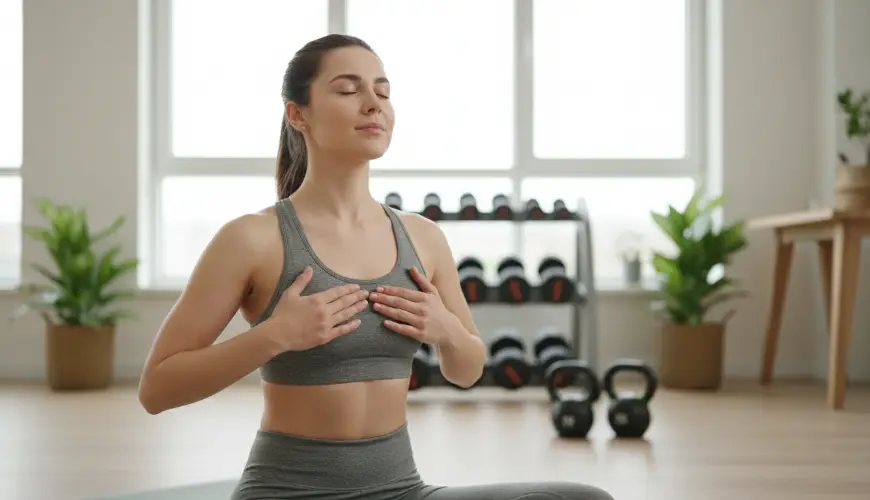
So how do you begin? The simplest exercise requires no equipment or special conditions. Simply lie on your back, place one hand on your chest and the other on your belly. When inhaling, the hand on the belly should rise, not the one on the chest. This simple diaphragmatic breathing is the foundation from which everything else follows. Mastering this pattern at rest is the first step towards making it work during movement as well.
The next step is to bring breath awareness directly into training. Simply telling yourself to do it is not enough – it must be repeated until it becomes automatic. Some coaches recommend deliberately slowing down training at the outset and performing exercises more slowly, with full attention devoted to each inhale and exhale. Speed and intensity will come on their own once breath has become a natural part of movement.
Correct breathing during exercise is not a luxury, nor is it something reserved only for yogis and professional athletes. It is a fundamental skill that influences performance, safety, recovery, and overall health. The body already knows how to do it – it simply needs to be reminded and given the space to begin using that knowledge to its full potential. And that is precisely where the true power of conscious movement lies.