

Grip Training Will Improve Your Health and Posture
Few people, when looking at their everyday movements, realize the crucial role played by their hands – specifically the strength of their grip. In the morning you open a jar of jam, on the way to work you grab a handle on the tram, in the afternoon you carry shopping bags, and in the evening you might go rock climbing or get to work in the garden. All these seemingly mundane activities have one thing in common: they depend on the strength and quality of your grip. Yet grip training is practiced by only a fraction of those who exercise regularly, and even fewer of those who think about their health in a broader context.
Grip strength, as it is known in English, is not just a matter for bodybuilders or climbers. Research repeatedly shows that it is one of the most reliable indicators of overall health status, across all age groups. A study published in the prestigious journal The Lancet followed over 140,000 adults in 17 countries and found that weaker grip strength is a stronger predictor of cardiovascular disease and premature death than blood pressure. That is a finding worth paying attention to.
Try our natural products


Grip as a window into overall health
Why should hand strength tell us anything about the state of the heart or length of life? The answer lies in how the body functions as a whole. The muscles of the hand and forearm are connected to the entire kinetic chain – a system of muscles, tendons, joints and neural pathways that extends from the fingers through the wrist, elbow, shoulder, all the way to the spine and trunk. When one link in this chain is weak or dysfunctional, it affects everything else.
People with a strong grip generally have better-developed muscles throughout the body, stronger bone tissue and more efficient neuromuscular coordination. In other words, strength in the hands is a reflection of overall physical fitness, not an isolated trait. Moreover, people who are physically active and regularly use their hands – whether through work, sport or conscious training – naturally have a stronger grip. And physical activity itself is one of the best-documented factors in longevity and prevention of chronic disease.
There is also an interesting perspective from the other side. Weak grip is often one of the first signs of sarcopenia – the gradual loss of muscle mass and strength that comes with age and dramatically increases the risk of falls, fractures and loss of independence. The World Health Organization only recognised sarcopenia as a standalone diagnosis in 2016, but the problem itself is as old as humanity. Anyone who has ever watched ageing parents or grandparents struggle increasingly with opening bottles or lifting heavier objects has witnessed sarcopenia in real time.
Yet this is not just a matter of old age. Even in young people who spend most of the day at a computer and move very little, the muscles of the hands and forearms weaken. Chronic wrist pain, carpal tunnel syndrome and tennis elbow are problems that are increasingly appearing even in people in their twenties, caused in part by an imbalance between overloading certain muscle groups and insufficient grip strength.
How grip training affects posture
The connection between grip strength and posture is not immediately obvious, but once you understand it, it makes perfect sense. Try a simple experiment: firmly clench your hand into a fist and observe what happens to your shoulder. Most people automatically feel a slight tension in the forearm, arm and shoulder – muscles activate throughout the chain. Now imagine this activation happening consciously and in a trained manner with every movement.
The muscles of the forearm and hand are connected via tendons and fascia to the muscles of the shoulder, shoulder blade and the entire upper back. Weak and untrained hands thus directly contribute to instability of the shoulder girdle, which manifests as rounded shoulders, a hunched back and an overall poor postural pattern. This is a reality that physiotherapists deal with every day – and grip training is one of the tools for addressing it.
Physiotherapist and musculoskeletal specialist Pavel Kolář, whose Dynamic Neuromuscular Stabilization (DNS) approach is recognised worldwide, repeatedly emphasises that the body's stability is built from the periphery inward – meaning that strong and coordinated limbs are a prerequisite for a stable trunk and spine, not the other way around. Grip training is therefore not just an exercise for the hands, but part of a comprehensive approach to working with the body.
Let us take a concrete example. Jana, a thirty-three-year-old graphic designer, spent eight to ten hours a day at a computer. She began complaining of pain in the cervical spine and neck that persisted even after work. During examination, her physiotherapist found significant weakness in the forearm muscles and instability of the shoulder joint. As part of the rehabilitation plan, alongside classic exercises for the shoulders and thoracic spine, targeted grip training was included – using grip training tools, dead hangs on a bar and resistance band work. After three months, the pain had significantly diminished and for the first time in years Jana was able to sit at a computer without constant tension in her neck.
How to train grip strength correctly
Grip training has more dimensions than might initially seem apparent. Experts distinguish several types of grip: power grip (firmly grasping an object with the whole hand), precision grip (delicately grasping small objects with the fingers), grip endurance (the ability to maintain a grip over a longer period) and pinch strength (the strength of the pinch between thumb and index finger). For comprehensive hand health and functionality, it is ideal to work on all four.
The simplest and at the same time most effective way to start is regular hanging from a bar. A dead hang on a straight bar for 20–60 seconds a day decompresses the spine, strengthens the entire shoulder girdle and intensively engages the muscles of the hands and forearms. The effect on thoracic spine mobility is also significant – this is the area that stiffens first in sedentary people. A pull-up bar or gymnastic rings are among the best investments in home exercise equipment, even from a cost-to-benefit perspective.
Other popular tools include:
- Grip trainers – simple squeezers with adjustable resistance, suitable for building power grip
- Resistance bands – allow you to strengthen not only the finger flexors, but also the extensors, which are often neglected in one-sided training
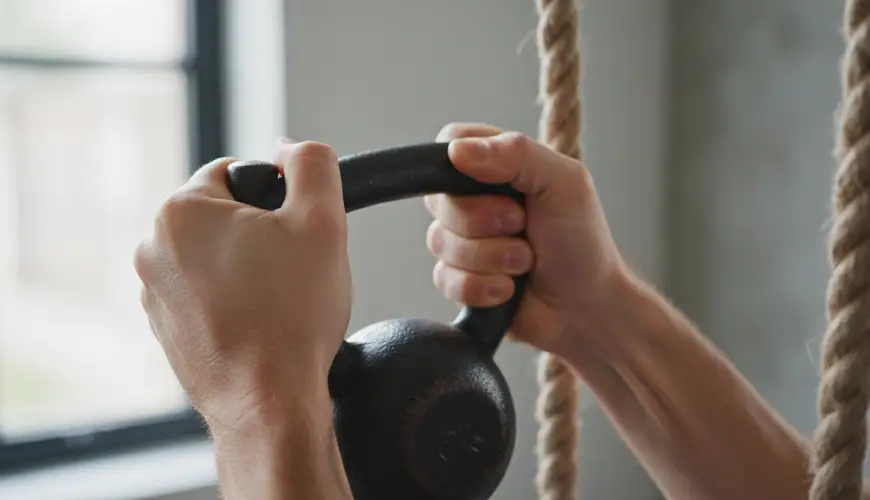
- Kettlebells and dumbbells with thick handles – so-called fat grip training, where a thicker handle diameter significantly increases the demands on grip
- Climbing – whether on an indoor wall or outdoors, this is one of the most comprehensive ways to develop grip strength, endurance and coordination
It is important not to forget stretching and recovery for the muscles of the hands and forearms. Just like any other muscle group, these muscles need time to recover. Regular stretching of the forearm flexors and extensors, massage of the palms and fingers, or working with a massage ball can significantly reduce the risk of overuse and tendon inflammation.
An interesting perspective on grip training is also offered by traditional systems of movement practice. Yoga, which places great emphasis on conscious work with the hands and fingers – so-called mudras and the correct distribution of weight through the palms in positions such as downward-facing dog or plank – naturally strengthens the grip while simultaneously building stability throughout the body. Tai chi and qigong work in a similar way, where gentle hand movements activate muscles that are completely ignored in other sports.
As the legendary strength coach Dan John once noted: "If you want to know how strong a person is, look at their hands." And while these words have a poetic quality, they are backed by solid physiological truth.
Age is no obstacle – quite the contrary. A study published in the Journal of Aging and Health showed that targeted hand training in adults over 65 led not only to improved grip strength, but also to a reduced risk of falls, improved fine motor skills and even positive effects on cognitive function. The connection between hand movement and the brain is no coincidence – the hands are one of the most richly innervated parts of the human body, and their active use literally stimulates brain activity.
For those who want to get started and are not sure how, a simple measurement is a good starting point. A dynamometer – a device that measures grip strength – is available at most physiotherapy practices and sports medicine clinics. Average values vary by age and sex, but as a general rule, grip strength in the dominant hand below 30 kg in men and below 20 kg in women may be a signal to reflect and begin targeted training.
Grip training is not a passing trend or a specialised discipline only for athletes. It is basic care for the body, which pays dividends in the form of better posture, a lower risk of injury, greater independence in old age and – as the scientific data show – a longer and healthier life. At a time when we spend ever more time with phones in our hands and ever less time in genuine physical work, consciously strengthening the hands is one of the most sensible steps you can take for yourself.