

# How Light Pollution and Health Are Connected and What to Do About It ## What Is Light Pollution?
Anyone who grew up in the countryside as a child probably knows the feeling well – lying on your back in the grass, gazing up at a sky scattered with thousands of stars. Today, most people living in cities have almost no experience of this. The night sky above Prague, Brno or Ostrava glows with an orange haze, behind which the stars disappear like candles in fog. This is not merely an aesthetic problem or the loss of a romantic view. Light pollution has demonstrable effects on human health, and that is precisely why this topic deserves our attention.
Light pollution is a term describing excessive, misdirected or unnecessary artificial lighting that disrupts the natural conditions of the nocturnal environment. According to data from Light Pollution Map, Central Europe is among the regions with the highest concentrations of light pollution in the world. Approximately 99% of residents of the European Union and the United States live under light-polluted skies. This is not an abstract figure – behind it lie concrete consequences for sleep, hormones, mental wellbeing and long-term health.
Try our natural products






How artificial light at night confuses our bodies
The human organism evolved over millions of years in the rhythm of alternating light and darkness. This cycle is governed by the so-called circadian rhythm – internal biological clocks that synchronise virtually all bodily functions, from digestion and immune responses to mood. The key player in this system is melatonin, a hormone produced by the pineal gland, whose production is triggered precisely when light levels fall and peaks in the middle of the night.
The problem arises when the brain receives light signals at times when there should be darkness. Blue light – typical of LED diodes, phone and computer displays, and modern street lighting – is particularly insidious in this regard. The receptors in the retina of the eye are extraordinarily sensitive to this part of the spectrum, and even a relatively weak source of blue light in the evening can significantly suppress melatonin production. Research from Harvard Medical School shows that exposure to blue light before sleep can shift the circadian rhythm by several hours and reduce sleep quality in a manner comparable to the effects of mild jet lag.
Shortened or poor-quality sleep is not merely a matter of morning fatigue. Chronic sleep deprivation is associated with a higher risk of obesity, type 2 diabetes, cardiovascular disease and a weakened immune system. The World Health Organisation has classified night-shift work – and therefore prolonged exposure to artificial light at night – as a probable carcinogen. This is a serious claim that deserves attention well beyond the boundaries of specialist scientific circles.
An interesting example is provided by a study conducted in Israeli cities, where researchers tracked the correlation between the intensity of night-time lighting in different neighbourhoods and the incidence of breast cancer. Women living in neighbourhoods with the highest levels of light pollution had a statistically higher risk of developing the disease than women from less illuminated areas – even after accounting for other factors. Of course, correlation is not causation, but the results are sufficiently consistent for the scientific community to take them seriously.
The effects are not only physical. Disrupted sleep and dysregulation of melatonin have a direct impact on mental health. Studies repeatedly show a connection between light pollution and higher rates of depression, anxiety and seasonal affective disorders. People who sleep in rooms with higher levels of light show poorer results in cognitive function tests and report lower subjective wellbeing. This is no coincidence – the brain needs darkness just as much as it needs quiet or rest.
A city without stars: a growing problem
Urbanisation and the expansion of infrastructure bring ever more sources of light. Advertising billboards, illuminated building facades, car parks, motorways, industrial complexes – each of these sources contributes to the overall haze above cities that astronomers call sky glow. This phenomenon is so powerful that light from large cities is visible from hundreds of kilometres away.
Astronomers and ecologists have been sounding the alarm for decades. The International Dark-Sky Association (International Dark-Sky Association) maps areas with minimal light pollution and certifies so-called dark reserves – places where the night sky remains naturally dark. In the Czech Republic, such places exist, for example, in parts of the Šumava or Jeseníky regions, but for most residents they are accessible only as a day trip, not as an everyday reality.
The ecological dimension of the problem is just as serious as the health dimension. Artificial lighting disorients birds during nocturnal migrations, disrupts the reproductive cycles of insects, confuses sea turtles and affects the behaviour of nocturnal predators and their prey. As ecologist Travis Longcore noted: "Light pollution is one of the fastest-spreading forms of environmental degradation, yet we devote a fraction of the attention to it that it deserves." Entire ecosystems are calibrated to the natural cycle of light and darkness, and its disruption has cascading effects that we are only beginning to fully understand.
Nevertheless, the situation is slowly changing in some areas. A number of European cities are switching to intelligent lighting systems that dim streets in the late night hours when traffic is minimal. The Slovak town of Banská Štiavnica, for example, has introduced regulated lighting with a colour temperature adapted to the circadian rhythm. These are small steps, but they show that change is possible.
What can be done at home
Waiting for systemic change is a legitimate stance, but in the meantime much can be done within one's own home. And it is not just about darkening the bedroom – it is about a more comprehensive approach to how we use light in our homes.
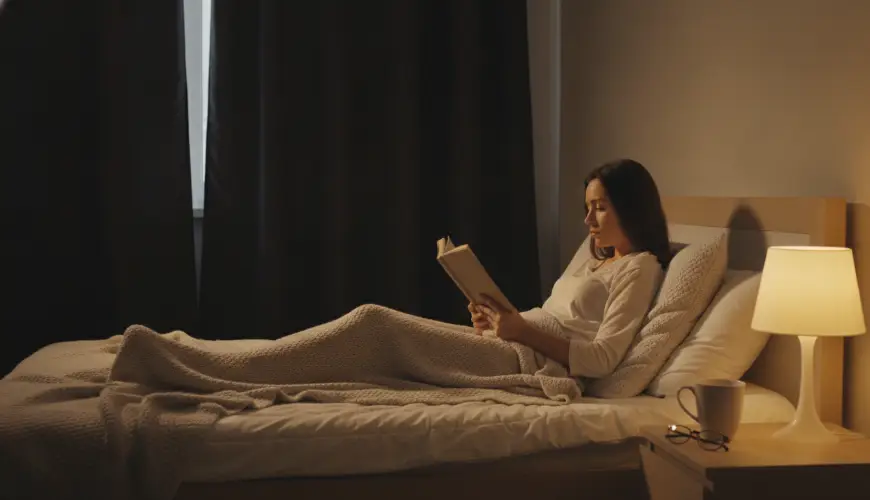
The first and most effective step is limiting exposure to blue light in the evening hours. In practice, this means switching displays to night mode (such as Night Shift on Apple devices or Night Light on Windows), using applications like f.lux, or – even better – putting screens away at least an hour before bedtime. Instead, one can read by the warm light of a candle or a lamp with a low colour temperature bulb (below 2700 K, meaning a warm yellow colour).
The bedroom itself deserves special attention. The ideal sleep environment is as dark as possible – even through closed eyes, since light penetrates eyelids and continues to affect brain activity. Quality blackout curtains or blinds are one of the best investments in sleep quality. If this is not possible, even a simple sleep mask will help. It is also worth removing unnecessary light sources from the bedroom – chargers with LED indicators, televisions on standby, digital alarm clocks with illuminated displays.
For those who want to go further, the choice of lighting throughout the entire flat is also worth considering. Modern smart bulbs allow the colour temperature to be adjusted according to the time of day – cool white light during the day to support concentration, warm orange light in the evening to prepare the body for rest. Such an approach mimics the natural progression of daylight and helps keep the circadian rhythm in balance. Specialised blue-light-blocking glasses are also available on the market, which can be worn in the evening when working at a computer – their effectiveness is confirmed both by users and by a number of clinical studies.
An interesting choice for the home are also beeswax or soy wax candles, which emit very warm light with minimal blue wavelength content. Using them in the evening before sleep is a pleasant ritual that simultaneously serves a practical function – naturally signalling to the body that rest time is approaching. Salt lamps and various types of decorative lighting with a warm spectrum work in a similar way.
When it comes to external light pollution – that is, light entering through windows from the street – blackout curtains are truly irreplaceable. There are versions that combine a blackout function with an attractive design and do not create the impression of a "bunker". Well-chosen curtains can eliminate most of the disruptive light from outside and transform the bedroom into the dark sanctuary it naturally should be.
It is worth remembering children too. Their brains are even more sensitive to light stimuli than those of adults, and yet they are being exposed to screens more and more, and from an ever earlier age. Establishing a "digital sunset" ritual – in which all screen devices are put away about an hour before bedtime – can significantly improve the quality of children's sleep and thereby their attention, mood and overall health.
It is worth noting that approaching light pollution as a problem that can at least be partially addressed at home is not merely a matter of personal comfort. It is a conscious decision to live in harmony with the natural rhythms that our bodies need. In an age when we are surrounded by ever more stimuli and light sources, the ability to create a dark, calm space for rest is actually a form of self-care – just as natural as a healthy diet or physical exercise.
A night sky full of stars may not return to our cities any time soon. But a high-quality dark night at home – that is something everyone can reach out and create for themselves today.