
# Clean Windows Without Streaks and Without Professional Products
Everyone who has ever spent an hour polishing windows only to see streaks across the entire glass in the afternoon sunlight knows how frustrating it can be. The windows look worse than before cleaning, your hand aches, and any motivation to clean is gone. Yet this is one of the most common household problems that a surprisingly large number of people struggle with – and the solution is usually much simpler than it might seem. Cleaning windows without streaks is no rocket science, but it requires a slightly different approach than most households take with their windows.
Streaks on glass typically have three main culprits: an unsuitable cleaning product, poor technique, or the wrong tool. Commercial window sprays are ubiquitous, but few people read their ingredients – and even fewer suspect that these products may be responsible for a large proportion of streaks. Many of them contain silicone or wax, which leave a thin film on the glass. This film is initially invisible, but once dry, it manifests in exactly the way every frustrated cleaner knows all too well. Moreover, such chemical solutions are an unnecessary burden on household waste and the environment – especially at a time when alternatives exist that are both cheaper and more effective.
Try our natural products
Why home remedies work better than you think
One of the oldest and most reliable helpers for washing windows is simple vinegar. Specifically, white distilled vinegar diluted with water in a ratio of approximately 1:1 forms the basis of a cleaning solution that was used long before supermarket sprays came along. Acetic acid effectively dissolves grease, limescale, and residues from previous cleaning products – precisely the layers responsible for streaks. Research and everyday practice both confirm that an acidic environment is ideal for removing mineral deposits left by hard water. The Czech Republic is among the countries with relatively hard water in many regions, making this a very widespread problem here.
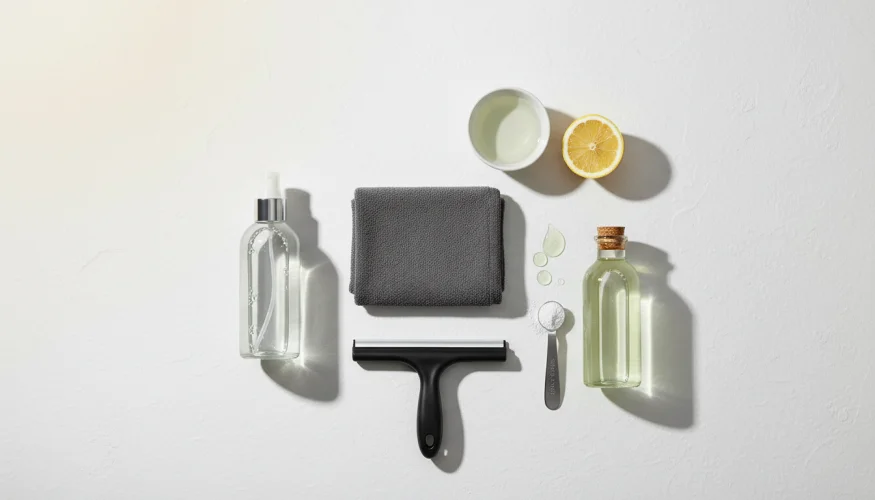
An even more effective variation is adding a few drops of washing-up liquid or another dish soap to the vinegar solution. The detergent helps emulsify grease while also reducing the surface tension of the water, causing the solution to glide more easily across the glass without leaving droplets. You really only need a few drops – too much detergent will cause foaming, which is itself a source of streaks. Practically the same result can be achieved with lemon juice instead of vinegar, which also leaves a pleasant scent and has similar acidic properties.
An interesting alternative that gets less attention is distilled water. In areas where tap water is very hard, simply switching to distilled water can make a significant difference. The minerals in hard water are one of the main causes of streaks – once the water dries, they leave white residue on the glass. Distilled water contains no such minerals, so it leaves no marks when dry. For regular window washing, this is a more expensive option than tap water, but combined with a little vinegar and the right technique, it delivers results that many would only expect from professional cleaning services.
Just as important as the composition of the cleaning solution, however, is what you use to wipe the windows. Paper towels and newspaper are classic tips, but the reality is more nuanced. Newspaper does actually work – the printer's ink has mildly abrasive properties that help polish the glass, and the paper doesn't shed fibres. However, modern newspapers are printed differently than they used to be, and results can be inconsistent. A microfibre cloth is a more reliable choice: it captures dirt at a microscopic level, sheds no fibres, and when used correctly, leaves glass perfectly clean. The key is to wash the cloth regularly – a clogged microfibre cloth behaves like any other dirty rag and tends to smear streaks rather than remove them.
The technique that makes all the difference
Even the best product will fail if applied incorrectly. One of the most common mistakes is washing windows in direct sunlight or in hot weather. The cleaning solution then dries too quickly – before it has had a chance to do its job and before you can wipe it off. The result is inevitable streaks. Ideal conditions are an overcast day, morning, or late afternoon, when the glass is cooler and the solution has time to work.
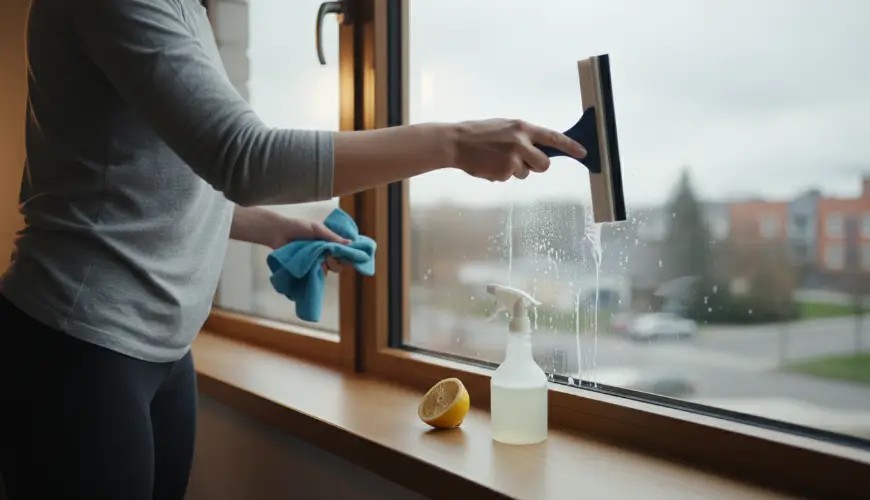
The washing technique itself also has its rules. Professional window cleaners use a squeegee – and for good reason. A rubber squeegee is by far the most effective tool for achieving streak-free glass. The movement should be smooth and in one direction, and after each stroke the squeegee must be wiped with a dry cloth to prevent dirt from being transferred back onto the glass. The "S" motion technique used by professionals allows large areas to be covered without interruption and minimises the risk of streaks at the edges. For home use, a simpler approach is perfectly adequate – horizontal strokes from top to bottom, wiping the squeegee after each pass.
The edges and corners of windows are where streaks most often survive. The squeegee can barely reach these areas, so they need to be finished off with the dry corner of a microfibre cloth or an old cotton rag. Many people skip this step and then wonder why the window still looks unsatisfactory at an angle or in certain light.
The British organisation dedicated to sustainable living, Ethical Consumer, puts it well: "The best cleaning product is the one you actually use – and if it's also kind to the environment, that's just a bonus." This principle applies doubly to window washing, where simplicity and correct technique triumph over a complex chemical arsenal.
Take a specific example: Jana from Brno struggled for years with the windows in her flat with hard water. She tried various commercial sprays, paper towels, and specialist cleaning kits from household goods shops. The result was always the same – streaks in the afternoon light. The turning point came when she tried a simple solution of distilled water, a tablespoon of white vinegar, and two drops of washing-up liquid, applied with a microfibre cloth and wiped off with a rubber squeegee. For the first time in years, the windows were truly transparent. The whole solution cost her a fraction of the price of commercial products and took no longer than her usual cleaning routine.
It is also worth mentioning the important role played by surface preparation. If windows are heavily soiled – for example after winter, after building work, or after a long period without washing – it is not enough to go straight to the final polishing stage. First, coarser dirt, dust, and cobwebs must be removed with a dry cloth or brush. Only then does it make sense to apply the cleaning solution. Skipping this step means the solution will spread dust and dirt evenly across the entire glass surface – resulting in streaks again, this time from smeared dust.
Windows with plastic or wooden frames are a special case. The frames need to be cleaned separately from the glass, and ideally before it, so that dirt from the frames does not get back onto the clean glass. A mild detergent solution works well for plastic frames, while wooden frames require a more careful approach – excessive moisture can damage the wood or cause it to swell. A microfibre cloth that is damp rather than wet is the ideal choice here.
As for frequency, the general rule is that windows should be washed two to three times a year – in spring after the winter season, when dirt from heating and road salt has settled, and in autumn before winter arrives. In areas with heavier traffic, in houses near roads, or in industrial zones, windows may need to be cleaned more frequently. Recommendations from home care experts agree that regular maintenance is always easier than a one-off intensive clean after months of neglect.
It is also worth knowing that eco-friendly approaches to window cleaning are not just a passing trend. Common commercial cleaning products contain substances that enter wastewater after being rinsed away and can burden aquatic ecosystems. Vinegar, lemon juice, and bicarbonate of soda are fully biodegradable, and their production has a significantly lower carbon footprint than industrially manufactured sprays packaged in plastic bottles. For households trying to reduce their environmental impact, switching to home cleaning recipes is a simple and meaningful step – without any compromise in results.
Microfibre cloths are somewhat paradoxical in this regard: they are excellent for cleaning, but release microplastics into wastewater when washed. The solution is to use specialist microfibre laundry bags, such as the Guppyfriend, which capture these particles. It is a small detail, but one that makes a big difference for those who want to be truly thorough.
A clean window is not merely an aesthetic matter. It lets in more natural light, which has a demonstrable effect on the wellbeing and mood of a household's occupants – and in winter months, also on the natural warming of a room by sunlight. Investing in the right technique and simple home remedies thus pays off not only in the form of gleaming windows, but also in lower spending on commercial chemicals, less plastic waste, and a somewhat more pleasant home.