

# Choose the Right Herbal Tea to Calm You Before Bedtime
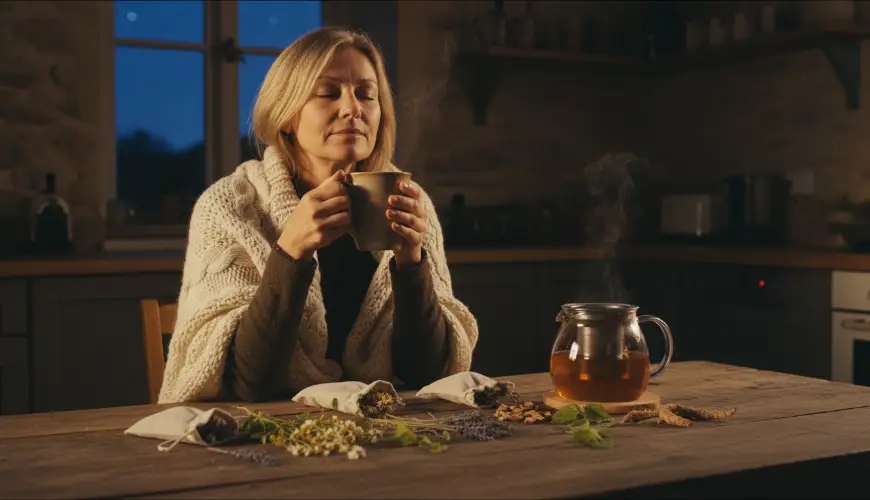
Everyone knows it – a head full of thoughts, a tired body, but sleep simply won't come. Modern life brings a level of stress that our nervous system can't always handle on its own. And it's in moments like these that many people reach for a cup of warm herbal tea, which has become a kind of ritual at the boundary between day and night. This isn't just a romantic habit from grandmother's time – science increasingly confirms that the right combination of herbs can have a measurable effect on sleep quality and evening stress levels.
The question is: which herbs actually work, and how should they be best combined to make the resulting tea as effective as possible?
Try our natural products
Why herb combinations are more effective than individual varieties
The world of herbalism works with the concept of synergy – the idea that a well-composed blend of herbs can be more effective than each herb on its own. This isn't alternative mysticism, but a fairly well-documented phenomenon. Different plants influence different mechanisms in the body: one may lower cortisol levels, another may release muscle tension, and a third may directly support the production of melatonin or serotonin. When you combine these effects, you get a tea that addresses evening restlessness from multiple angles at once.
Imagine a middle-aged woman who can't unwind after a demanding workday. Thoughts keep circling around unfinished tasks, her body is tense, and falling asleep takes hours. She tries a tea made from pure chamomile – with a mild effect. But as soon as she adds lemon balm and a few leaves of valerian to the chamomile, the result is noticeably different. This isn't an anecdote – it's an experience shared by a large number of people who work with herbs regularly.
According to research published in the specialist journal Phytomedicine, combined herbal extracts show better results in many cases for treating anxiety and sleep disorders than isolated active compounds. The whole plant – or a combination of plants – simply works differently than an extracted chemical compound.
The most effective herbs for restful sleep and their combinations
Before we get into specific recipes, it's worth knowing the main players. Common chamomile (Matricaria chamomilla) is probably the best-known calming herb of all. It contains apigenin, a flavonoid that binds to benzodiazepine receptors in the brain – the same sites targeted by certain sedative medications, though with an incomparably gentler effect. Chamomile reduces nervous tension, eases anxiety, and helps the body transition into a resting state.
Lemon balm (Melissa officinalis) is another herb with a rich history of use for insomnia and stress. It contains rosmarinic acid and various terpenoids that inhibit the enzyme that breaks down GABA – the neurotransmitter responsible for calming the nervous system. Simply put, lemon balm helps the brain keep its own "brakes" active for longer.
Valerian (Valeriana officinalis) is a more powerful player. Its root contains valerianic acid and a range of other compounds that demonstrably shorten the time it takes to fall asleep and improve sleep depth. Valerian is more suitable for those who have genuinely significant sleep difficulties – its taste is strong and bitter for many, but the effect is worth it.
Lavender (Lavandula angustifolia) acts primarily through the olfactory system, but in tea form it also has an internal calming effect. Studies from the University of Miami School of Medicine have shown that lavender reduces heart rate and blood pressure, bringing the body into a parasympathetic – that is, relaxed – state.
Passionflower (Passiflora incarnata) is a lesser-known but highly valuable herb for those whose insomnia stems more from ruminating thoughts than from physical tension. Research suggests that passionflower increases GABA levels in the brain and helps quiet the so-called "monkey mind" – that restless internal monologue that keeps many people awake well past midnight.
Finally, small-leaved lime (Tilia cordata) with its delicate white flowers is a classic of Czech folk medicine. Its sedative effects are milder, but they pleasantly complement other herbs. It also has a naturally sweet taste that makes the resulting blend more enjoyable.
Specific herbal tea combinations for relaxation and good sleep
Theory is one thing, practice is another. Here are specific combinations that make sense not only from the perspective of traditional herbalism, but also in light of available scientific research.
The classic trio for mild restlessness – chamomile, lemon balm, and lime blossom – is the ideal choice for those who don't have serious sleep problems but need to unwind after a demanding day. This combination is gentle, tastes pleasant, and can be drunk every evening without concern about habituation or side effects. The recommended ratio is approximately 2 parts chamomile, 1 part lemon balm, and 1 part lime blossom. Pour hot water over it (not boiling – ideally around 90°C) and steep for 7–10 minutes.
The combination for deep sleep – valerian, passionflower, and lemon balm – is suitable for people with more pronounced difficulties falling asleep or for those who wake during the night. Valerian forms the base, passionflower dampens mental activity, and lemon balm softens the overall effect. This blend has a stronger taste and is not suitable before driving or other activities requiring full attention. It's best to drink it 30–45 minutes before your planned bedtime.
The aromatic combination with lavender – chamomile, lavender, and lime blossom – is the choice for those who respond well to scents and want to get the most out of the tea ritual. Lavender in tea is surprisingly subtle and doesn't overwhelm the entire flavour. This trio is also suitable for older children or teenagers (of course, taking age and health status into account).
As herbalist and author Rosemary Gladstar once said: "Herbs are not a substitute for self-care – they are an expression of it." It is precisely this philosophy that underlies why the evening tea ritual becomes something more than just a drinking habit for many people.
Things to keep in mind when preparing and selecting herbs
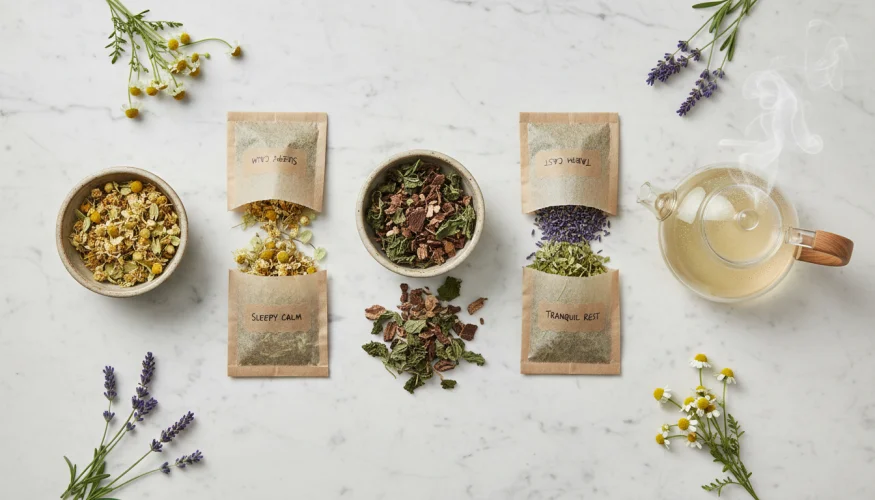
The quality of the herbs used plays a crucial role. Dried herbs from a supermarket in a paper sachet and certified organic herbs from a trusted source can have very different concentrations of active compounds. If you're serious about herbal care, it's worth investing in quality ingredients – whether that means loose-leaf tea or carefully composed blends.
The preparation method also matters. Water that is too hot can destroy some sensitive aromatic compounds, while too short a steeping time won't be sufficient to extract the active substances. The ideal is water at a temperature of 85–95°C and a steeping time of 8–12 minutes, and we recommend covering the vessel so that the essential oils don't escape into the air.
Another aspect that is often overlooked is regularity. Calming herbal teas are not like medications that work immediately on the first use. Their full effect becomes apparent with regular evening drinking over a period of at least two to three weeks, during which the body becomes accustomed to the new ritual and begins to associate it with approaching sleep. This is a combination of physiological and psychological effect – and both are equally valuable.
People with certain health conditions or those taking medications should consult a doctor or pharmacist before regularly drinking stronger herbs (especially valerian or passionflower). Valerian, for example, can enhance the effects of certain sedatives or antidepressants. Pregnant and breastfeeding women should avoid passionflower and valerian altogether.
It's also worth knowing that herbal tea is just one part of a broader picture of sleep hygiene. Research repeatedly shows that combining herbal tea with other habits – such as limiting blue light before bed, maintaining a regular bedtime, or keeping the bedroom cooler – produces significantly better results than any of these interventions on their own. Detailed information on sleep hygiene is offered by the National Sleep Foundation, whose recommendations are based on extensive scientific research.
Ultimately, the choice of herbs and their combinations is also a very personal matter. What works wonderfully for your neighbour may not suit you – and vice versa. That's why it's worth experimenting, observing your own reactions, and gradually putting together your own favourite evening blend. Many people develop their own "signature" over time – a combination that smells right, tastes good, and helps them transition from the pace of the day into a calm evening. And that is one of the greatest pleasures of working with herbs: it's not just about chemistry, but about a relationship – with plants, with yourself, and with the rhythm of your own body.