

What to do when a child won't even taste vegetables
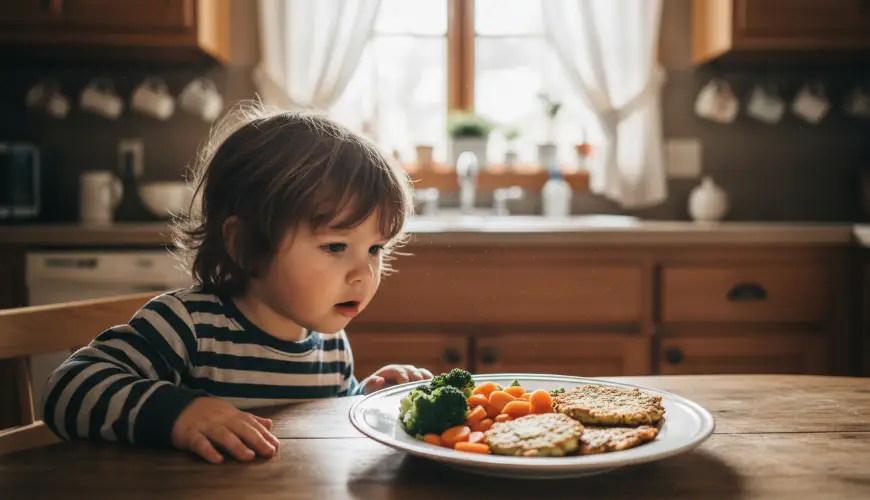
Every parent knows the feeling. A beautifully prepared plate of broccoli, carrots, or perhaps zucchini fritters sits on the table, and the child looks at it as if someone had served them something from another planet. Then comes the decisive "I don't want it" – and the negotiation that leads nowhere begins. Refusing vegetables is among the most common eating challenges families face, and yet it's surrounded by plenty of myths and unnecessary stress. So what should you actually do when your child won't eat vegetables – without pressure and without hiding them?
The answer isn't as simple as it might seem from popular articles that advise "just blend the vegetables into a smoothie and the child won't notice a thing." Hiding vegetables in food may boost vitamin intake in the short term, but in the long run, it won't teach a child to have a positive relationship with vegetables. And pressure? That almost always makes the situation worse. Research in the field of child nutrition repeatedly confirms that pressure around food leads to greater pickiness, not to overcoming it. A study published in the journal Appetite, for example, showed that children whose parents exerted pressure during meals tended to reject new foods even more than children who were given space to make their own decisions.
Before we dive into specific approaches, though, it's worth understanding why children so often refuse vegetables in the first place. It's not a whim, nor is it bad parenting. From an evolutionary standpoint, children are programmed to be cautious about new foods – this phenomenon is technically called neophobia, and it's completely natural. It typically peaks between the ages of two and six and gradually fades. The bitter taste found in many types of vegetables also often signaled poisonous substances in nature, so small children's aversion to broccoli or cabbage makes perfect sense from a biological perspective. As American psychologist and child feeding expert Dr. Dina Rose noted: "The problem isn't that children don't eat vegetables. The problem is how we react to the fact that they don't."
And this is exactly where the path to change begins.
Try our natural products



Why Pressure and Hiding Don't Work
Imagine a typical dinnertime situation. Five-year-old Eliška is sitting in front of a plate of rice, chicken, and steamed carrots. She eats the rice and meat without any issues but systematically pushes the carrots to the edge of the plate. Her mom says: "You're not getting dessert until you eat your carrots." What happens in Eliška's mind at that moment? The carrots become the enemy, an obstacle between her and something pleasant. Dessert becomes a reward, and therefore even more enticing. The value of vegetables drops and the value of sweets rises. The exact opposite effect from what the parent intended.
Systematically hiding vegetables in food is similarly problematic. When a mom blends spinach into pasta sauce so the child won't notice it, she's solving an immediate problem – the child gets some vitamins. But she's not addressing the cause. The child doesn't learn to eat spinach. They don't learn that vegetables can taste good. And worse – if they figure it out, they may lose trust in the food their parents put in front of them. This doesn't mean that adding vegetables to dishes is wrong. The difference is whether you do it secretly or openly. If a child knows there's zucchini in the sauce and eats it anyway, that's an entirely different situation than when they discover it by accident and feel deceived.
But there is a third path that requires neither coercion nor deception. It's slower, it requires patience, but its results are more lasting.
The foundation of this approach is the so-called division of responsibility model, developed by American dietitian Ellyn Satter. The principle is elegantly simple: the parent decides what will be eaten, when, and where. The child decides whether they will eat and how much. This means the parent has full control over what foods appear on the table – and vegetables should always be there. But the decision of whether the child puts vegetables on their plate and actually eats them is up to the child. No persuading, no conditions, no rewards or punishments.
It may sound too permissive, perhaps even risky. But it works, for a simple reason: when the pressure disappears, so does the resistance. A child who knows that nobody is going to force them to eat broccoli can look at it with far less suspicion. And this is where the process experts call repeated exposure begins. Research shows that a child needs to be exposed to a new food an average of 10 to 15 times before they'll taste it – and sometimes many more times than that. Importantly, simply seeing the food on the table counts. A child doesn't have to taste the vegetables to start getting used to them. It's enough that they regularly see them as a normal part of a meal.
What does this look like in practice? The family sits down to dinner, and on the table are several dishes including a bowl of cherry tomatoes or slices of bell pepper. Nobody says "take a tomato." Nobody comments that the child didn't take a tomato. The parents eat vegetables themselves, naturally, without making a big show of it. The child observes, learns, and one day – maybe in a week, maybe in a month – they take a tomato. Or they don't. And that's okay too, because nothing has been ruined and no relationship with food has been damaged.
How to Create an Environment Where Your Child Will Come to Like Vegetables on Their Own
Beyond regular exposure to vegetables, there are many ways to bring children into the world of vegetables without pushing them into it. The key is to engage as many senses as possible and create a positive, playful environment around food.
One of the most effective approaches is involving children in food preparation. A child who helps wash tomatoes, tear lettuce, or stir batter for zucchini fritters has a completely different relationship with the resulting food than a child who simply has a finished plate land in front of them. The point isn't that the child necessarily eats the vegetables – it's that they hold them in their hands, smell them, see how they change during cooking. Sensory experience is the first step toward tasting. Even a three-year-old can help in the kitchen, and the sooner they become part of the cooking process, the more natural tasting will feel to them.
Another effective strategy is growing your own vegetables. You don't need a garden – a pot of cherry tomatoes on the balcony or a window box of herbs on the windowsill is enough. Children who watch a seed grow into a plant and produce fruit develop a much closer relationship with vegetables. According to research by the Royal Horticultural Society, children who participate in growing vegetables are far more likely to taste them than children who first encounter them on a plate.
The way vegetables are served also plays an enormous role. The same carrot can be unacceptable to a child when steamed and soft, but absolutely wonderful when raw and crunchy. Many children prefer raw vegetables over cooked ones – and that's a perfectly legitimate way to eat them. Offer vegetables in different forms: raw with a dip, roasted with a little olive oil and salt, in soup, on pizza, in pancakes. The form of presentation can be decisive. Some children refuse vegetables on a plate but enthusiastically eat carrot sticks with hummus or bell pepper strips dipped in yogurt dip. Dip is truly a magical tool – it gives the child a sense of control while also making vegetables more interesting.
Equally important is leading by example. Children are incredibly observant and imitate the behavior of the adults around them far more than we realize. If a parent doesn't eat vegetables themselves or comments on them negatively, it's hard to expect a child to embrace them enthusiastically. Conversely, when a child sees that parents, older siblings, or friends eat vegetables with enjoyment, the likelihood that they'll taste them themselves is significantly higher. Shared family meals where everyone eats the same thing is one of the strongest factors influencing children's eating habits, as confirmed by data from long-term studies at Harvard University.
One specific real-life story illustrates the power of this approach. The Novák family from Brno was struggling with their four-year-old son Matěj refusing virtually all vegetables. His mom tried everything – hiding them in food, persuading, rewards for tasting. Nothing worked, and the atmosphere at the table grew increasingly tense. On the recommendation of a pediatric nutrition therapist, they tried changing their approach. They stopped commenting on Matěj's refusal of vegetables, began offering vegetables in small bowls as part of every meal without any expectations, and involved him in cooking. After three weeks, Matěj tasted raw bell pepper for the first time. After two months, he was regularly eating carrots, cucumber, and cherry tomatoes. Not because he had to, but because he wanted to.
One more aspect worth mentioning that is often overlooked: the emotional atmosphere at the table. Mealtimes should be a pleasant social experience, not a battlefield. The moment the table turns into a place of negotiation and tension, the child begins to associate food with negative emotions – and this applies not just to vegetables but to food in general. If conflicts are addressed during meals, if a child is criticized or ridiculed for their food choices, it can lead to a problematic relationship with food that persists into adulthood. Conversely, a calm, friendly atmosphere where food is discussed positively and without pressure creates a space in which a child is willing to experiment.
As for specific tips that can help parents on the journey toward their children accepting vegetables naturally, several simple principles have proven effective:
- Offer vegetables repeatedly, but without comment and without pressure
- Serve them in various forms and combinations – raw, roasted, in soup, with dip
- Involve children in shopping for, choosing, and preparing vegetables
- Eat vegetables yourself and talk about them positively but naturally
- Don't link vegetables to rewards or punishments
- Be patient – change can take weeks or even months
It's understandable that parents feel anxious when their child refuses an entire food group. Concerns about adequate intake of vitamins and minerals are legitimate. If a child consistently refuses not only vegetables but also fruit, and their diet is significantly limited, a consultation with a pediatrician or pediatric nutrition therapist is certainly warranted. In the vast majority of cases, however, refusing vegetables is a developmentally normal phase that will pass with the right approach.
The path to getting a child to eat vegetables isn't a sprint but a marathon. It doesn't lead through ultimatums at dinner or secretly blended broccoli. It leads through patience, repetition, positive example, and trust that the child is capable of learning to eat a varied diet – if we create the right conditions for them. And perhaps that's the most important lesson our children give us at the dinner table: that real change comes when we stop pushing and start trusting.