

Water retention in the body as part of the female cycle

The feeling that your body has suddenly "puffed up," that your ring won't turn and your shoes seem a size too small – many women know this all too well. Water retention is a phenomenon that troubles women across all age groups, and although it is completely natural, it can be unpleasant, frustrating and sometimes even painful. Yet few people know that behind this seemingly trivial problem lies a complex interplay of hormones, lifestyle and the female cycle that deserves deeper understanding.
Water retention, medically referred to as oedema or fluid retention, occurs when the body accumulates excess fluid in the tissues instead of continuously eliminating it. The result is swelling, a feeling of heavy legs, a bloated abdomen or a puffy face upon waking in the morning. Although fluid retention can have more serious causes, such as kidney, heart or thyroid disease, in the vast majority of cases it is a functional response of the organism to hormonal changes, dietary habits or lack of physical activity.
Try our natural products

How the female cycle influences water retention
The connection between women's health, the cycle and water retention is inseparable. Hormonal fluctuations that accompany the menstrual cycle are one of the most common triggers of fluid retention in women. Two hormones play a key role here – oestrogen and progesterone – whose levels change significantly throughout the cycle.
In the second half of the cycle, namely the luteal phase, which begins after ovulation and lasts approximately until the start of menstruation, progesterone levels rise. This hormone has, among other things, the ability to influence the balance of sodium and water in the body. Just before menstruation, progesterone levels drop sharply, while oestrogen may relatively dominate – and it is precisely this hormonal imbalance that causes the body to begin retaining more fluid. Many women notice in the last week before menstruation that their weight has increased by one to three kilograms without having changed their diet or exercise habits.
This phenomenon is so widespread that it has its own name: premenstrual fluid retention. It is part of the broader spectrum of premenstrual syndrome (PMS) symptoms, which according to estimates by the World Health Organization affects up to 75% of women of reproductive age to varying degrees of intensity. Breast tenderness, a bloated abdomen, a feeling of heaviness in the legs – these are accompanying symptoms that women know well and which typically subside on their own with the onset of menstruation.
It is important to know that this water retention is not a signal of fat gain or a failure of the body. It is a natural physiological response that has its logic in the evolutionary history of the human organism. During the luteal phase, the body prepares for a possible pregnancy, and a mild fluid retention is part of this preparation. Once fertilisation does not occur and menstruation arrives, the excess water is naturally released from the body.
However, this does not mean that nothing can be done about the unpleasant symptoms. On the contrary – understanding the cycle and adapting one's lifestyle to its individual phases can significantly reduce the intensity of fluid retention and overall improve women's health and wellbeing throughout the entire month. It is precisely on this principle that the concept of cyclical self-care is based, which in recent years has been gaining increasing attention both among experts and among women themselves.
Take the example of thirty-year-old Kateřina, who works in an office and had long suffered from severe PMS. Every month in the last week before menstruation she felt bloated, tired and irritable. It was only when she began tracking her cycle and adapting her diet, exercise and rest to it that she found the symptoms significantly reduced. "I couldn't believe what a difference it can make simply knowing which phase of your cycle you're in," she described her experience. Her story is not exceptional – it is typical of thousands of women who are gradually discovering what a powerful tool of self-knowledge the female cycle can be.
What to do about water retention: natural approaches that work
The most common mistake women make when dealing with water retention is restricting their fluid intake. The logic seems straightforward – the less I drink, the less water my body will retain. But the opposite is true. Insufficient fluid intake is perceived by the body as a threat and it begins to retain water even more intensively. Adequate hydration – ideally with plain water or herbal teas – conversely helps the kidneys work efficiently and eliminate excess fluids.
Diet composition also has a significant impact. Excessive salt intake, meaning sodium, is one of the main causes of fluid retention regardless of the phase of the cycle. Sodium binds water in the body and its excess causes the kidneys to be unable to eliminate the excess fluid in time. Industrially processed foods, fast food, processed meats, canned goods and salty snacks contain enormous amounts of sodium – and their consumption tends to be highest during the premenstrual period, when women experience increased cravings for sweet and salty foods.
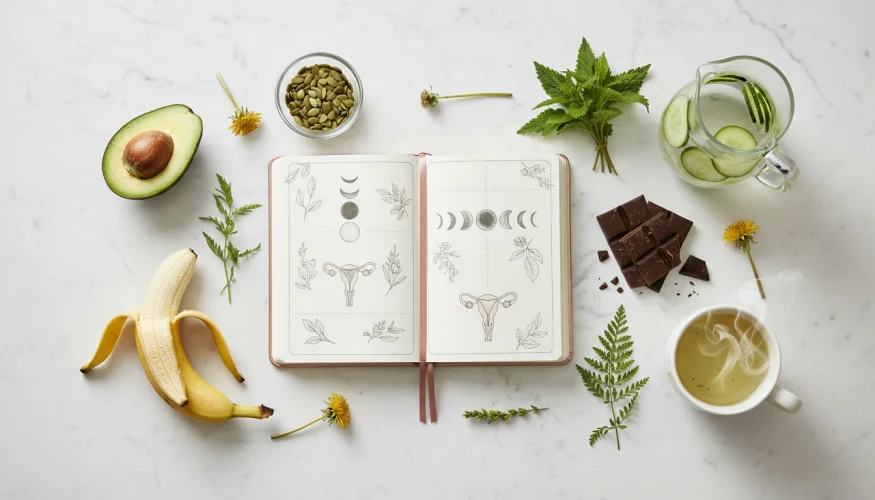
In contrast, foods rich in potassium help balance the sodium equation and naturally support the elimination of excess water. Bananas, avocado, sweet potatoes, leafy vegetables, beans or nuts are excellent sources of potassium and should form a regular part of the diet, particularly in the second half of the cycle. Magnesium works similarly, and its deficiency is very common in women with more pronounced PMS – magnesium helps regulate hormonal balance and reduce inflammation, which promotes fluid retention. Dark chocolate, pumpkin seeds, spinach or wholegrain cereals are natural sources of this mineral.
Herbal support has a long history in the traditional approach to women's health. Stinging nettle is considered one of the most effective naturally diuretic plants – it supports kidney function and helps the body rid itself of excess water. Horsetail, dandelion and green tea work similarly. These herbs can be consumed in the form of teas or extracts, and their regular inclusion in the diet can bring noticeable relief.
Movement is another powerful ally in the fight against fluid retention. Physical activity stimulates the lymphatic system, which plays a key role in draining excess fluids from tissues. It need not be intense exercise – brisk walking, yoga, swimming or stretching are absolutely ideal choices during the luteal phase of the cycle, when the body naturally has lower energy reserves. Conversely, prolonged sitting or standing in one place worsens fluid retention, as it hinders proper circulation.
As Hippocrates aptly noted: "Let food be thy medicine and medicine be thy food." This thought holds true in the context of water retention as well – what we eat and how we live has a far greater influence on our hormonal system and overall women's health than we are willing to admit.
Also worth mentioning is the influence of stress, which tends to be overlooked in discussions about fluid retention. Chronic stress raises cortisol levels, the stress hormone which, in conjunction with aldosterone – the hormone regulating the balance of sodium and water in the body – directly promotes fluid retention. Women who are under prolonged stress may therefore suffer from water retention practically throughout the entire month, not only in the premenstrual period. Stress management techniques such as meditation, breathing exercises, adequate sleep or time spent in nature are therefore not a luxury, but an integral part of comprehensive women's health care.
It is also worth mentioning the role of quality sleep. During sleep, the body regulates hormonal secretion, including the hormones responsible for fluid balance. Lack of sleep disrupts this regulation and can contribute to more pronounced fluctuations throughout the cycle. Women who sleep fewer than seven hours per night statistically experience more severe PMS symptoms, including stronger fluid retention.
If symptoms of water retention persist after menstruation, are very intense, or are accompanied by pain, significant swelling of one limb or shortness of breath, consultation with a doctor is always appropriate. These symptoms may indicate a more serious health condition requiring professional care. For common functional fluid retention associated with the cycle, however, natural approaches – proper hydration, a balanced diet, movement, herbal support and psychological wellbeing – represent a safe and effective path to alleviating discomfort.
The female cycle is not a weakness or an obstacle – it is a sophisticated system which, when properly understood, can serve as a guide to a woman's own body. Water retention is just one of many signals that the body sends, and learning to read them is the first step towards feeling well in one's own skin – every day of the month, not only on the days when one feels "at the top."