

# How to Manage a Sick Child and Work at the Same Time
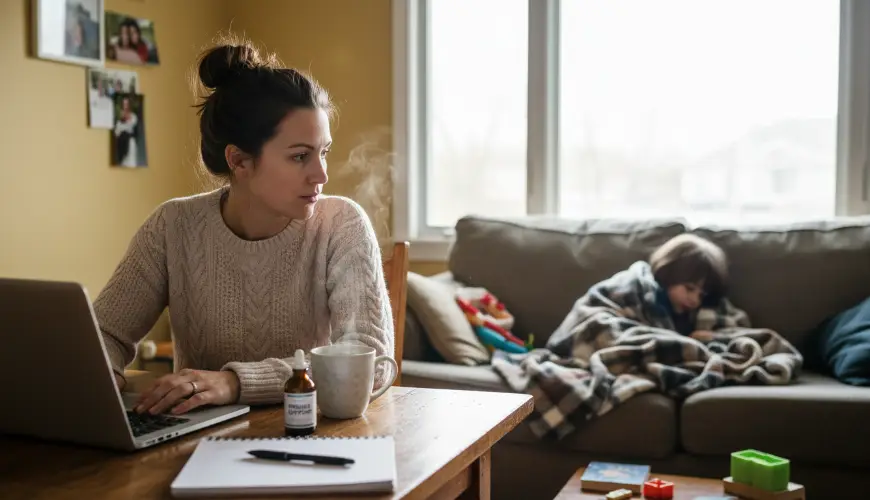
Every parent knows it. In the morning you're getting ready for work, packing your bag, when your child suddenly appears with red eyes, a fever, and a nose full of mucus. You have no time off, a meeting is scheduled, the boss is waiting – and you're standing in the middle of the kitchen not knowing where to start. Situations where you need to manage a sick child and work at the same time are among the most stressful moments of parenting life. Yet there are ways to get through it with minimal losses – for the child, for yourself, and for your employer.
The Czech Republic offers parents specific legal tools in such situations. The so-called nursing benefit, or OČR (caring for a family member), allows employees to stay home with a sick child under 10 years of age for up to 9 calendar days, or up to 16 days for single parents. The benefit amounts to 60% of the daily assessment base, which is not a full salary, but at least provides a basic financial safety net. Detailed information about the conditions and amount of the benefit can be found directly on the website of the Czech Social Security Administration. Unfortunately, not every parent can afford even this partial loss of income, so many look for alternative solutions.
Try our natural products





Working from home as a lifeline – but with conditions
If your job position allows remote work, working from home during a child's illness can seem like an apparently ideal compromise. The reality, however, is more complex. A three-year-old with a fever won't last an hour alone in a room just because you have a video call. An older school-age child can stay in bed with a tablet for longer, but will still call out, need tea, medicine, or simply the presence of a parent. Productivity during such "multitasking" naturally declines, especially for work requiring concentration or creative thinking.
Yet working from home can work – but only if approached with a sensible strategy. Experienced parents recommend dividing the day into blocks: use the morning, when the child is sleeping or resting after medication, for the most demanding work tasks. Handle phone calls and emails during calmer moments. It is also crucial to communicate openly with your employer – explain the situation in advance, offer specific deliverables rather than hours worked, and agree on realistic expectations. Most reasonable employers will appreciate honesty far more than silent struggling that ultimately leads nowhere good.
It is also important to set clear but gentle boundaries for the child. Even young children are capable of understanding that "mum or dad is working now, but will come soon." Short but quality breaks – a story together, warm tea, a moment of cuddling – can give the child enough reassurance and give the parent the peace they need for focused work.
Take Martina, a mother of two from Brno, who works as a freelance graphic designer. When her seven-year-old daughter falls ill, Martina divides her day into three blocks: she works for two hours in the morning while her daughter sleeps after medication, takes a break in the afternoon to devote herself fully to her daughter, and finishes remaining tasks in the evening after the child falls asleep. "It's not ideal," she admits, "but it works. And most importantly – my daughter feels my presence, even when I'm working." This approach isn't for everyone, but it illustrates that with a little organisation, a way can be found even on difficult days.
When to ask for help and who to turn to
One of the biggest mistakes parents make in such situations is the belief that they must handle everything on their own. Yet it is precisely a network of mutual support – whether family, friends, or neighbours – that can be absolutely crucial when a child is ill. Grandparents who are able and willing to help are worth their weight in gold. But friends or neighbours who offer to bring groceries or watch an older sibling for a while should not be turned away out of false pride.
There are also paid alternatives. Agencies offering care for sick children at home are not yet as widespread in the Czech Republic as in Western Europe, but their numbers are slowly growing. Services such as short-term care from vetted nannies or specialised care for sick children can be a lifesaver in situations where the nursing benefit is insufficient or when a parent simply cannot leave work. Prices naturally vary, but investing in such help can be entirely justified in a critical moment.
Employers play a crucial role in the whole equation. A corporate culture that penalises parents for a child's illness is not only unethical but also harmful to the companies themselves in the long run – it leads to higher employee stress, lower loyalty, and ultimately greater staff turnover. Conversely, companies that offer flexible working hours, the option to work from home, or so-called "family leave" build a stronger and more dedicated team. As the International Labour Organization (ILO) notes, investment in family care pays off for companies in the form of higher productivity and lower absenteeism.
If your employer does not yet offer such options, a child's illness can paradoxically be an opportunity for an open conversation about more flexible work arrangements. Not every manager responds positively, but many – especially if you present a concrete proposal for how to fulfil work obligations even in non-standard situations – are willing to seek a compromise. The approach of "coming with a problem and a solution at the same time" tends to be far more effective than simply announcing an absence.
Taking care of your own mental health is also an indispensable part of the whole situation. Parents who strive to be excellent employees and perfect carers at the same time are under enormous pressure. Feelings of guilt – whether towards the sick child or towards colleagues who take on part of the workload – are entirely natural, but they should not grow into chronic stress or burnout. A parent who breaks down helps no one. A short meditation, a walk, a phone call with a friend, or just five minutes of quiet with a cup of tea can work wonders for restoring inner balance.
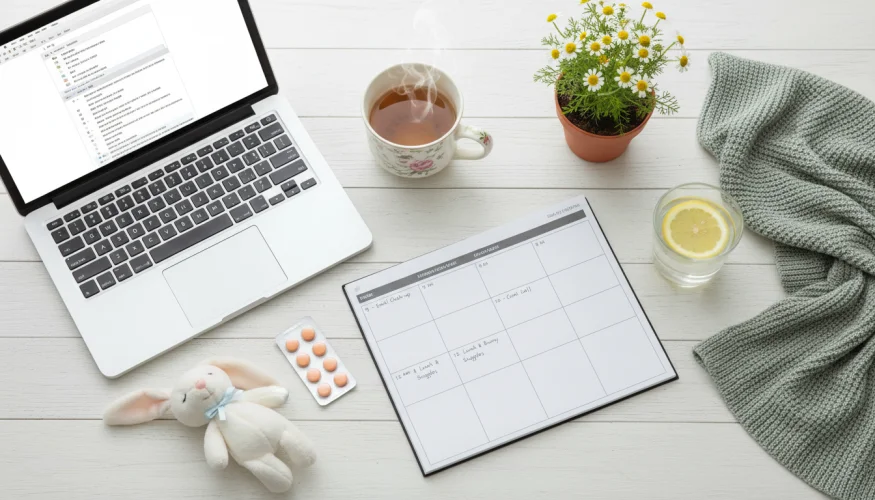
Indeed, it is precisely on such difficult days that it becomes clear how important it is to have a home environment that feels calm and supportive – not only for the sick child, but for the parent as well. Natural scents, quality herbal teas, a pleasant environment – seemingly small things that help make harder moments more bearable. For example, soothing herbal blends or natural remedies for boosting immunity can be part of a home medicine cabinet that helps the family get through periods of illness more quickly and naturally.
When it comes to caring for a sick child, the basic rules are well known but worth repeating. Sufficient fluids, rest, an appropriate room temperature, regular ventilation, and monitoring of symptoms are the fundamentals. Paediatricians repeatedly point out that antibiotics are not a solution for viral infections, which make up the vast majority of childhood illnesses, especially in autumn and winter. The Czech Paediatric Society offers parents comprehensive information on the most common childhood illnesses and their proper treatment on their website. Unnecessarily administering medications that won't help the child only prolongs recovery and burdens the body.
In the long run, it is also worthwhile to think preventively. Building the resilience of a child's immune system is not a matter of one vitamin or a miracle supplement, but of an overall lifestyle. A varied diet rich in vegetables and fruit, sufficient physical activity, quality sleep, and limiting unnecessary stress – these are factors that science repeatedly confirms as key to a healthy immune system. Parents who apply these principles in their family's everyday life can save themselves several difficult sick weeks throughout the year.
It is equally important to build a good reputation and relationships at work before a sick-child situation arises. An employee who is reliable, communicative, and willing to help colleagues during their own difficult moments can count on a greater degree of understanding and solidarity in a critical moment. Work relationships function similarly to all others – investment in them pays off in hard times.
A child's illness is simply part of parenthood that cannot be planned for or eliminated. The average pre-school-age child will experience, according to estimates from the World Health Organization, six to eight respiratory infections per year – meaning that every parent of a young child will encounter this situation repeatedly. The better prepared they are – practically, organisationally, and psychologically – the better they will handle it. And a child who, during illness, feels the presence, calm, and love of their parent, recovers more quickly and with a greater sense of security. In the end, that is what matters most.