

Try homemade fruit leathers instead of candy

Who could resist sweet temptation? Sweets, jelly, chocolate bars – shop shelves are full of treats that promise instant pleasure. But behind that sweet façade lurk kilograms of added sugar, artificial colours and preservatives that do the body little good. And this is precisely where homemade fruit leathers come in – delicate, naturally sweet alternatives that can satisfy a sweet tooth without bringing unnecessary chemicals along. This is no passing trend, but rather a method of preserving fruit that people have known for centuries.
Fruit leathers, sometimes also referred to as fruit skins or dried fruit sheets, are made by slowly drying fruit purée or thin slices of fruit until they achieve a flexible, chewy consistency. The result is surprisingly similar to commercial fruit bars or chewy sweets – but without additives, without glucose-fructose syrup and without empty calories. The whole process is surprisingly simple and can be managed by virtually anyone who has access to an oven or a food dehydrator.
Try our natural products



Why homemade fruit leathers are better than shop-bought sweets
To understand the true benefit of homemade fruit leathers, one need only look at the ingredients of an average bag of sweets. Sugar or glucose-fructose syrup typically tops the ingredient list, followed by various types of gelatine, acids, colourings and flavourings. According to the World Health Organization, the intake of free sugars should not exceed ten percent of total daily energy intake – ideally no more than five percent. A single average bag of sweets can easily exceed this recommended limit.
Homemade fruit leathers, by contrast, contain only what you yourself put into them. The base consists of fresh or frozen fruit, optionally supplemented with a little lemon juice to preserve colour and flavour. No added sugars are necessary – ripe fruit is sweet enough on its own. Moreover, it retains its fibre, vitamins and antioxidants, which disappear during the industrial processing of sweets long before the product reaches the shelf.
Interestingly, fruit leathers also have a psychological effect. Thanks to their chewy consistency, eating them takes longer than consuming ordinary sweets, giving the brain more time to register satiety. This effect is confirmed by numerous studies focused on mindful eating – for example, research published in the journal Appetite repeatedly shows that slower eating leads to lower overall energy intake.
A practical example might be a family that decided to reduce sweets for their children. Rather than banning sweets altogether, they began making a batch of homemade fruit leathers from strawberries, mango or raspberries once a week. The children quickly grew fond of not only the treats themselves, but also the shared cooking experience – and the parents had the assurance of knowing exactly what their little ones were eating.
How to prepare homemade fruit leathers: from fruit to finished treat
Preparing homemade fruit leathers requires no special skills or expensive equipment. The basic procedure is the same regardless of which fruit you choose: the fruit is blended into a smooth purée, strained if necessary to remove seeds, and then spread onto a baking tray lined with baking paper or a silicone mat. The layer should be even and approximately three to four millimetres thick – too thin a layer burns easily, while too thick a layer will not dry evenly.
Drying in the oven takes place at a low temperature, ideally between 60 and 80 degrees Celsius, for four to eight hours. It is advisable to leave the oven door slightly ajar so that moisture can escape. Those who own a food dehydrator have an even simpler route – a temperature of around 55 degrees and six to ten hours of work, with the dehydrator handling all concerns about moisture regulation on its own.
The choice of fruit is almost unlimited. Strawberries, raspberries, blueberries and apricots are among the most popular choices for their intense flavour and natural sweetness. Mango and peaches add a tropical touch, while apples provide a gentler, more subtle aroma. Excellent results can also be achieved with combinations – such as strawberry with basil or raspberry with lemon zest. This creative freedom is one of the greatest advantages of homemade production: no commercial manufacturer will offer you precisely the combination that suits your taste preferences.
Finished leathers should be flexible and slightly sticky to the touch, but should not tear or feel gritty. If they are still wet or too soft, they need more time in the oven. Conversely, over-dried leathers are brittle and crumble – they are still edible, but lose that characteristic chewy texture that makes them so enjoyable. Once cooled, the leathers simply need to be cut into strips or rolled up, and they are ready to eat or store.
Storage is straightforward: an airtight container or glass jar in a cool, dry place will keep fruit leathers fresh for two to four weeks. In the refrigerator they will last even longer, and in the freezer for several months – so it is worth preparing a larger batch at once and keeping a supply on hand.
As American author and nutrition expert Michael Pollan once said: "Eat food. Not too much. Mostly plants." Homemade fruit leathers embody this philosophy literally – they are real foods, minimally processed, derived entirely from plant sources.
The question naturally arises as to whether fruit leathers are suitable for children or people monitoring their sugar intake. The answer is broadly positive, but with one caveat: even the natural sugars found in fruit are still sugars, and fruit leathers should therefore form part of a varied diet rather than its foundation. For diabetics or people with insulin resistance, it is advisable to consult a doctor or nutritional adviser about incorporating fruit leathers into their diet, particularly when it comes to fruit with a higher glycaemic index, such as mango or banana.
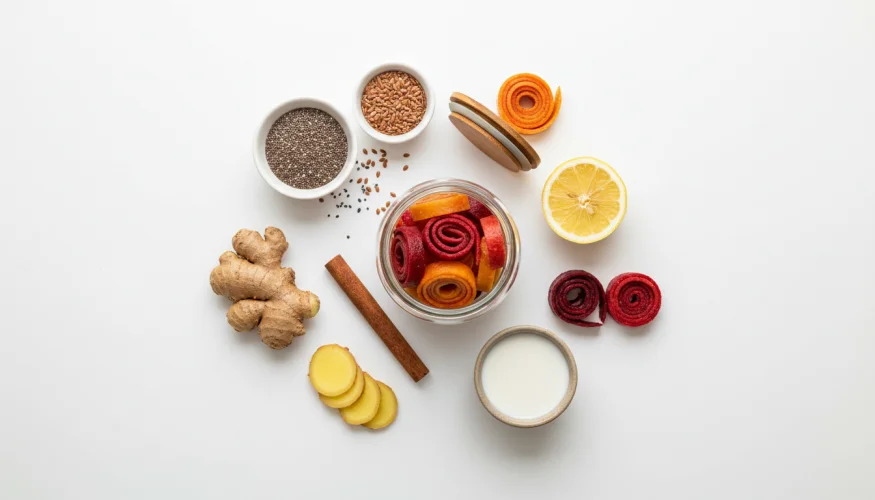
An interesting option is also to enrich fruit leathers with additional health-promoting ingredients. Chia seeds or flaxseeds mixed into the purée will increase the content of omega-3 fatty acids and fibre. A pinch of cinnamon or ginger adds not only an interesting flavour but also anti-inflammatory compounds. Coconut milk or almond butter can create a creamier texture and add healthy fats. Leathers enriched in this way are then not merely a sweet treat, but a genuinely nutritious snack.
For those interested in sustainability and ecology, homemade fruit leathers have one further hidden benefit: they are an excellent way to use up fruit that would otherwise end up in the bin. Overripe strawberries, soft peaches or bananas with brown spots are less appealing for fresh consumption, but are ideal for fruit leathers – their intense sweetness and soft texture make them easier to process, and the resulting flavour is more pronounced. This naturally connects homemade fruit leather production with the philosophy of zero waste and the effort to reduce food waste, which is increasingly important today.
It is worth noting that similar fruit-drying techniques are used across cultures throughout the world – from Turkish pestil to Armenian pomegranate lavash to the Mexican rolled fruit treat known as rollo de guayaba. Each culture has developed its own version, adapted to locally available fruit and tastes. This tradition is therefore no modern health-lifestyle trend, but rather a deeply rooted way of preserving seasonal abundance for leaner times.
Today, when shops are stocked year-round with fruit from around the world, this approach takes on a new dimension: it is less about necessity and more about conscious choice. The decision to swap industrially produced sweets for homemade fruit leathers is a small but meaningful step towards a more mindful way of life – towards greater control over what we eat, where it comes from and what it does to our bodies. And since it involves a treat that genuinely tastes good, there is no reason to put this step off.