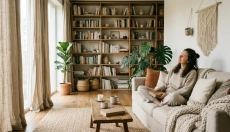

Subtle lighting changes the atmosphere of your home
Light is one of the most underestimated elements of interior design. Most people think about furniture, wall colors, or decorations, but consider lighting only as an afterthought – and yet it is precisely lighting that determines how we feel in a room. Soft lighting, warm tones, and well-chosen light fixtures can transform an average apartment into a cozy home where people genuinely enjoy spending time. It's not magic or an expensive renovation. It's the science of light and its effect on human psychology.
Everyone knows this from personal experience. You come home after a long day, turn on the cold overhead light, and instead of relaxation, you feel only fatigue and irritability. Then you remember a weekend spent in a mountain cottage, where candles burned and lamps emitted a warm glow – and suddenly you felt like talking, laughing, and resting. The difference between these two scenarios wasn't in the room itself, but in the lighting.
Try our natural products






Why light has such an impact on our mood
The answer lies in biology. The human brain is programmed to respond to light in ways that have evolved over thousands of years. Intense blue light – typical of fluorescent tubes or cool LED bulbs – is interpreted by the brain as daytime and stimulates the production of cortisol, the hormone of alertness and stress. Conversely, warm, dim light signals to the body that evening is approaching and triggers the release of melatonin, the hormone of rest. This response is completely automatic and unconscious – the brain reacts to light before we even become aware of it.
Research in the fields of chronobiology and neuroscience repeatedly confirms that the quality and temperature of light directly influences not only mood, but also productivity, sleep quality, and even appetite. For example, a study published in the Journal of Environmental Psychology showed that people in rooms with dim lighting felt more relaxed and creative than those sitting under bright overhead lights. It's therefore not just about aesthetics – it's about health and wellbeing.
Interestingly, in Nordic countries, where winters are long and dark, the question of home lighting is taken with utmost seriousness. The Danish concept of hygge – a feeling of coziness, wellbeing, and shared joy – is largely built on light. Candles, dimmed lamps, warm light sources distributed throughout the room. Danes are among the happiest nations in the world, and their relationship with light in the home is no coincidence.
The circle of lights as a path to a harmonious space
One of the most effective tools for transforming the atmosphere of a home is the so-called circle of lights – layering multiple light sources at different heights and positions so that light surrounds the space from all sides and doesn't emanate from a single point. This approach, which architects and interior designers have used for ages, is based on a simple principle: one strong overhead light creates a flat, unwelcoming environment, while several smaller light sources distributed around the perimeter of a room create depth, warmth, and intimacy.
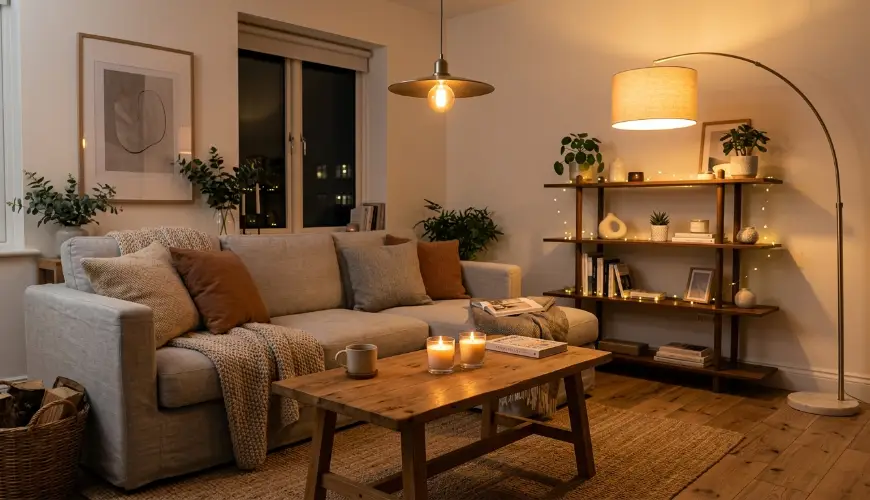
Imagine a living room where only a single chandelier in the middle of the ceiling is lit. Light falls from top to bottom, casting sharp shadows, and the entire space feels like an office or a hospital waiting room. Now imagine the same room where the chandelier is dimmed to a minimum, a floor lamp with warm light stands in the corner, small fairy lights glow on a shelf, and two candles burn on the table beside the sofa. The room is the same, the furniture is the same – but the atmosphere is completely different. That is the power of the circle of lights.
This approach is neither complicated nor financially demanding. The key is combining three types of lighting that designers call ambient, task, and accent. Soft lighting in the form of the ambient component forms the foundation – it doesn't fill the space with harsh brightness, but creates a soft, even glow. To this are added spotlights for reading or cooking, and decorative elements that add character.
A practical example might be a family living in a panel apartment with standard overhead lighting in every room. Although the apartment was well-furnished, it always had a somewhat sterile atmosphere – they never felt as comfortable there as at friends' homes or in their favorite café. After consulting with an interior designer, they made one fundamental change: they added supplementary light sources in all rooms, fitted the overhead lights with dimmers, and replaced the bulbs with warm LED variants with a color temperature of around 2700 K. The result was remarkable – the apartment hadn't changed, but suddenly it was cozy, calm, and pleasant. Visitors began commenting on how good they felt there.
How to achieve soft lighting in practice
Transitioning from harsh overhead lighting to a layered, softer alternative doesn't necessarily require structural work or major investment. It's enough to start gradually and think about each room separately, because each space has different needs and a different rhythm of use.
In the living room, the goal is to create a space where you can relax, but also entertain guests or watch a film. The ideal combination is dimmable ambient lighting complemented by a floor lamp in the corner and several smaller light accessories – fairy lights, candles, or decorative luminaires. The light temperature should not exceed 3000 K, ideally ranging between 2200 and 2700 K, which corresponds to the color of a candle or a sunset.
The bedroom deserves special attention, as it is the space where the body prepares for sleep. Strong overhead lighting in the bedroom is one of the most common causes of sleep problems – the brain receives a signal that it is still daytime and refuses to calm down. The solution is bedside lamps with warm light, or alternatively smart bulbs that can be programmed to gradually reduce intensity and shift to warm tones in the hours before bedtime. The World Health Organization and sleep medicine experts repeatedly warn that exposure to blue light in the evening disrupts the circadian rhythm and impairs sleep quality.
The kitchen is unique in that people need good task lighting for food preparation, but also want the space to feel pleasant during meals. The solution is a combination of bright spotlights above the work surface and warm decorative lighting above the dining table. Pendant lamps with warm light or candles work particularly well above the table – they literally bring food to life and give shared meals the atmosphere of a restaurant.
When it comes to specific products, the market offers an enormous range of options – from simple fairy lights and candles to designer lamps and smart lighting systems that can be controlled via phone. When choosing, it is essential to pay attention not only to design, but also to the color temperature of the light (measured in Kelvin) and the Color Rendering Index (CRI), which indicates how faithfully the light renders the colors of objects. The higher the CRI (ideally above 90), the more natural everything in the room illuminated by that source will appear.
The writer and philosopher Johann Wolfgang von Goethe, who devoted his entire life to the theory of colors and light, once wrote: "Light is the first painter of the world." This thought applies equally to nature and to the home interior – light determines how things look, how we perceive them, and how we feel in their presence.
An important but often overlooked aspect of working with light is natural daylight. Mirrors strategically placed opposite windows can double the amount of natural light in a room. Light-colored walls and glossy surfaces reflect light and spread it into corners that would otherwise become dark, unpleasant recesses. Curtains and drapes made from light, translucent materials allow daylight to pass through while still ensuring privacy – unlike heavy, dark fabrics, which visually shrink the room and weigh it down.
A special category involves seasonal changes in lighting. In autumn and winter, when natural light is scarcer, the psychological impact of home lighting is amplified. These are precisely the months when symptoms of Seasonal Affective Disorder (SAD) most commonly appear – fatigue, depressive moods, and loss of energy. Experts recommend using special light therapy lamps with an intensity of at least 10,000 lux during the darker months, but it is equally important to create a home environment that compensates for the lack of natural light with coziness and warmth. The circle of lights, layered lighting, and warm tones become, during the winter months, a literal tool for mental health care.
The trend of a conscious approach to lighting is growing hand in hand with the general interest in a sustainable and healthy lifestyle. People increasingly perceive their home as a sanctuary, a place for regeneration and restoration of energy – and light is one of the simplest and most accessible ways to build this sanctuary. There is no need to renovate an apartment, buy new furniture, or spend large sums of money. It is enough to think about light differently – not as a functional tool for visibility, but as a living element of the interior that shapes the atmosphere, influences emotions, and creates the story of every home.
The circle of lights that surrounds a space from all sides, soft lighting that doesn't broadcast stress but calm – these are simple principles with a profound impact. And perhaps it is enough to start with just one new lamp in the corner of the living room to understand how much light determines how we feel at home.