

# How to Sort Waste Correctly Without Unnecessary Doubts
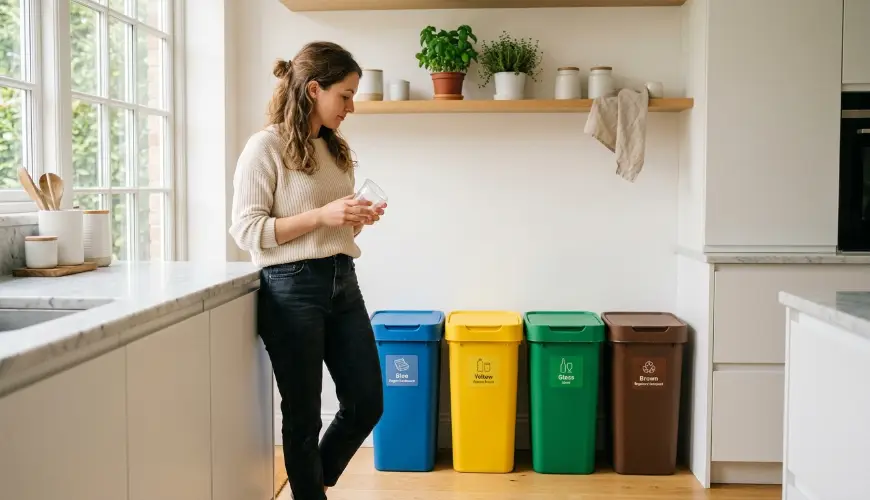
Every one of us knows this feeling. You're standing over a rubbish bin with an empty yoghurt container, a crumpled piece of aluminium foil, or a broken headphone, wondering where it actually belongs. Sorting waste sounds simple – after all, coloured bins are now a fixture in every housing estate and village – yet in practice, many people run into questions that nobody has properly answered for them. So everything ends up in the black bin, because that feels like the safest option. But this very uncertainty is one of the greatest enemies of genuine waste sorting.
The Czech Republic is among the European countries with a relatively well-developed waste sorting infrastructure, yet according to data from the Czech Statistical Office, a large proportion of recyclable materials still ends up in landfills or incinerators simply because people fail to sort them correctly. It's not laziness – it's primarily an information gap. The sorting system is not as intuitive as it might initially appear, and the rules can vary from one municipality to another.
Try our natural products
Basic rules that will spare you unnecessary doubt
Before we dive into the specific pitfalls, it's worth reminding ourselves of the basic logic behind the whole system. The coloured bins are not arbitrary – each colour corresponds to a different material. The blue bin is for paper, the yellow one for plastics and metals, the green (or white) one for glass, and the brown one for organic waste. The grey or black bin is for residual waste – for everything that genuinely cannot be recycled or otherwise reused.
The key rule worth remembering first is: packaging should be empty, dry, and as clean as possible. You don't need to wash it to a shine like dishes, but food residue or liquid can contaminate an entire batch of recyclable material. Dirty plastic or paper complicates processing and, in the worst case, causes the entire bin's contents to be treated as general waste – which is precisely where you didn't want it to end up.
Another important principle is separating materials. Composite packaging – that is, packaging made from multiple different materials bonded together – is a mystery to many people. A typical example is juice or milk cartons, known as Tetra Paks. These go into the yellow bin, even though they are partly made of paper. Why? Because the separation of their individual layers takes place during an industrial process, and the sorting system is designed to handle this.
Let's now look at the specific things that cause people the most confusion – and there are surprisingly many of them.
Plastic bags and film are one of the most common sources of bewilderment. They go in the yellow bin, but only if they are clean. Film from a buttery wrapper or a bag from frozen minced meat covered in blood does not belong there. The same applies to yoghurt or soft cheese pots – simply rinse them with water and they can go into the yellow bin. Add plastic lids as well, but metal lids (such as those from glass jars) also go in the yellow bin, because in the Czech Republic, metals and plastics share a single container.
Paper seems straightforward, but there are traps here too. The blue bin accepts newspapers, magazines, cardboard boxes, notebooks, and advertising leaflets. However, it does not accept greasy paper from pizza or pastries, waxy paper (such as some butter wrappers), napkins, or paper tissues. These are biologically contaminated and do not belong in paper recycling. The same goes for photographic paper or till receipts – these contain chemical substances that complicate recycling.
Glass is perhaps the most straightforward category, yet it has its own specifics. Bottles and jars go in the glass bin, but not ceramics, porcelain, mirrors, or car glass. These materials have different compositions and melting temperatures, and would contaminate an entire batch of recycled glass. The same applies to light bulbs and fluorescent tubes – these go to a specialist collection point because they contain hazardous substances.
What to do with things that don't belong in any bin at all
Now we come to the truly tricky part – waste that simply does not belong in any of the standard bins, and yet people regularly throw it in the black bin as a last resort. Yet for most of these items, there is a specific and accessible solution.
Electronics and electrical appliances – from an old mobile phone to a broken hairdryer to a non-functioning fridge – belong in what is known as e-waste. This is collected at recycling centres or in special bins that are now available in many supermarkets. Under the European directive on waste electrical and electronic equipment (WEEE), manufacturers and retailers are obliged to accept items for take-back, so when purchasing a new appliance, you have the right to hand in the old one directly in the shop.
Medicines that have passed their expiry date or unused pharmaceutical products are another problem. These should never go down the toilet or into general waste – they contain pharmaceutical substances that can contaminate soil and groundwater. Hand them in at a pharmacy, which is legally required to accept them and ensure their safe disposal.
Batteries and accumulators go into the special red or orange containers found in supermarkets, schools, or municipal offices. They contain heavy metals such as lead, cadmium, or mercury, the release of which into the environment can have serious ecological consequences. Nevertheless, surveys suggest that a large proportion of batteries in the Czech Republic still end up in ordinary bins.
Clothing and textiles, even if torn or otherwise beyond repair, do not belong in the black bin. Textile collection bins are distributed throughout the country, where you can deposit both clothing intended for further wear and textiles for recycling into rags or insulation materials. Sustainable clothing consumption is one of the key issues of our time – the Ellen MacArthur Foundation states that every second, an amount of textiles equivalent to a full lorry ends up in landfill or an incinerator.
Hazardous waste – paints, thinners, motor oils, pesticides, or cleaning products bearing warning symbols – must go exclusively to a recycling centre or to a mobile hazardous waste collection point, which municipalities organise on a regular basis. Pouring these substances down the drain or throwing them in the bin is not only environmentally irresponsible but also illegal.
Imagine a situation that is entirely common in Czech households: a mother doing her spring clean comes across a box containing old medicines, two dead batteries, a broken tablet, leftover wall paint, and a bag of old clothes. If she threw everything into the black bin, she would be making five separate sorting mistakes at once. Yet the solution is relatively straightforward – the pharmacy, supermarket, recycling centre, and textile bin are now accessible in virtually every larger town and smaller village alike.
What should you do when you genuinely don't know what to do? There are useful tools that can advise you specifically for your local area. The Kde třídit app or the website jaktridit.cz, run by EKO-KOM, offers a clear sorting guide including a search function for the nearest collection points. Simply enter the name of the material or product and the system will tell you where to take it.
It is also worth mentioning that the rules can differ between municipalities. Some cities have organic waste collection directly from households, others collect metals separately from plastics, and some municipalities have special bins for cooking oil. It is always worth checking the local conditions – you can find information on your municipality's website or by contacting the local technical services.
As the pioneer of the circular economy Walter Stahel once said: "Waste is a raw material in the wrong place." And it is precisely this idea that captures the entire philosophy of sorting – it is not a bureaucratic obligation, but an awareness that most of what we throw away has the potential to become a valuable raw material once again.
Waste sorting is not rocket science, but it does require a little patience and a willingness to learn a few basic rules. The biggest mistake is to give up at the first moment of doubt and throw everything into the black bin. A much better strategy is to accept that a certain degree of uncertainty is natural, and to gradually build habits rooted in understanding rather than fear of making a mistake. Because even incomplete sorting is better than none at all, and every correctly sorted bottle, box, or battery has a real impact on the amount of waste that ends up in landfill.
If you are interested in sustainable living beyond just waste sorting, it is also worth thinking about what you buy and how it is packaged. Choosing products with minimal or recyclable packaging, buying in larger quantities, or preferring reusable alternatives are steps that address the problem of waste at its very source – and that is always more effective than even the best sorting at the end of a product's life cycle.