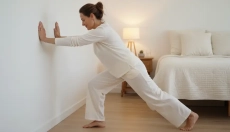

Rotation of the thoracic spine will improve your posture
We sit at computers, stare at our phones, drive cars – and our backs have been patiently putting up with all of it for years. But patience has its limits. Rounded back, forward head posture, pain between the shoulder blades – these are signals the body sends when passive rest is simply not enough. It needs movement. Specifically, one of the most underrated movements of all: thoracic spine rotation.
Most people who come to a physiotherapist with back pain share a common denominator. Their thoracic spine barely moves. Stiff as a board, locked in a forward bend, unable to rotate in either direction. And it is precisely this loss of mobility that is one of the main causes of what is commonly called a rounded back – clinically referred to as thoracic hyperkyphosis.
Try our natural products




What happens to the thoracic spine when we sit all day
The thoracic spine forms the middle section of the spinal column and consists of twelve vertebrae. Unlike the cervical or lumbar spine, it naturally curves slightly backward – this curvature is called kyphosis. The problem arises when this natural curve stops being mild and becomes pronounced. At that point, we speak of hyperkyphosis – that characteristic rounded back posture that is so widespread today that many people consider it a normal part of ageing or an inevitable consequence of office work.
But that is not true. Rounded back is not inevitable. It is the result of specific movement habits – or rather, their absence. When the thoracic spine remains in one position for an extended period, the anterior muscle fibres in the chest shorten, the muscles of the interscapular region weaken, and the entire upper trunk becomes "stuck" in a forward bend. Thoracic spine rotation becomes nearly impossible, and that is the moment when problems go beyond aesthetics and progress into pain, restricted mobility, and in extreme cases even breathing difficulties.
Take the example of a thirty-year-old graphic designer who works eight to ten hours a day at a computer. After a few years, they start noticing neck and shoulder pain, difficulty turning their head when reversing a car, and a sense – when looking in the mirror – that their posture has "slumped" forward. A physiotherapist measures their thoracic spine mobility and finds that rotation is limited to just thirty percent of the physiological norm. This is precisely where rehabilitation begins – and precisely where thoracic spine rotation exercises play a key role.
As the American Academy of Orthopaedic Surgeons points out, long-term overloading of the spine in a poor position can lead not only to pain but also to structural changes that are then difficult to correct. Prevention and regular movement are therefore far more effective than any subsequent treatment.
Why thoracic spine rotation matters so much
Thoracic spine rotation is not just about being able to turn around and hand something from the back seat of a car. It is a movement that fundamentally affects the functioning of the entire body. The thoracic spine is the centrepiece of the kinetic chain – it connects the upper and lower body and is involved in every complex movement, from walking and sport to simply tidying the house.
When the thoracic spine rotates properly, it relieves load on the cervical and lumbar spine, which would otherwise have to compensate for its stiffness. This is why people with a stiff thoracic spine so often suffer from neck or lower back pain – their body tries to find movement wherever it can, even at the cost of overloading other structures. As the saying goes in the rehabilitation world: "Movement will always be found – just not always where we want it."
Regular thoracic spine rotation exercises therefore do not only help the back. They release tension in the shoulders, improve breathing (because the chest can expand more fully), reduce headaches caused by tension in the cervical region, and significantly improve overall posture. The effects are visible even without instruments – it is enough to compare photographs taken before starting the exercises with those taken after a few weeks of regular practice.
Thoracic spine mobility is not only a concern for young athletes. Research repeatedly shows that even older adults can significantly improve their range of motion in the thoracic region with regular and correct exercise. A study published in the Journal of Physical Therapy Science confirms that targeted thoracic spine exercises lead to measurable improvements in mobility even in people over sixty.

Exercises for rounded back: how to start and what works
The good news is that training thoracic spine rotation requires no expensive equipment or hour-long gym sessions. All you need is a mat, a little space, and the willingness to dedicate ten to fifteen minutes a day to it. The key, however, is correct technique – because a poorly executed exercise can deepen stiffness further or transfer movement to somewhere other than intended.
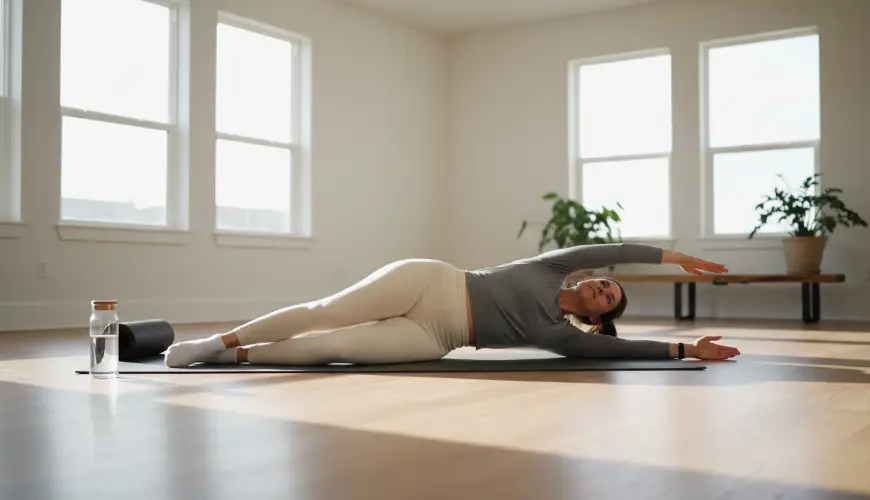
One of the most effective and accessible exercises is the side-lying rotation, also known as "open book." The person lies on their side, bends their knees to approximately a right angle, and extends both arms in front of them. The bottom hand stays on the floor, while the top hand slowly moves in an arc over the body to the other side – as if opening a book. The movement originates from the thorax, not from the shoulders or lower back. The lumbar spine remains as still as possible. This gentle thoracic spine rotation is an excellent starting point for anyone just beginning to work on mobility.
Another popular and highly effective exercise is seated rotation on a chair or fitball. The person sits upright, crosses their arms over their chest or places their hands behind their head, and slowly rotates the trunk alternately to each side. The important thing is to keep the pelvis firmly in place and isolate the movement to the thoracic region. When performed correctly, the person should feel a pull and release between the shoulder blades – exactly where most people accumulate tension from prolonged sitting.
For more advanced practitioners, rotation on all fours is a suitable option. One hand is placed behind the head, the elbow points toward the ceiling, and the trunk slowly rotates so that the elbow traces the largest arc possible. This variation requires somewhat more core stability, but also allows for a more pronounced and deeper thoracic rotation.
Exercises that help combat rounded back also include:
- Thoracic spine extension over a foam roller – slowly rolling over a foam roller in the thoracic region releases stiffness and helps restore the natural curvature
- Cobra and sphinx – gentle yoga backbends that stretch the front of the chest and strengthen the spinal extensors
- Strengthening the interscapular muscles – exercises such as "W" or "Y" in a lunge position help stabilise the shoulder blades and maintain an open chest position
One fundamental rule applies to all these exercises: movement should not be painful. A pleasant pull or a feeling of release is desirable; sharp or shooting pain is a signal that the exercise needs to be modified or that a specialist should be consulted.
Interestingly, proper thoracic spine training has a positive effect not only on the musculoskeletal system but also on mental wellbeing. An upright, open posture influences hormone production and overall self-confidence – this connection between posture and psychological state is discussed, for example, in research by Amy Cuddy of Harvard University, summarised in her popular TED Talk on the power of posture.
Consistency is more important than intensity in this context. Ten minutes every day will yield significantly better results than an hour of exercise once a week. The thoracic spine needs repeated stimuli to "remember" the new range of motion and gradually become more mobile. Just as stiffness developed over years, resolving it is also a matter of weeks and months – but the changes are real and lasting.
Rounded back is not fate. It is a habit. And like any habit, this one can be changed – you just need to know where to start. Thoracic spine rotation is precisely that first step, and it is worth taking before pain starts speaking louder than reason.