

Pomegranate has effects that you will appreciate when you incorporate it into your regular diet.
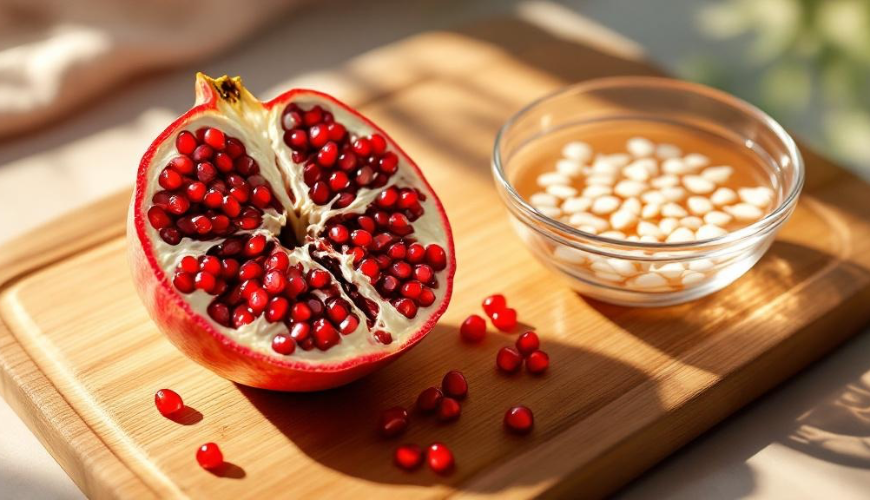
In recent years, the pomegranate has made its way from exotic shelves into everyday kitchens. At first glance, it looks a bit mysterious: a hard rind, inside hundreds of shiny "rubies," and juice that can stain fingers and cutting boards. Yet people return to it again and again — partly because of its flavor, which is both sweet and tangy, and partly because of its often-touted health benefits. So what are the effects of pomegranate, how do you actually eat a pomegranate, how to peel a pomegranate without a mess, and where in the kitchen does it make sense to add it? And are there any side effects to be aware of?
Pomegranate and Its Effects: Why It's So Talked About
The pomegranate (Punica granatum) is not just a "pretty fruit for salads." It's a natural source of several bioactive compounds, especially polyphenols. In practice, this means it's often mentioned in connection with antioxidant effects, helping to protect cells from so-called oxidative stress. Oxidative stress is one of the mechanisms associated with aging and various lifestyle-related issues. It's not a magical shield, but rather another piece in the mosaic of a diverse diet.
When talking about the effects of pomegranate, three areas are most often highlighted: heart and blood vessels, inflammatory processes in the body, and support for overall vitality. Scientific studies usually focus either on pomegranate juice or extracts, but for the average person, the simple message is that within a balanced diet, pomegranate can be a tasty way to increase the intake of plant protective substances.
Authoritative sources, such as review articles in academic databases (e.g., PubMed), describe the polyphenol content and its potential health connections. Well-processed reviews can be found here: https://pubmed.ncbi.nlm.nih.gov/ (search "pomegranate polyphenols review"). For a more general framework on healthy eating and the importance of fruits and vegetables, it's sensible to refer to the recommendations of the World Health Organization: https://www.who.int/news-room/fact-sheets/detail/healthy-diet.
What does this mean in a typical day? Pomegranate often comes in handy when one doesn't just want "something sweet," but rather a fresh taste that can be combined with savory dishes. And that's its subtle advantage: it supports diversity. A varied diet is more important for health than chasing after a single "superfood."
It might sound overly simple, but sometimes that's all it takes: adding a handful of seeds to lunch or a snack, instantly making the meal more interesting, colorful, and often reducing the craving for sweets. "The best diet isn't the perfect one on paper, but the one you can live with long-term." And pomegranate fits quite well into that approach.
How to Eat a Pomegranate and Peel It Without Unnecessary Mess
The most common question is surprisingly practical: how do you eat a pomegranate when there aren't traditional segments like in an orange? The good news is that you mainly eat its seeds surrounded by juicy pulp — these are called arils (commonly just "seeds"). The white inner membrane is not eaten, as it tends to be bitter. The hard outer rind is, of course, also not eaten.
And now the main thing: how to peel a pomegranate so that the kitchen doesn't look like it was hit by a raspberry bomb. There are several methods, but one proves effective repeatedly because it's clean and quick:
First, cut off the "crown" at the top (just a thin layer of the rind). Then make shallow cuts on the rind from top to bottom along the natural "ribs" — usually 5 to 6. It's important not to cut deeply into the seeds. Then, carefully open the fruit into sections. At this point, the seeds can be relatively easily removed with fingers.
Those who want even less juice on their hands can use the water trick: submerge sections of the pomegranate in a large bowl of water and "pluck" the seeds out under the surface. The pulp sinks to the bottom, and the white membranes often float. Finally, just strain. The result is surprisingly clean, and the cutting board stays in better condition.
In real life, it looks something like this: on a Sunday afternoon, a quick lunch is being prepared at home, there's a cutting board, a bowl, and one piece of fruit that's been waiting for a few days. Instead of ending up forgotten in the bowl, it transforms into a handful of ruby seeds in three minutes. Half goes into a salad, the other half into yogurt. Kids usually enjoy "fishing" the seeds with a spoon, and adults appreciate that it's sweet and tangy without being overly sweet. And when done in water, there’s almost no trace left on the kitchen counter.
One more common uncertainty: should the seeds be chewed or spit out? It depends on the variety and personal preference. The seeds are edible; some are harder, others softer. Many people chew and eat them, while others prefer to spit out the seeds and savor just the juice. From a comfort and nutritional perspective, it's common to eat the seeds, but it's not mandatory.
What Dishes to Add Pomegranate to So It Tastes Good and Makes Sense
Pomegranate is interesting because it doesn't only fit into sweet dishes. Its taste can "cut through" richer foods, enliven a plain salad, and add flair to recipes that might otherwise seem flat. Those wondering what dishes to add pomegranate to are often looking for inspiration that's not complicated and doesn't seem like a "fad."
It works wonderfully in simple combinations. In yogurt or kefir, it creates a contrast to the mild flavor and adds pleasant juiciness. On oatmeal, it can replace some of the sweeteners — it's not sugar, but the naturally sweet flavor is suitable, especially when nuts or cinnamon are added. In fruit salads, pomegranate doesn't get lost; instead, it often elevates a regular mix to "something extra" because the seeds pleasantly pop between the teeth.
Even more interesting is its use in savory cuisine. The seeds fit well in vegetable salads (such as with arugula, spinach, roasted pumpkin, or beetroot), where they add a striking accent in both color and flavor. In combination with legumes (lentils, chickpeas), they add freshness and help the dish feel lighter. In some Middle Eastern cuisines, pomegranate is used in sauces or as a topping on finished dishes — often a small amount is enough to enhance the flavor.
For those who don't want to devise anything complicated, remember this simple logic: pomegranate is excellent where something tangy and juicy would be fitting. Sometimes it replaces lemon, other times it complements vinegar in a dressing, and often it just "lifts" the taste of an already prepared dish.
One practical list of inspirations is enough to start right away:
- Breakfast: plain yogurt/coconut yogurt, oatmeal, chia pudding, cottage cheese with nuts
- Lunch and dinner: salad with leafy greens, roasted vegetables, lentil salad, couscous or bulgur, hummus as a topping
- Quick snacks: on avocado toast, in smoothies (more as a topping than blended), in a fruit bowl
In the kitchen, pomegranate juice is sometimes also considered. It's tasty but tends to be more concentrated in sugars than the whole seed, and you lose some fiber. If consumed, it should be treated similarly to other fruit juices: it can be part of the diet, but it's not an "unlimited healthy drink." This is why utilizing the whole seed makes more sense — it's more filling and usually more natural.
And what about storage? Whole fruits last for several days to weeks at room temperature (depending on ripeness), often longer in the fridge. Peeled seeds are better stored in a sealed container and eaten within a few days. For those who like to plan ahead, they can also be frozen — they will be softer upon thawing, but still suitable for porridge or yogurt.
When talking about health benefits, one often forgets an important aspect: the food must be practical. Pomegranate sometimes has a reputation for being a "labor-intensive fruit," but once you find your peeling method and a few favorite combinations, it starts to make sense even in a typical week. And perhaps that's its biggest trick — it naturally encourages you to slow down for a few minutes, prepare something nice, and eat more mindfully. Not a small feat in a time when lunch is often rushed at the keyboard.
Side Effects of Pomegranate and When to Be Cautious
Alongside praise, it's fair to discuss the flip side. Side effects of pomegranate are not common for most people, but there are situations when it's wise to be cautious.
In sensitive individuals, consuming larger amounts may cause digestive discomfort — bloating, abdominal pressure, or diarrhea, similar to other fruits. It depends on the amount and overall diet composition. If eating pomegranate for the first time after a long period, it's sensible to start with a smaller portion.
Some individuals might experience an allergic reaction, although it's not common. If itching in the mouth, rash, or swelling occurs after consumption, it's advisable to avoid the fruit and consult a doctor if more severe symptoms arise.
Special attention should be given to interactions with medications. Pomegranate (especially in juice or extract form) is sometimes mentioned in relation to affecting the metabolism of certain medications — similar to grapefruit, although the mechanisms and potency may differ. If someone is taking medication for blood pressure, cholesterol, or drugs with a narrow therapeutic range, it's safer to discuss regular consumption of concentrated forms (juice, supplements) with a pharmacist or doctor. A typical serving of seeds in food usually doesn't pose a problem, but dietary supplements involve higher doses.
Finally, a practical detail that might seem trivial but is common in households: the juice stains strongly. It can leave marks on clothing and wooden cutting boards. It's helpful to work on a plate, use an apron, and rinse the cutting board immediately. It's not a health risk, but it can be discouraging — and it would be a shame for the pomegranate to lose out just because of a few drops.
Thus, the pomegranate remains a fruit that is both beautiful and useful: offering an interesting taste, diversity in the kitchen, and a decent nutritional profile. Those who learn how to peel a pomegranate without stress quickly find that it can be eaten much more frequently than just "at Christmas." And when combined with common sense — moderation, awareness of one's body, and caution with concentrated products — it can become a small but pleasant ritual that enriches both the plate and the day.