
How to Create a Healthier Relationship with Consumption That Will Relieve Both Your Household and Mi
Consumption is a peculiar mirror of the times. On one hand, it offers comfort, speed, and the feeling that we have things under control. On the other hand, it can subtly grow into a state of "always missing something"—whether in the kitchen, bathroom, or in our heads. However, the question of how to create a healthier relationship with consumption doesn't necessarily mean a radical cut, ascetic life, or a competition to produce the least waste. More often, it's about a slight change in perspective: stopping self-punishment, stopping comparisons, and starting to notice what is truly useful, what only calms nerves, and what is merely a habit.
It may sound paradoxical, but people often arrive at lower consumption when they allow themselves to slow down. Not to be "eco-friendly enough," but so that life at home functions normally—without cluttered cabinets, without perpetual restocking, and without guilt over something not lasting. This is where the desire for simplicity naturally meets what is nowadays referred to as zero waste naturally: not as a perfect system, but as a practical and humane style.
Try our natural products

Healthier Relationship with Consumption: Less Pressure, More Clarity
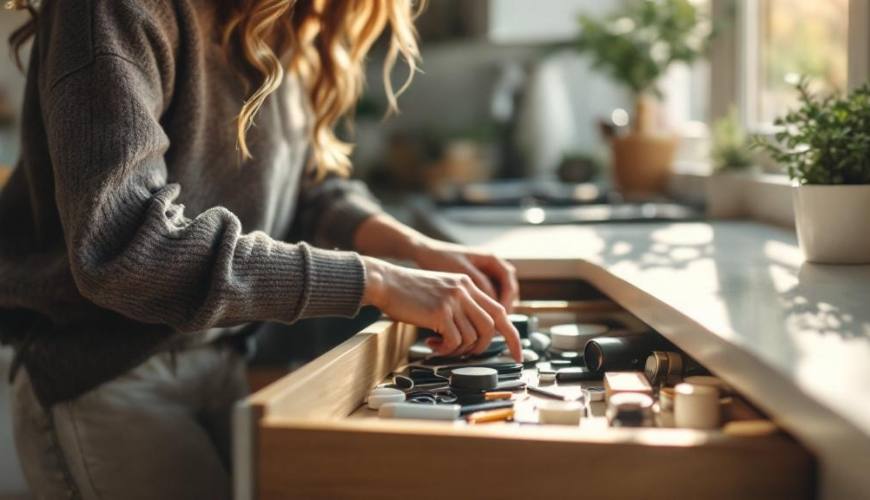
It often starts subtly. One day, a drawer of "useful things" is opened, spilling out three spare cables, four pens, five cosmetic samples, and a box that was kept "for something." At other times, expired food is found during cleaning because it was bought in bulk, but life moved on. In such moments, it's less about morality and more about information: consumption doesn't align with what is actually used.
A healthier relationship with consumption is fundamentally about two things—attention and kindness. Attention means noticing what comes into the home and why. Kindness means not punishing oneself for past purchases but learning from them. When lower consumption becomes a contest or punishment, it doesn’t last. When it becomes a way to relieve oneself, it starts making sense.
A simple question that helps in almost any situation: does it really solve a problem, or does it just create the feeling that something is happening? For some purchases, the answer is clear—the detergent is finished, the shoes fell apart. For others, it's a gray area: "a new scent for the home," "another mug," "a cream that might be better than the current one." And it is in this gray area that the greatest potential for change lies, without the need for dramatic prohibitions.
Interestingly, this topic is not just a "modern trend." A credible framework is offered by the waste management hierarchy long used by the European Union—the most important is to prevent waste generation, then reuse, recycle, and finally deal with the rest. This principle is clearly explained, for instance, on the European Commission's pages on waste and circular economy. Translated into everyday language: the best waste is that which does not arise at all—and often, this requires less automatic shopping.
Yet reality intervenes: stress, work, family, fatigue. That's why it's useful to think about changes that don't require extra energy. How to have lower consumption at home and in life without pressure? By choosing a few habits that naturally reduce chaos and save time—and thus sustain themselves.
A quote often repeated in this context goes: "It's best not to add more rules, but to remove unnecessary steps." And that's precisely it. Most people don't need a new list of duties. They need less decision-making and fewer small "quick fixes" that then accumulate at home.
Zero Waste Naturally: When Sustainability Doesn't Look Like a Project
The idea of zero waste sometimes unnecessarily intimidates because it evokes images of jars with perfectly arranged legumes and a home without a single piece of plastic. Yet, zero waste naturally can be understood differently: as the ability to use things longer, buy fewer "one-time" solutions, and have a system at home that works even on a Monday evening when there's no energy for grand ideals.
Very often, it turns out that the biggest difference is made by a few subtle changes that are repeated every week. It's not about having everything perfect immediately, but about reducing the volume of things the household constantly has to deal with: packaging, unnecessary duplicates, short-lived products, impulsive "just in case" purchases.
In real life, this might look like this: a family with children notices that most waste and expenses arise around snacks and quick dinners. Not because they eat poorly, but because they often buy small packages, drinks in PET bottles, and disposable packaging "on the go." Instead of a revolution, they introduce two things: they have one shelf with long-lasting "rescue" foods (pasta, tomatoes, legumes, oats) and a few reliable containers and bottles that are actually used. After a month, they find that less is thrown away, there are fewer trips "just for something," and there's less stress in the evening. Without big speeches about ecology, something important happened: consumption aligned with reality.
This naturalness is key. A sustainable habit is one that doesn't require constant self-control. For example, when cleaning at home is simplified, it's easier to stick with more environmentally friendly products—not because "you have to," but because it's more pleasant. Similarly, with cosmetics: fewer products that are actually used often mean less waste and less chaos in the bathroom.
For credibility, it's good to remind that waste is not just an aesthetic problem. According to the United Nations Environment Programme (UNEP), one of today's big issues is not only the amount of waste but also how quickly material consumption is growing and the pressure it puts on resources. One doesn't have to read lengthy reports to understand the point: when consumption slows down, it relieves the budget, the household, and the environment.
And yet—it's not necessary to deny joy. A healthier relationship with consumption means that joy is not automatically excluded; it just less often gets confused with quick relief. Sometimes it’s much more "zero waste" to buy one quality item that lasts than five cheap substitutes that are soon discarded. And sometimes the most sustainable decision is simply to buy nothing and give oneself time.
Small Shifts That Bring Great Calm (A Checklist)
To sustain changes without pressure, it pays off to start where consumption is most repetitive—in the kitchen, bathroom, and during regular shopping. The following tips are not "rules," but rather inspiration for creating a healthier relationship with consumption without feeling the need to change one's entire life:
- Pause at shopping triggers: hunger, fatigue, boredom, reward after a hard day. When the trigger is identified, it's easier to choose a different reward than shopping.
- Don't buy organizers before tidying: often it helps to first sort out what's already at home. Only then does it make sense to deal with boxes and containers.
- One category, one "hero": instead of five cleaning products, find one or two that cover most needs. Similarly, in cosmetics—fewer products that are actually used tend to be more practical.
- Rule "use it up first": before a new shampoo or spice comes home, it's worth checking what's already open. Not for saving at all costs, but for space and clarity.
- Shopping pause for small items: for things up to a few hundred, a short delay often works ("if I still want it in a week, I'll come back to it"). Many impulses dissipate on their own.
- Gifts and joy without things: sometimes the most pleasing is shared time, good food, a ticket, massage, or a small service. Not every occasion needs to result in another object.
Each point is essentially about the same thing: reducing the number of decisions made in haste. And by doing so, the consumption that arises "incidentally" gradually decreases.
How to Have Lower Consumption at Home and in Life Without Pressure
The household is an ecosystem. When one thing changes, others often shift as well. A typical example is food: once planning improves (not perfectly, just a bit), waste decreases, shopping simplifies, and packaging reduces. Similarly, with clothing: when one stops chasing constant novelty and prefers what fits, lasts, and can be mixed, the number of "quick" purchases naturally decreases.
The psychological aspect is also important. Consumption sometimes substitutes for a sense of control: when the world is confusing, a new purchase can briefly bring the impression that something has improved. But then reality hits—another thing to care for, clean up, decide where it belongs. And so the circle closes. Lower consumption without pressure isn't about denying that need but offering it another path: a calmer household, fewer things in sight, fewer obligations.
In practice, it helps to stop viewing "saving" as the main motivation. A much more sustainable motivation is: the home should breathe better. When the number of things decreases, so does the number of small tasks. And paradoxically, this frees up energy for what people often postpone—repairs, care for items already at home, or just ordinary stress-free cooking.
When seeking balance, it's worth remembering that a healthier relationship with consumption doesn't mean living "less." It means living with less noise. There's a difference between buying little with a sense of lack and buying little because there's enough at home. The latter is the goal—and it can be reached gradually.
A rhetorical question that captures it well: how many things at home truly serve—and how many things at home are "waiting" for their time to come? Waiting things take up space and attention. And attention is perhaps the most precious resource today.
Another important dimension enters here: sustainability is not just about waste, but also about health and well-being. When unnecessary chemicals are limited in the household, routines are simplified, and preference is given to quality materials, it often helps people with sensitive skin or allergies. For general context around chemicals and their impacts, it's useful to refer to information from the World Health Organization (WHO), which has long focused on the relationship between environment and health. It shouldn't lead to panic; rather, to sensible choices and ensuring that the household need not be a laboratory.
And when speaking of "without pressure," it's worth saying aloud one liberating thing: not every change succeeds immediately, and not every area of life is ripe for minimalism. Some start in the kitchen, others in the bathroom, and others with clothing. The important thing is that it doesn't become another discipline in which one evaluates oneself. Zero waste naturally is more a direction than a finish line.
In the end, it often turns out that the biggest shift doesn't come from buying the "right" alternatives, but from buying less overall. And when one does buy, it's more consciously: considering longevity, repairability, and whether the item truly fits into the life being lived now—not into an ideal version that might one day come.
A healthier relationship with consumption is recognized by a simple signal: fewer things at home evoke a sense of obligation, and more things make sense. And that's a change that isn't enforced by pressure. It's promoted by relief. When consumption stops being automatic, it becomes freer—and in that freedom, one surprisingly breathes well.