

The art of doing nothing helps when you're overwhelmed, and teaches you to relax without guilt
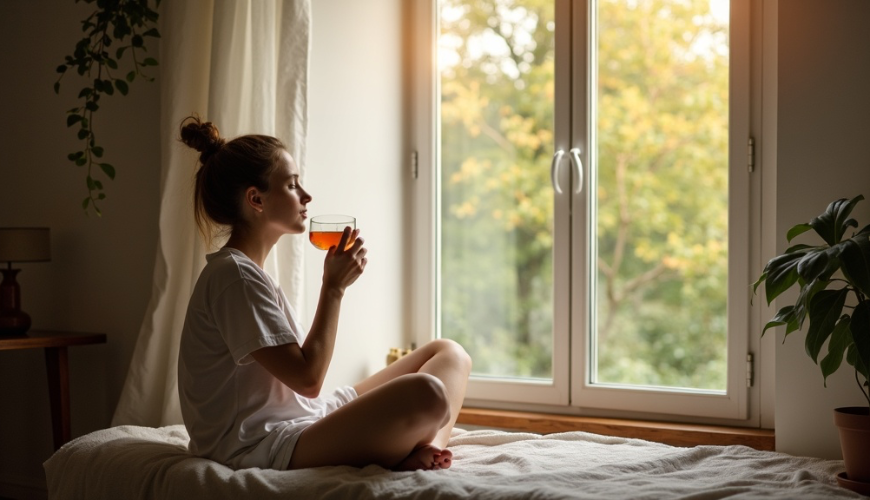
The calendar fills up with meetings, the phone buzzes with notifications, and even free evenings often end with "just quickly" checking emails, cleaning, or messaging. In such a rhythm, the art of doing nothing almost sounds provocative — like a luxury only those with plenty of time can afford. But here it's worth shifting perspective: doing nothing for health is not a whim, but a skill. Sometimes it's even necessary. Both the body and mind need moments when nothing is "produced," nothing is optimized, and nothing is caught up on. In these gaps, attention is restored, the nervous system is calmed, and one gains distance from the endless list of obligations.
One might ask: if rest is so important, why do so many people feel guilty when they just sit and stare out the window? The answer is partly cultural. Society has long valued performance, speed, and visible results. What isn't measurable is easily deemed unnecessary. Yet, the human organism functions differently from an Excel spreadsheet. Without regular breaks, performance drops, irritability rises, and the body enters a state that can be described as a permanent alert. And that's precisely why doing nothing for health is important — not as an escape, but as prevention.
Try our natural products



Why Doing Nothing for Health is as Essential as Sleep
We often imagine rest as sleep or a vacation. But between "going full throttle" and "sleeping," there's a vast territory that remains unused: short, ordinary moments without a goal. From a physiological perspective, they are crucial. When a person is under prolonged stress, the body maintains elevated levels of stress hormones and the nervous system remains tense. Even if nothing dramatic is happening on the outside, internally things are running at high speed. This is where knowing how to do nothing helps — giving the brain the signal that nothing is being chased, nothing is being solved, nothing is necessary.
Interestingly, the brain certainly doesn't "shut off" during apparent inactivity. On the contrary, it switches to a mode associated with internal processing, sorting information, and creative connecting. Scientifically, this is often referred to as the default mode network, a network that activates when attention isn't focused on a specific task. Without delving into expert details, a simple experience suffices: how many times has a good idea appeared in the shower, during a walk, or while waiting for a tram — moments when "nothing was happening"?
Doing nothing for health also relates to the psychological aspect. When breaks are missing, emotions accumulate, and one stops recognizing what is actually tiredness and what is exhaustion. In silence and calm, the ability to perceive the body returns: that there's thirst, a need to stretch, that the head is overloaded. It's no coincidence that recommendations for mental well-being often revolve around simple habits: short outdoor stays, mindful breathing, limiting stimuli. All these are various forms of doing nothing — just in a modern guise.
For credible context, one can look into information about stress and its health impacts on the World Health Organization (WHO) website or sleep and recovery overviews from the NHS. It's not about finding a universal rule, but rather confirming that the body has its limits and that prevention isn't a weakness.
And another thing: doing nothing isn't just a "break from work." It's a break from constant decision-making. Every day, one decides what to reply to, what to buy, what to cook, what to accomplish. This is sometimes called decision fatigue — and although the term sounds scholarly, the experience is simple: by evening, there's no capacity for anything else. In such moments, the healthiest thing might be what sounds simplest: sit down, just be, and resolve nothing.
Doing Nothing Doesn't Mean Laziness: Where the Boundary Lies and Why It Matters
One of the biggest obstacles is the fear that if one slows down, they'll slip into passivity. But doing nothing doesn't mean laziness. Laziness is more about long-term avoidance of what's important, often associated with apathy or loss of motivation. Doing nothing, on the other hand, is a conscious, time-limited space for renewal. The difference is akin to "I never go running because I never feel like it" versus "I'm not running today because my body needs recovery."
In practice, it's recognizable by the outcome. After healthy doing nothing, one feels calmer, clearer, sometimes even more determined. After long aimless procrastination, on the other hand, comes heaviness, pressure, and the feeling that the day slipped through one's fingers. The latter often isn't even rest — it's just another form of being overwhelmed, only instead of responsibilities, external stimuli overwhelm. Endless scrolling or watching short videos might seem relaxing, but the brain still receives stimuli. And that's precisely why one might paradoxically be more tired in the evening.
A simple rule might help: doing nothing is quiet and "low-stimulating." It doesn't have to be perfectly meditative, but it shouldn't be aggressively entertaining. It's a moment when nothing is required. Someone might sit with tea and watch the sky, another takes a walk without headphones. Someone lies on the ground and focuses on their breath. It's surprisingly ordinary.
Here, a quote often attributed in various forms to philosopher Blaise Pascal fits: "All of humanity's problems stem from man's inability to sit quietly in a room alone." Regardless of the accuracy of authorship, the thought holds. Being without a task often brings to the surface what noise manages to suppress during the day. And while this can be uncomfortable — it's also healing. The art of doing nothing isn't just about rest but also about the courage to remain without crutches for a moment.
A real-life example? In a typical household, this might occur quite unnoticed: a parent comes home from work, automatically turns on the TV "in the background," starts cleaning, checks homework, answers messages. By evening, they feel they haven't stopped for a minute, yet somehow haven't rested. But if they try a small experiment — sit down for ten minutes after coming home, put the phone out of reach, and look out the window — the first three minutes are strange. The fifth minute brings a yawn. The tenth minute often surprises: the mind clears a bit, and the next part of the evening is calmer. Responsibilities don't disappear, but part of the internal rush does. That's exactly the difference confirming that doing nothing doesn't mean laziness but practical hygiene for the nervous system.
How to Learn to Do Nothing When the World Keeps Tugging at Your Sleeve
The question of how to do nothing might sound simple, but in practice, it encounters habits. The modern environment is designed so that one is never without stimuli. And when stimuli stop for a moment, the hand automatically reaches for the phone. Therefore, it's useful to start with small steps and treat doing nothing as a skill, not a state that either "works" or "doesn't work."
It also helps to clarify what doing nothing isn't. It's not a project with a list of tasks. It's not performance. It's not even an obligation to "rest properly." It's a space that can be protected similarly to sleep. And sometimes it needs to be literally fought for — not against people, but against one's autopilot.
As a practical start, one well-chosen routine is enough. For example:
- 10 minutes a day without screens and without a goal (just sitting, lying down, looking outside, breathing slowly, or walking around the house without headphones)
That's all. One list, one rule. It's important that it truly be "without a goal." Once it becomes "now I have to figure out what to do with myself," it stops working. When boredom comes, it's okay. Boredom is often just a transitional phase where the brain searches for another stimulus. When it doesn't get one, it starts to calm down.
The environment also plays a big role. Doing nothing is easier where there aren't too many temptations. That's why simple tricks work: putting the phone in another room, turning off notifications, sitting on the balcony, taking only keys to the park. It's not about asceticism, just about not having to resist temptation every minute. In an eco-friendly home, it often turns out that fewer things mean less visual noise — and thus easier calming down. Minimalism isn't for everyone, but the principle of "fewer stimuli, more calm" is universal.
And then there's another subtle but important thing: doing nothing can be socially invisible, and thus harder to justify. When someone says they're going for a run, it sounds "healthy." When they say they're going to sit for ten minutes and do nothing, it sounds suspicious. Yet, the effect can be similarly restorative. It helps to frame it differently: it's a short break for the mind, mental hygiene, quiet regeneration. Names aren't the essence, but they can reduce internal resistance.
For those seeking support in verified information on how long-term stress affects the body and why prevention is important, resources like the American Psychological Association (APA) can be helpful. It's not about studying expert articles in depth, but rather confirming that rest isn't a weakness, but a fundamental human need.
Finally, a simple, somewhat provocative question arises: what if doing nothing were taken as seriously as work? Not as an ideal that must fill half the day, but as a small habit that protects health similar to a drinking regime. The art of doing nothing isn't about giving up ambitions. It's about having enough calm to make ambitions sustainable.
And when it works, something surprising often happens: one becomes more attentive in everyday life. They notice the taste of food, the light on the wall, that the body needs a break before a headache strikes. In that lies the quiet strength of doing nothing — unobtrusive, but practical. And most importantly, it's accessible to almost anyone who allows themselves to stop proving that rest must be earned.