
You can bake double-crust pies at home so that they are moist, richly filled, and beautifully fragra
Moravia has a special talent for transforming ordinary ingredients into something that smells like home from a hundred meters away. And it is here that you might occasionally come across the somewhat mysterious phrase: dvojctihodné koláče. You might find it in a family recipe notebook, a local newsletter, or in a Sunday coffee chat. What exactly are dvojctihodné koláče – and why are they spoken of with such reverence? It's not just a cute name. There's a slice of tradition, a dash of humor, and above all, a taste that stays in memory.
In Czech cuisine, it often happens that one type of pastry has several names depending on the region, family, or specific custom. "Dvojctihodný" sounds like an older, somewhat archaic word that evokes times when cakes were baked not only for pleasure but also as a social event. A cake wasn't just a dessert – it was a signal of hospitality, care, and sometimes prestige. And if somewhere it's said that a cake is "dvojctihodný," it's as if the hostess is saying: here, nothing was spared on the filling or the authenticity.
What are “dvojctihodné koláče" and why are they called that
The term dvojctihodné koláče is most commonly explained colloquially: a cake is "ctihodný" (honorable) when it is made genuinely – from good dough, with a rich filling, and baked correctly. And "dvojctihodný"? It seems to have twice the authenticity. In practice, this usually means more filling, more layers, more work – simply a cake that isn't baked "just like that."
In some families, this term refers to cakes that combine quark and plum jam (or even poppy seeds), elsewhere the "dvojctihodnost" relates to the cake being doubly filled or doubly "secured" with streusel and butter. Whatever the origin of the name, the meaning is surprisingly comprehensible: these are cakes that are meant to be festive and generous.
Naturally, the concept of the Moravian cake enters into this. Anyone who has ever been to a festival, fair, or wedding in the Slovácko or Haná regions knows that Moravian cakes are not just a small snack for the road. They are often soft, fluffy cakes made from yeast dough, with a filling so rich it almost doesn’t stay in place – yet it does. This type of baking pairs well with "dvojctihodnost."
Interestingly, similar traditions of "authentic cakes" are repeated throughout Europe. Yeast pastries with quark, poppy seeds, or plum jam have long been part of Central European cuisine, and their significance was both historical and practical: quark and poppy seeds provided energy, while plum jam allowed fruit to be used outside of its season. For those seeking authoritative context on traditional ingredients and their role in the diet, it's worth looking into materials related to Czech food heritage or general nutritional recommendations (such as overviews of dairy products and cereals on the SZÚ – Státní zdravotní ústav website: https://szu.cz/). It's not about making the cake a "healthy food," but understanding why it holds so firmly in traditional cuisine.
And then there's another level: dvojctihodné koláče often signify cakes "for an occasion." They are not baked in haste. When someone embarks on making them, it's usually to bring joy – to family, guests, or neighbors. And isn’t that really why some recipes are passed down so tenaciously?
Moravian dvojctihodný koláč: a flavor that stands on detail
When you hear the best Moravian dvojctihodný koláč, it sounds like a competitive discipline. In reality, it's more a collection of small decisions that together make a big difference. Yeast dough might be similar to that used in other cakes, but what matters is whether it’s given time, handled gently, and not overbaked. The filling may seem simple, but its consistency is crucial: quark should not be watery, plum jam should be thick and fragrant, and poppy seeds properly ground and scalded, so they aren’t dry.
Moravian cakes are often about "balance." Plum jam provides depth and a slight tanginess (depending on the fruit), quark softens and adds creaminess, poppy seeds bring a distinct, almost nutty flavor. The streusel on top gives a crunch that contrasts with the soft dough. And sometimes, there's one last touch: after baking, the cakes are lightly brushed with melted butter or simply left to rest under a cloth to remain moist.
A real-life example of all this plays out annually in many homes before a larger family event. Imagine a typical scenario: on a Friday afternoon, the kitchen is filled with the aroma of yeast and vanilla, a bowl of quark sits on the counter, alongside a jar of plum jam and a cup of ground poppy seeds. The children occasionally "check" the streusel because butter and sugar are simply a magnet. And the grandmother (or whoever has the baking skills) casually says a sentence that sounds like a life rule: "You can tell if there’s harmony at home by the cakes." It might be an exaggeration, but anyone who has tasted a truly authentic cake understands what she meant.
And here naturally arises the question: does it still make sense to bake such "festive" cakes today when sweet pastries are available on every corner? Precisely because a homemade cake is not just sugar and flour. It is tempo, aroma, and sharing. And with "dvojctihodné" this counts double.
A recipe for dvojctihodné koláče that makes sense even in an ordinary household
The following recipe for dvojctihodné koláče is designed to match the Moravian tradition: yeast dough, double (or triple) filling, and authentic streusel. It can be baked as a larger round Moravian cake, or as smaller koláčky. From a practical standpoint, it's often more convenient to make smaller pieces – they portion more easily, and everyone can take "their own" with their favorite filling combination.
H3 Ingredients (approx. 12–16 smaller cakes or 2 larger ones)
For the dough:
- all-purpose flour (approx. 500 g)
- milk (approx. 250 ml)
- yeast (1 cube or equivalent amount of dry yeast)
- sugar (2–3 tablespoons)
- a pinch of salt
- 1–2 eggs
- butter (approx. 80–100 g, melted)
- lemon zest or vanilla to taste
For the fillings (this is where "dvojctihodnost" is born):
- quark (approx. 250–300 g), ideally richer
- sugar to taste, vanilla, lemon zest
- 1 egg yolk or a bit of cream to soften the quark
- plum jam (plum is classic), possibly slightly diluted with rum or warm water to be spreadable
- ground poppy seeds (approx. 150 g), milk, sugar, possibly a pinch of cinnamon
Streusel:
- coarse flour or semi-coarse (approx. 100 g)
- sugar (approx. 60–80 g)
- butter (approx. 60–80 g)
For finishing:
- melted butter for brushing after baking (optional, but very "Moravian")
H3 Method without unnecessary haste
First, prepare the starter: add a little sugar, yeast, and a tablespoon of flour to lukewarm milk. Once the starter rises, mix it with flour, salt, eggs, and melted butter. The dough should be soft, elastic, and not tear. Then comes the part that cannot be rushed: rising. In a warm, draft-free environment, let the dough rise to about double its size, typically 60–90 minutes, depending on conditions.
In the meantime, prepare the fillings. Mix the quark with sugar, vanilla, and lemon zest; if it's too dry, an egg yolk or a tablespoon of cream can help. Briefly cook the poppy seed filling with milk and sugar so it's not dry, then let it cool. Adjust the plum jam to a spreadable consistency.
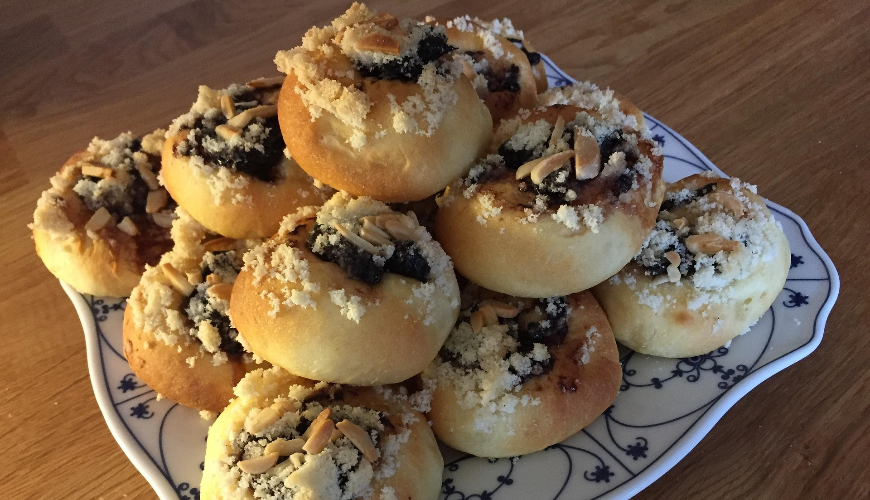
Divide the risen dough into balls (or shape it into two larger cakes). For smaller cakes, flatten the ball and make a well in the center – ideally so the edges stay higher and the filling doesn't escape. Now comes the main gesture: don't skimp on the filling. The most common "dvojctihodná" variant is quark + plum jam, possibly quark + poppy seeds, or even quark + plum jam + poppy seeds in smaller mounds next to each other. Top with streusel, quickly crumbled between fingers to remain crumbly.
Let the cakes rise briefly on the baking sheet, then bake in a preheated oven at around 170–190 °C until golden. The time varies by size, but typically 12–18 minutes for smaller ones, longer for larger ones. After taking them out, they can be lightly brushed with melted butter – this detail often determines whether the cake remains moist the next day.
Those looking for the "secret ingredient" for the best Moravian dvojctihodný koláč often find that there is no secret. It's more about the combination: good butter, quality quark, authentic plum jam, and time. In recent years, there’s increasing talk about the origin of ingredients – not just for taste but also for the impact their production has on the landscape. In this regard, it makes sense to opt for local ingredients when available, choosing those with simpler compositions.
And this is where the "Moravian cake" beautifully aligns with the philosophy of a more sustainable household. Not because the cake itself is an ecological project, but because home baking often means fewer packages, less waste, and more control over what is eaten. Plus, you can bake as much as will actually be eaten, and leftover cakes can easily be frozen or shared – which, by the way, is one of the most natural forms of neighborhood solidarity.
Ultimately, what's most beautiful about all this is that dvojctihodné koláče are not just about recipes, but about atmosphere. About letting dough rise quietly in a kitchen while it gets dark outside and the house smells of vanilla and butter. About placing the cake in the center of the table without anyone asking too much if it’s "right." It’s enough that it’s good – and that someone reaches for it once more.