
How to Eat Well and Healthily When You Don't Have Time but Still Want Stable Energy
In a time when social media challenges like "eat as much protein as possible" alternate with advice like "just eat less," it's easy to get the impression that the quantity of food is the main measure of success. However, the body is not a calculator, and food is not just a number in an app. More and more often, it is becoming clear that quality of food means more than quantity – and that the debate "quality versus quantity in food" is not a fashion trend, but a practical question of everyday health, energy, and long-term well-being. Why does it matter, how to recognize a quality choice in a regular day, and how to arrange a plate so that it makes sense not only on paper but also in reality?
Try our natural products


Why Food Quality Often Wins Over Quantity
Let's start with a simple idea: two snacks may have similar caloric values but completely different impacts. One is a sweet bar and a flavored drink, the other is plain yogurt, a handful of nuts, and fruit. At first glance, it's "just" about energy. However, inside the body, a different story unfolds – different satiety, different blood sugar levels, different nutrition for the gut microbiome, different intake of fiber, vitamins, and minerals.
This is where it becomes clear why food quality means more than quantity. Quality foods bring what is known as nutritional density: more nutrients per serving. It's not about perfection or eating "clean" at all costs. Rather, it's about ensuring that most meals in the week are based on ingredients that provide something to the body – not just quick energy, but also building material and support for regeneration.
Satiety is also important. Ultra-processed foods often combine sugar, salt, and fat to be as appealing as possible, but not necessarily the most filling. Quality food, on the other hand, usually contains fiber, proteins, and healthy fats, which help maintain stable energy. And those who feel stable naturally have less need to "top up" late at night or hunt for sweets between meetings.
The topic of quality today is also supported by serious data. For example, the World Health Organization (WHO) has long emphasized the importance of diets rich in vegetables, fruits, whole grains, legumes, and nuts, while limiting added sugars and excess salt. Similarly, Harvard T.H. Chan School of Public Health offers a clear recommendation with the "Healthy Eating Plate," which is not based on precise counting but on quality fundamentals of the plate.
There's also another dimension that's talked about less: the quality of food also affects how a person feels mentally. Fluctuating energy, irritability from hunger, the feeling of a "heavy" stomach after highly processed foods – these are small things that collectively transform into overall well-being. Sometimes just a few adjustments, and the day suddenly becomes simpler, not more complicated.
"Food should not just be fuel, but also information for the body," is sometimes said in nutritional circles – and although it sounds poetic, in practice, it means that the composition of food affects hormones, satiety, and energy.
Quality versus Quantity in Food: Where People Often Get Lost
The debate "quality versus quantity in food" is often unnecessarily simplified. As if there were only two options: either eat "little" and lose weight, or eat "a lot" and gain weight. In reality, it's more of a map with several blind alleys, where one can easily veer off.
One such alley is the pursuit of low intake regardless of what is eaten. When a person tries to "save calories" by skipping a full meal and replacing it with something random, they often end up being chased by hunger in the evening. The result is a paradox: little during the day, a lot at night – and mostly without a sense of satisfaction. Quality in such moments acts as a stabilizer.
The second blind alley is the opposite: eating "quality" without recognizing quantity. Yes, nuts, olive oil, or avocado are great, but they are energy-dense. That doesn't mean they should be feared. Rather, it's useful to perceive portions naturally – based on hunger, activity, and what has been consumed during the day. Quality is not an excuse for unlimited quantity, but a good foundation that gives the body a chance to function without extremes.
The third common problem is "healthy-sounding marketing." Words like fit, protein, gluten-free, sugar-free, or organic can be nice, but they don't guarantee a nutritious choice by themselves. Sugar-free can mean more sweeteners, a protein bar can still be a sweet treat with a long list of ingredients. In quality, it pays to return to simplicity: the more understandable the ingredients, the easier it is to navigate.
And then there's time. People often don't eat poorly because they want to, but because they are pressed for time. That's why it makes sense to look for simple principles that work even in a regular week. How to eat quality and healthy is not about a perfect kitchen and three hours of cooking daily. It's more about a few certainties that can be repeated.
A Real-Life Example: A Snack That Changes the Whole Day
Let's imagine a regular workday. A quick coffee and roll in the morning "just to have something," lunch in a hurry, an afternoon slump, and a craving for sweets. At that moment, the importance of eating quality isn't in question – it's about surviving until the end of the shift. But a small change is enough: instead of just the roll, add protein and fiber. For example, whole grain bread with hummus and vegetables, or yogurt with oats and fruit. Suddenly, the afternoon energy doesn't dip as deeply, and the craving for "something quick" isn't as urgent. It's not magic, just the physiology of satiety in practice.
This small change often triggers a chain: more stable energy → fewer impulsive purchases → better dinner → better sleep. And that's the power of quality. It's not about a single "right" meal, but about an effect that builds day by day.
How to Eat Quality and Healthy Without Stress (and with Pleasure)
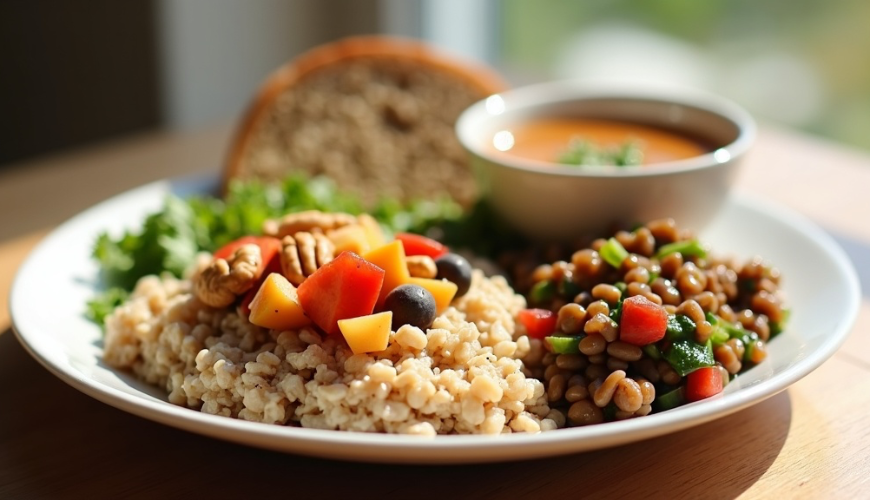
A quality diet doesn't have to be complicated. Usually, it's enough when the plate is based on a few basic building blocks: vegetables (even frozen), proteins (legumes, eggs, quality dairy products, fish, tofu/tempeh), a fiber-rich side (whole grains, potatoes, sweet potatoes), and fats in reasonable amounts (olive oil, seeds, nuts). It sounds simple – and that's the point. How to eat quality and healthy is often a matter of routine, not discipline.
Working with the environment also helps a lot. When there's a bowl of fruit, nuts in a reasonable portion, and maybe quality tea at hand at home, there's less chance of reaching for a random sweet just because "there's nothing else." Similarly, a shopping list works: not as a restriction, but as insurance. Quality is most often won already in the store, not at the fridge at nine in the evening.
A significant topic is sustainability – not only ecological but personal. A diet that's too strict doesn't last long. Quality therefore doesn't mean a ban, but a predominance of good choices. When most meals are based on quality ingredients, an occasional pizza or dessert doesn't feel like a disaster but like a normal part of life. The body doesn't collapse from one dinner, but reacts to a long-term pattern.
And when it comes to specific inspiration, it's helpful to have a few "certainties" that are quick, tasty, and can be varied according to the season. The following ideas are not a diet plan, but practical tips for quality healthy meals that can be put together even on days when there's no mood for complex cooking:
Tips for Quality Healthy Meals That Work in a Regular Week
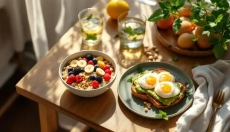
- Oatmeal with fruit, a spoonful of nut butter, and seeds (fills you up for a long time and can be made "overnight" the night before).
- Legume salad (lentils/chickpeas + vegetables + olive oil + lemon + herbs), which lasts in the fridge and is suitable for a lunchbox.
- Eggs in various ways with vegetables and whole grain bread – simple, quick, universal.
- Soup from red lentils or vegetables with potatoes, complemented with quality bread; ideal when you want "something warm" without complexities.
- Bowl: rice/quinoa/potatoes + roasted vegetables + tofu/tempeh/fish + yogurt and herb dressing.
However, quality is not just recognized by the recipe, but by the details. In bread, it matters if it's truly whole grain. In yogurt, if it isn't full of sugar and flavors. In ready-made meals, how long the ingredient list is and how many of them sound like something you'd have at home in the kitchen. And with vegetables, sometimes it's enough to admit reality: frozen is often an excellent choice because it's processed quickly after harvest and is available year-round.
For credibility, it's good to rely on generally accepted principles. For example, recommendations to increase fiber intake and limit highly processed foods are repeated across institutions and reviews. Practically, this means: adding vegetables to almost every main meal, alternating protein sources, not forgetting legumes, and not being afraid of quality fats, but using them wisely. For a simple compass, one can also be inspired by the framework offered by the NHS – National Health Service in recommendations for a balanced diet.
And perhaps the most important question is: what is actually "quality"? For some, it's organic vegetables from the farmer's market, for others, it's accessible foods from a regular store but with good composition. Quality isn't an elite club. It's a range of decisions that can be made according to possibilities – financial, time, and family. Sometimes the highest quality choice is the one that is realistic: canned legumes, frozen vegetables, plain yogurt, oats, seasonal fruit.
And why is this important from a broader perspective? Because food quality often intersects with quality of life. When the body receives what it needs, it's easier to move, concentrate, sleep, and have patience – even with oneself. In this, there's a subtle but great advantage: a quality diet isn't an extra project, but a supportive network for everything else that happens during the week.
It might be worth asking a simple rhetorical question: when so much time is spent on food – shopping, preparation, lunch break – shouldn't it be something that truly helps the body? Quality over quantity isn't moralizing or a competition in perfection. It's a practical way to make food an ally. And when this succeeds in at least a few common situations during the week, the difference is usually noticed more quickly than one might expect.