

Strength training for women over 40 is beneficial because it protects muscles, bones, and joints.
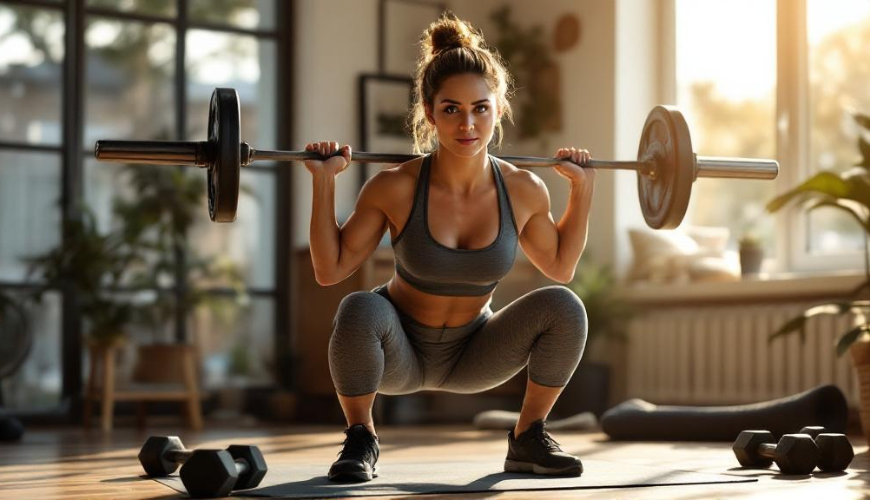
A few years ago, strength training in women's locker rooms was often simplified to "weights are for bodybuilders" and "mainly tone up with cardio." However, once you hit your forties, it becomes clear that this division is outdated. A woman's body naturally changes, metabolism doesn't run as smoothly as it did in your twenties, and muscle mass—if not actively maintained—tends to gradually decrease. And that's not just a topic for athletes. Strength training for women over 40 is increasingly seen today as a practical tool for everyday life: for stronger backs, more confident steps, more resilient bones, and a calmer mind. It might also be the answer to the question many women ask when they first hear a crack in their knee on the stairs: why is strength training important right now?
Around the age of forty, several things often come together. Work becomes more demanding, children are older (and sometimes paradoxically "heavier" in logistics than before), sleep fluctuates, and the body stops tolerating long-term overloading without consequences. Yet, in this phase of life, it makes sense to invest energy into something that pays off in the form of functional strength. Why is strength training important for women over 40? Because it's not just about appearance but about the ability to function without pain and with a reserve—and that can be built even when "quick results" are no longer expected.
Try our natural products





Why Strength Training for Women Over 40 is Crucial
One of the main reasons is the natural decline of muscle mass with age. Scientifically, it's called sarcopenia—and it's not about fear-mongering, but rather a reality that can be significantly influenced. Muscles are not just an "aesthetic accessory." They are metabolically active tissues that help the body manage energy, support joint stability, and protect the spine. When muscles decline, the body often feels more fragile, tires more quickly, and everyday tasks—carrying groceries, lifting a suitcase, walking uphill—start to require more effort than one might expect.
Equally important is the bone aspect. After forty, women gradually face an increased risk of bone density loss, especially around menopause. Strength training for women is among the activities that signal bones to "strengthen." Bones respond to stress: when they receive it appropriately and regularly, they tend to maintain their strength. As useful context for osteoporosis prevention, you can refer to resources from the International Osteoporosis Foundation (IOF), which has long summarized what helps reduce risk.
The hormonal level also plays a role. Female hormones can behave more variably after forty, and the body sometimes reacts differently than before—such as with increased cravings for sweets, changes in fat storage, or fluctuations in energy. Strength training itself is not a "magical hormonal reset," but it can be surprisingly stabilizing: it improves insulin sensitivity, supports better sleep, and for many women, brings a sense of firmness and control over their own body. And that's often as important as the number on the scale.
Interestingly, societal perspectives have also been changing in recent years. While women were once expected to be "more gentle," it's now seen how much strength without apologies suits—and benefits—women. As a frequently quoted phrase puts it: "Strength is not a male trait. It's a human trait." And after forty, strength might be what brings ease to everyday life.
What Strength Training Truly Brings (and Why It's Not Just About Weight Loss)
In practice, the question of "why is it important" often narrows down to weight loss. But weight reduction is just one of the possible motivations—and not always the most reliable one. Strength training for women over 40 often doesn't bring an immediate weight drop because muscles may increase, the body retains water, and composition changes gradually. What often comes sooner is a change in feeling: a firmer core, less fatigue when climbing stairs, more stable knees, less "pulling" in the lower back.
Stronger muscles also act as natural protection for joints. Knees, hips, and shoulders become more sensitive after years of sitting and unilateral strain. When the strength of the glutes, back, and core improves, posture often improves too—and with it, how one feels in everyday life. It's worth noting that strength training doesn't have to mean extremes or overloading. On the contrary, for many women, it's a way to gradually move out of pain because stability and movement control improve.
A big bonus is the mental aspect. It sounds like a cliché, but it works: when a woman lifts something she couldn't a month ago, it translates into daily life. Suddenly, it's easier to say, "I can handle this." And in a period where care for others, work, and one's own energy are often addressed, it's a valuable experience.
And then there's another practical thing that's talked about less: strength saves time. Those with better muscle conditioning can handle more walking, longer trips, quicker city commutes, and household chores without "falling apart." This is the answer to why strength training is important for women over 40: because it adds a reserve that the body no longer adds on its own.
How Should a Woman Over 40 Train for Strength to Make Sense
The most common mistake is not a lack of will, but poorly chosen intensity and expectations. Some women start taking it too easy and keep training "comfortably" without progress, while others jump into a regime that worked in their thirties, and the body responds with overloading. Yet the answer to how a woman over 40 should train for strength is surprisingly simple: regularly, technically cleanly, and with gradually increasing loads.
The foundation is to build training on large, natural movements. Squat (or its variation), pull (such as a deadlift with a lighter weight or hip hinge), press (bench press or dumbbell press), row (rowing, band pulls), and carry (farmer's walk). These patterns mimic everyday life: lifting things, getting up from a chair, carrying bags. The more these "functional" parts are strengthened, the more noticeable it is outside the gym.
Practically, training 2-3 times a week is effective. Two sessions a week are a great foundation, three are very effective if there's space for recovery. Each training can have 4-6 exercises and doesn't need to last longer than 45-60 minutes. Consistency is more important than length. The body often responds well to regularity and reasonable stress after forty but less well to sporadic extremes.
Intensity? You don't have to train "to complete failure." Many women find it fits to work with the feeling that at the end of a set, they could still do 1-3 more reps (the so-called reserve). It's challenging enough to give muscles a reason to grow and strengthen but doesn't usually exhaust the nervous system so much that there's no energy for everyday functioning in the following days.
If menopause, irregular sleep, or higher stress is a concern, fewer but better-executed sets often help. Fewer exercises, better technique, thoughtful progression. And a friendlier approach to recovery: walks, mobility, adequate protein, and sleep whenever possible. For basic orientation in movement recommendations, the World Health Organization (WHO) also emphasizes the importance of strengthening for adults.
To make the text as practical as possible, it's enough to keep an eye on a few points that often repeat in practice:
What Usually Works Best
- 2-3 strength training sessions a week, with a rest day or lighter activity (walking, mobility) in between
- Focus on the whole body, not just "problem areas"
- Gradually increasing the load (slightly higher weight, more repetitions, or better technique)
- Emphasis on technique and range of motion, as quality pays off twice after forty
- Recovery as part of the plan, not as a reward for surviving the week
This includes reasonable expectations. After forty, results often come "quietly": first, posture improves, then minor pains disappear, then performance improves—and only then does appearance start to change. Those who expect only quick visual changes might give up just before the most valuable shifts occur.
A Real-Life Example That Almost Everyone Knows
Imagine a woman who works in an office, has two children, and returns to exercise after a long break. Initially, she struggles with back pain from long sitting and knee pain when going down stairs during weekend trips. She starts attending strength training focused on the whole body twice a week: squats to a bench, band pulls, rows, light dumbbell presses, core strengthening. The first two weeks, she mostly learns technique and finds her "load." After a month, she notices that when carrying groceries, she automatically engages her core and isn't as broken in the evening. After two months, she manages a trip without knee worries, thanks to stronger glutes and better stability. Her weight may have changed little, but the feeling of firmness and energy is completely different. And that's often the reason women stick with strength training.
A common concern related to the topic: "Won't I be too muscular?" In practice, this is more of a myth for most women. Building significant muscle mass requires a long-term specific training regimen, diet, and often genetic predispositions. In a regular regime of 2-3 times a week, the body usually firms up, improves proportions, and gains functional strength. And that's precisely what most women over 40 are looking for: a firmer body, more stable joints, and less pain, not a bodybuilding physique.
Strength training also beautifully complements other "sustainable" habits that fit into the philosophy of a healthy lifestyle: regular walking, quality food, less alcohol, more sleep, stress management. It's not about perfection, but about the body gradually becoming a more reliable partner. And when you add a gentler approach to yourself—perhaps in planning the day, recovering, and choosing activities that make sense long-term—strength training for women over 40 becomes not just "another obligation" but a natural part of life.
Perhaps, in the end, it's most accurate to say that strength training isn't just a sport. It's a form of prevention and confidence in movement. And when a woman over forty asks how she should train for strength, the answer fits into one sentence: in a way that makes her a bit stronger, more stable, and calmer each month—and sustainable even in weeks that aren't ideal. That's the true strength that remains.