

Exercising in front of the TV will help you stay fit without a gym
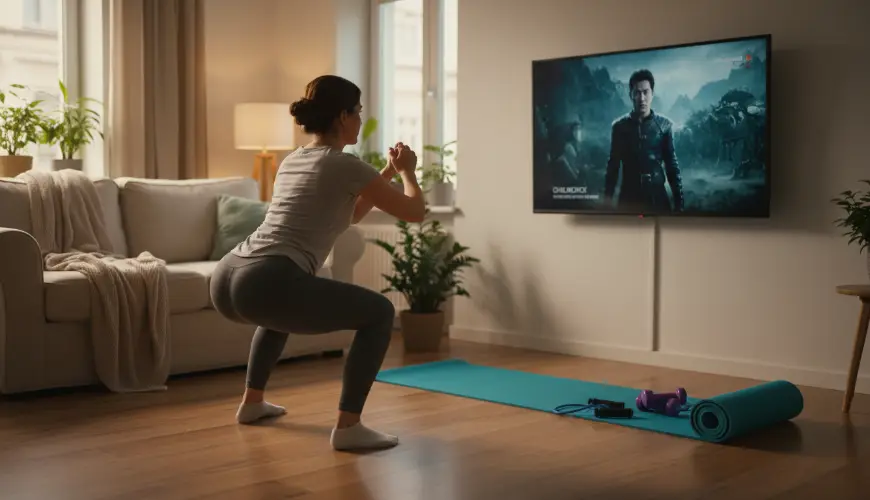
Imagine a situation familiar to many people: after a long working day, you sink into the sofa, turn on your favourite series, and promise yourself that tonight you will simply rest. Yet rest and movement don't necessarily have to be at odds. Exercising while watching television is a phenomenon that has been gaining more and more followers in recent years – and it's not just a passing trend. It is a practical strategy for fitting movement into a busy day without a sense of sacrifice or self-torment.
Many people think that sport requires dedicated time, special clothing, an expensive gym membership, and the willpower to ignore all comfort. But the reality of modern life is different. The average Czech person watches television for approximately three hours a day – that's three hours that could at least partly be devoted to movement. This doesn't mean turning the living room into a gym or doing an exhausting workout every evening. It's about something far more subtle and sustainable.
Try our natural products





Why movement in front of the TV makes sense
The science behind this idea is surprisingly solid. Research repeatedly shows that even low-intensity movement – so-called NEAT (Non-Exercise Activity Thermogenesis), meaning energy expenditure outside of intentional sporting activities – has a fundamental impact on human health. Studies published in the American Journal of Clinical Nutrition confirm that people who are naturally more active during the day maintain a healthier body weight and have a lower risk of cardiovascular disease than those who exercise intensively but otherwise sit all day.
Exercising while watching TV makes use of exactly this principle. The goal is not to replace regular sport, but to complement it – or, for many people, to begin the journey towards a more active life at all. The barrier to entry is extraordinarily low. You don't need special equipment, you don't have to travel anywhere, and you don't have to change your evening ritual. You just need to get up off the sofa.
Psychologically, this approach is also very clever. Television serves as a natural motivator and at the same time as a reward. If a person decides they will only watch their favourite series while moving, they create a positive association between exercise and pleasure. Over time, this habit becomes automatic – just as a person automatically makes coffee in the morning, they begin to automatically exercise as soon as they turn on the television.
Take Martina, a thirty-year-old accountant from Brno, as an example. She sits at a computer all day, is tired in the evening, and has neither the energy nor the desire for conventional exercise. However, she started doing simple stretching exercises and squats during commercial breaks. Within three months, she noticed that her posture had improved, her back pain had disappeared, and she felt generally more refreshed. She didn't dramatically change her lifestyle – she simply added movement where before there had only been passive rest.
What to do specifically and how to start
The key to success is choosing movement that doesn't require concentration on technique and can be performed automatically. If a person has to think about every step, it will soon start to bother them and they'll give up. Simple yet effective exercises are therefore ideal.
One of the most popular strategies is the so-called "commercial break workout". An average hour of television broadcasting contains approximately fifteen to twenty minutes of commercials. These are minutes that most people spend mindlessly scrolling on their phones. Instead, this time can be used for short sets of exercises – squats, lunges, push-ups, sit-ups, or a plank. If a person keeps this up every evening, they gain an extra thirty to forty minutes of movement per week without a single extra hour in their schedule.
Another option is movement directly while watching a programme. Yoga, pilates, and stretching exercises are ideal choices because they don't require intense concentration and can be performed while watching a screen. Many people put an exercise mat on the floor and watch an entire evening series in various positions – lying down, sitting on their heels, or in child's pose. The body moves, the mind is engaged in the story, and time passes surprisingly quickly.
For a more advanced version, simple equipment can be used. Resistance bands, dumbbells, or a kettlebell are items that don't take up much space but significantly expand training options. With a resistance band around the ankles, you can strengthen the gluteal muscles, inner thighs, or stabilising muscles during a single episode of a series. Dumbbells allow you to train arms, shoulders, and back without having to stop following the plot.
There is also an approach that could be called "active sitting". Instead of a conventional sofa, you can sit on a balance ball or a special active stool while watching television. The body is constantly forced to maintain balance, which engages the deep stabilising muscles and improves posture. This solution is particularly appreciated by people who suffer from back pain caused by sitting at a computer all day.
As world-renowned physiotherapist and author Kelly Starrett states: "Sitting is not the problem in itself – the problem is sitting without a break and without conscious movement." This thought precisely captures the philosophy of exercising in front of the TV. It's not about sitting less, but about moving more cleverly.
How to turn it into a real habit
Knowing the exercises is only half the battle. The other – and perhaps more important – half is building a habit that lasts. Behavioural psychology offers a clear answer in this regard: new behaviour is best anchored when it is linked to an already existing routine. Watching television is a strong and stable routine for most people, which makes it an ideal anchor for a new movement habit.
Research in the field of habit formation, such as the work of BJ Fogg at the Behavioral Design Lab at Stanford University, shows that the most successful habits are those that start very small. If a person decides they will exercise for an hour every evening, they will likely give up after the first demanding day. If they decide they will do five squats every time they turn on the television, it is so easy that it would be foolish not to do it. And from five squats it gradually becomes ten, then twenty, then a complete series.
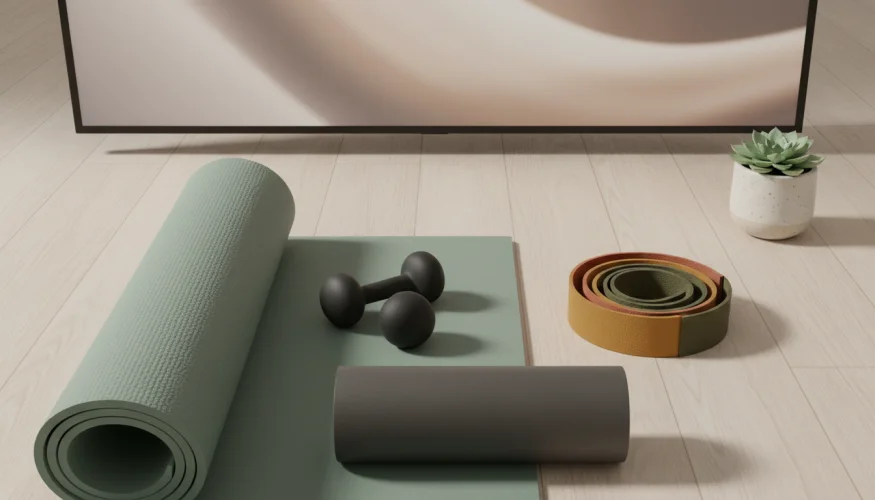
Preparing the environment is also important. An exercise mat placed in front of the television acts as a visual reminder and at the same time removes an obstacle – you don't have to look for it, it's simply there. Resistance bands or dumbbells placed in a visible spot serve the same function. The fewer obstacles standing between a person and movement, the higher the likelihood that movement will actually happen.
The choice of programmes also plays a major role. Series with episodes lasting twenty to thirty minutes are ideal for more intensive exercise, because the pace of the story maintains motivation. Longer documentaries or films, on the other hand, are excellent for slower, regenerative movement – stretching, foam rolling, or gentler yoga. A person thus naturally adapts to what they are watching, and exercise becomes a natural part of the evening.
It is worth mentioning that exercising in front of the TV is not a substitute for regular sport, but a complement to it. People who go running or to the gym three times a week can use this approach to improve recovery, strengthen weak areas, or simply keep the body moving even on days when intensive training is out of the question. A combination of both approaches is ideal from a health perspective.
It is also worth mentioning the ecological dimension of this approach. Home exercise significantly reduces the carbon footprint associated with commuting to a fitness centre. At a time when more and more people are looking for ways to live more sustainably, exercising at home is a natural choice. Moreover, home exercise equipment – if chosen wisely and with quality in mind – lasts for years and doesn't require ongoing expenses like a gym membership.
For those who want to involve the whole family in exercising in front of the TV, interesting possibilities open up. Exercising together with a partner or children transforms evening movement into a social activity and naturally increases motivation. Children also readily accept movement as part of fun – jumping, rolling around on the floor, or simple yoga can be an adventure for them, not an obligation. The relationship with movement built in this way from an early age is one of the most valuable things parents can pass on to their children.
Whether a person opts for squats during commercial breaks, evening stretching during a documentary, or active sitting on a balance ball, one thing is essential: to start. A perfect plan that remains only in one's head has no value. On the contrary, imperfect movement that is repeated every evening gradually changes both body and mind. And the television, which used to be a symbol of passivity, can become an unexpected ally on the journey towards a healthier and more active life.