

# How to Easily Season Bland Food Without Salt and Sugar
There is a moment that almost everyone who has ever tried to eat healthier will recognise. You cook a pot of lentils, prepare some steamed vegetables, or bring a recipe from a nutrition magazine to life – and the result is nutritious, but also irresistibly... bland. Without salt, food loses its usual appeal; without sugar, it seems to lack roundness of flavour. And so your hand automatically reaches for the salt shaker or a spoonful of honey, even though you promised yourself that this time you would manage differently.
Yet the taste of food does not depend solely on salt and sugar. On the contrary – over-salting and over-sweetening are bad habits that gradually dull the taste buds and lead to an inability to perceive food as tasty without these two ingredients. The World Health Organization (WHO) recommends a salt intake of less than 5 grams per day, while the average European consumes nearly twice this amount. The situation is similar with sugar – WHO recommends that free sugars make up less than 10% of total energy intake. Yet there are many ways to add depth and interest to food without these two substances – and many of them are surprisingly accessible.
Try our natural products






Spices, herbs and fermented foods as the foundation of flavour
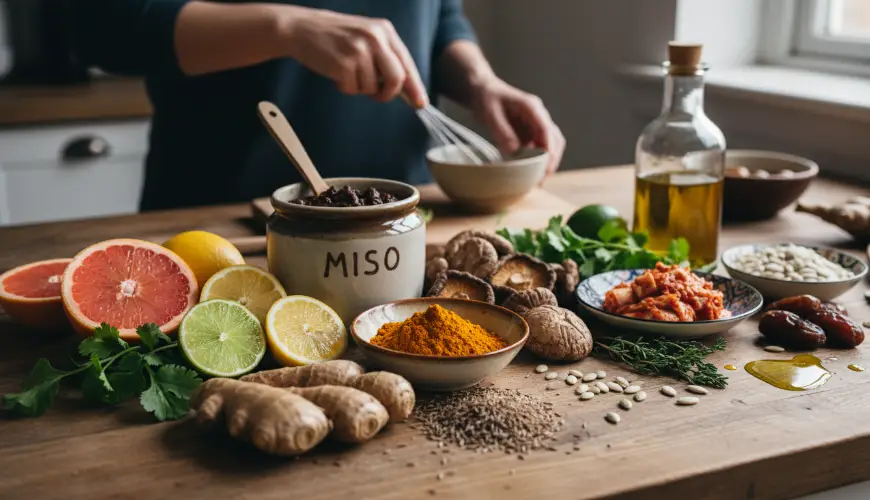
The foundation of any good cuisine that can do without excessive amounts of salt and sugar is aromatic herbs and spices. Their power lies in the fact that they activate different parts of the taste and olfactory system simultaneously – and the resulting experience is more complex than anything salt alone can achieve. Turmeric, cumin, coriander, paprika, ginger or cinnamon are not merely "extra ingredients" – they are genuine carriers of flavour, capable of transforming an ordinary dish into something you want to reach for again.
Take Maria, a thirty-year-old accountant from Brno, who decided two years ago to reduce her salt intake due to high blood pressure. At first, food tasted like cardboard to her. But then she began to experiment – adding fresh ginger and chilli to soups, stirring miso paste mixed with lemon juice into salads, and adding whole cumin seeds dry-toasted in a pan to braised vegetables. "I realised I had never actually properly tasted food before. Salt was always doing it for me," she says. Today she gets along easily without a salt shaker.
Fermented foods work in a similar way – kimchi, sauerkraut, tempeh or miso paste. These ingredients are naturally rich in umami, the fifth basic taste described by Japanese scientists at the beginning of the 20th century. Umami gives food depth and fullness without the need to add salt or sugar. Miso paste does contain salt, but thanks to the intensity of its flavour, a much smaller amount is needed than with conventional salting. Dried mushrooms – particularly shiitake or porcini – serve a similar function, as their stock is naturally rich in glutamates, which are the carriers of that hard-to-describe yet instantly recognisable fullness of flavour.
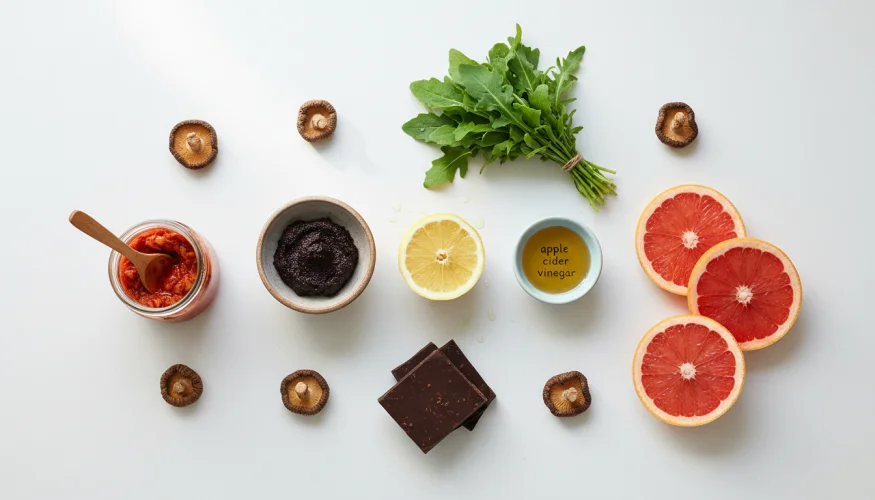
Acidity is another powerful tool that many cooks underestimate. Lemon juice, lime juice, apple cider vinegar or tamarind can "awaken" the flavour of a dish in much the same way as salt – they stimulate taste receptors in a way that the brain perceives as a more intense taste experience. It is no coincidence that professional chefs add a squeeze of lemon juice to almost everything. Acidity not only seasons but also balances other flavours and helps them to shine.
Equally underestimated is bitterness – naturally present in rocket, chicory, grapefruit zest or dark chocolate. Bitter flavour was long considered unpleasant, but in the right context and quantity it adds sophistication and contrast to a dish. A salad of rocket with orange segments and a little olive oil is a classic example – no salt, no sugar, and yet perfectly balanced in terms of flavour.
Texture, temperature and preparation technique as hidden allies
The taste of food is not merely a matter of what is added to the pot. The method of preparation also plays a crucial role. Roasting, sautéing and grilling trigger the Maillard reaction – a chemical process in which amino acids and sugars naturally present in the food react at high temperatures to create hundreds of new aromatic compounds. The result is that characteristic golden crust and intense flavour that simply cannot be achieved by boiling in water.
Next time, instead of braised vegetables, try slicing carrots, sweet potatoes and celeriac, drizzle them with a little olive oil and roast them in the oven at a high temperature. The result will be incomparably more intense – the caramelisation of the natural sugars in the vegetables creates a complex sweet-bitter flavour to which nothing needs to be added at all. Toasting onions or garlic in a dry pan works in a similar way – the natural sugars caramelise and a depth of flavour develops that would otherwise require a whole range of ingredients.
Texture is another aspect that influences how we perceive food. Research shows that crunchiness enhances the overall taste experience – the brain associates it with freshness and quality. This is why a simple salad of cooked lentils can take on an entirely new dimension if toasted pumpkin seeds, crunchy red radishes or a little sugar-free granola are added. The contrast of textures holds the attention and makes food feel more interesting, without any need to reach for the salt shaker.
Serving temperature also plays an important role. Dishes served too cold or too hot lose some of their aromatic potential – taste receptors function best at moderate temperatures. This is why soup served just below boiling point tastes different from the same soup served lukewarm. This small detail can determine whether we perceive food as tasty or as flat.
Fat is also not to be overlooked – not as an enemy, but as a carrier of flavour. Olive oil, avocado, tahini or nut butter are naturally rich in substances that bind aromatic compounds and deliver them to the taste buds. Food without any fat may be nutritious, but it is one-dimensional in terms of flavour. A spoonful of good-quality olive oil drizzled over a finished dish just before serving will do more for its flavour than a great deal of salt.
The world of plant extracts and natural flavourings offers a further source of inspiration. Vanilla without sugar can evoke a perception of sweetness without containing a single extra calorie – it works as an aromatic illusion that the brain interprets as sweet. Cinnamon or cardamom in porridge or a smoothie work in a similar way. By adding these spices, the need to add sugar or honey can be significantly reduced or eliminated entirely, while the resulting dish remains flavourful and satisfying.
Dried fruit – dates, raisins, apricots – can serve as a natural sweetener in cases where one does not want to give up sweet flavours entirely. They do contain fructose, but thanks to their fibre content they are absorbed more slowly than refined sugar, while also providing minerals and antioxidants. Blended dates make an excellent base for dressings, sauces or desserts, where they replace both sugar and honey.
An interesting chapter is also provided by edible flowers and unconventional herbs, which are only gradually making their way into Czech cuisine. Lavender, elderflowers, shiso or lemongrass bring entirely new aromatic dimensions to dishes that salt and sugar simply cannot match. Research published in the journal Flavour shows that the olfactory component accounts for up to 80% of what we perceive as taste – and it is precisely aromatic herbs and spices that make full use of this component.
It is also worth mentioning the psychological dimension of the whole matter. The way food is presented, the colours on the plate, the aroma rising from the pot, or the environment in which one eats – all of this influences how we perceive a dish. A research team led by Oxford professor Charles Spence demonstrated that people rate the same food as significantly more tasty when it is served on a white plate, in a pleasant environment, and with the knowledge that it comes from quality ingredients. In other words – taste is largely a matter of the brain, not just the tongue.
The transition to a less salty and less sweet diet is not a matter of a single day. Taste buds adapt gradually – research suggests that after four to six weeks of reduced salt intake, people begin to perceive previously favourite foods as over-salted and find pleasure in flavours that previously seemed bland to them. It is therefore a patient process of relearning, not an immediate sacrifice. And the result is not only a healthier body, but also the discovery of an entire spectrum of flavours that salt and sugar had been drowning out for years.
Seasoning without salt and sugar is not a limitation – it is in fact an expansion of one's culinary horizons. The world of spices, fermented foods, acids, textures and aromatic herbs is immensely rich and waiting to be explored. All it takes is the courage to put down the salt shaker and start experimenting.