

Doom scrolling and anxiety from negative news
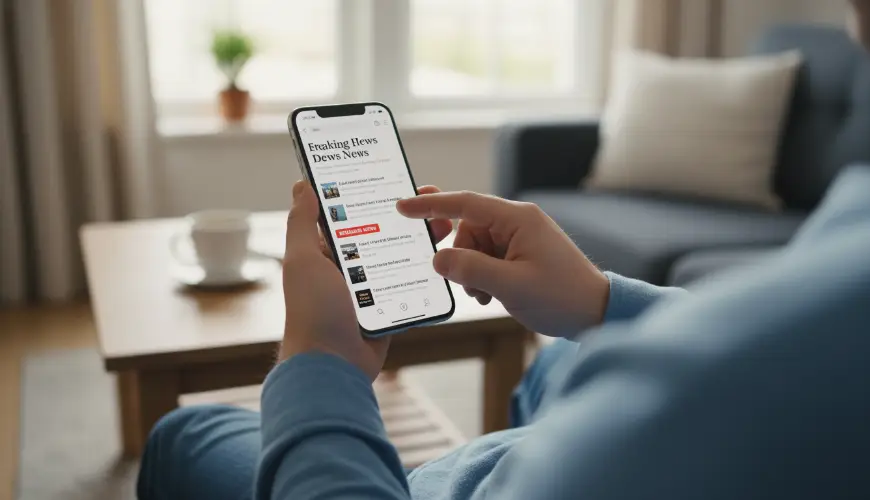
Everyone knows the feeling. You lie down in bed at night, unlock your phone to "just quickly check what's new," and suddenly it's midnight. Your thumb tirelessly scrolls through news about wars, economic crises, climate disasters, and political scandals. None of it makes you happy, none of it helps you fall asleep better, and yet you can't stop. This phenomenon has a name – doom scrolling – and its impact on the human psyche is much deeper than it might seem at first glance.
The term doom scrolling (sometimes written as doomscrolling) spread particularly during the COVID-19 pandemic, when millions of people around the world spent hours watching disturbing news about infection and death counts. The phenomenon itself, however, existed long before that. It involves compulsive consumption of negative news content, often on social media, which brings a sense of being informed but actually feeds anxiety, stress, and helplessness. And it's precisely the relationship between doom scrolling and anxiety – how the endless news cycle affects our psyche – that deserves attention.
Why can't we actually stop? The answer lies deep in evolutionary biology. The human brain is programmed to give priority attention to threats. This mechanism, known as negativity bias, was incredibly useful in times when it was necessary to quickly spot a predator in the bushes. Today, however, this same mechanism causes negative news to affect us more strongly than positive news. A study published in Proceedings of the National Academy of Sciences showed that people pay significantly more attention to negative information and remember it longer. Social media and news portals know this well – algorithms are designed to present us with content that evokes strong emotions, because such content generates more clicks, more shares, and ultimately more advertising revenue.
This creates a perfect loop. You read a disturbing story, feel uneasy, and immediately search for more information to alleviate that unease. But more information brings more negative news, the anxiety deepens, and you keep scrolling. It's a mechanism similar to what operates in casino slot machines – intermittent reinforcement. Occasionally you come across something interesting or useful, which keeps you in the cycle even though most of the content causes you discomfort.
The impacts on mental health are not merely theoretical. Research published in 2022 in the academic journal Health Communication found a direct link between excessive news consumption and deterioration of mental health, including increased levels of anxiety, depressive symptoms, and sleep disorders. Study participants who spent more than two hours a day watching news showed significantly higher stress levels than those who consumed news in moderation. Interestingly, it's not just about the amount of time but also about the manner of consumption – passive scrolling on social media was associated with worse outcomes than actively searching for specific information.
Consider Marek, for example, a thirty-year-old IT specialist from Brno. During the first wave of the pandemic, he began checking infection statistics every morning, watching press conferences, and reading comments under news articles. "I told myself I needed to know what was happening so I could protect myself," he recalls. Gradually, however, the morning check turned into an all-day ritual. Marek followed the news at breakfast, at work during breaks, and in bed at night. After several weeks, he began noticing that he was sleeping worse, was irritable, and couldn't concentrate. "Paradoxically, I felt less prepared for anything, even though I had more information than anyone around me." Marek's story isn't exceptional – it's rather typical. It's precisely this illusion of control, the feeling that the more information we have, the better prepared we are for a situation, that is one of the main drivers of doom scrolling.
How the News Cycle Works with Our Attention
The modern news cycle differs fundamentally from what previous generations knew. Just twenty years ago, most people consumed news twice a day – in the morning newspaper and during the evening television news. There was a clear beginning and end, a natural boundary, after which a person could turn to other things. Today, the news cycle is continuous. Phone notifications deliver breaking news at any hour, social media mixes friends' personal posts with disturbing headlines, and the boundary between informing and entertainment dissolves.
This transformation was aptly described by American media theorist Neil Postman back in 1985 in his book Amusing Ourselves to Death: "The medium is the metaphor. The way we receive information shapes how we think about it." Postman was talking about television at the time, but his words apply to the smartphone era even more urgently. The format of short, emotionally charged stories optimized for scrolling teaches us to perceive the world as an endless stream of crises over which we have no influence.
A key role is also played by the so-called mean world syndrome, a concept formulated by communication theorist George Gerbner. According to him, people who consume large amounts of media content focused on violence and disasters tend to perceive the world as more dangerous than it actually is. This distorted view then reinforces anxiety and the need to follow more news – because when the world is so dangerous, you surely need to know what's happening.
Young people are particularly vulnerable in this regard. According to a survey by the American Psychological Association from 2020, 68% of American adults said the news causes them stress, and among Generation Z (born after 1997), this number was even higher. Young people spend more time on social media, are exposed to a greater volume of unfiltered content, and often lack sufficiently developed coping strategies to deal with this flood of negativity in a healthy way.
At the same time, it cannot be said that the solution is to stop following the news entirely. Being informed is important for the functioning of a democratic society and for the ability to make qualified decisions in personal life. The problem isn't in following the news itself, but in how and in what quantity we consume it.
Try our natural products



The Path to a Healthier Relationship with Information
Psychologists and digital wellbeing experts suggest several approaches that can help break the doom scrolling cycle without having to live in an information bubble. These aren't radical steps, but rather conscious habits that gradually change our relationship with media.
The first and perhaps most important step is awareness. Most doom scrolling happens on autopilot – you reach for your phone without consciously deciding to do so. Simply recognizing this behavioral pattern is the first step toward changing it. A simple measure can help, such as tracking time spent on the phone using built-in tools (Screen Time on iPhone or Digital Wellbeing on Android). When someone sees they've spent three hours a day on news apps, that alone is often enough motivation to change.
Another effective approach is setting fixed times for news consumption. Instead of constantly monitoring notifications, set aside two specific times during the day – for example, in the morning after breakfast and in the afternoon after work – when you check what's happening in the world. Outside these times, turn off news app notifications. This may initially cause unease (which in itself testifies to how strong a habit doom scrolling is), but most people find that they don't miss anything essential.
The choice of sources also plays an important role. There is a fundamental difference between reading an analytical article in a quality outlet and scrolling through comments under a sensational headline on social media. Quality journalism provides context, explains causes and consequences, and offers perspective. Social media, on the other hand, often tears events out of context and amplifies emotional reactions. Consciously choosing trustworthy sources and limiting time on social media can significantly reduce the anxiety associated with news consumption.
Also worth mentioning is the concept of the "information diet," popularized by author Clay Johnson in his book of the same name. Just as with food, it's not just about quantity but also quality. Consuming dozens of short, emotionally charged news items is the equivalent of eating at a fast-food restaurant – it fills you up quickly but is harmful in the long run. Slow, in-depth reading of quality articles or listening to podcasts is, by contrast, like a balanced meal – it requires more time but leaves you with a better feeling and genuine understanding.
Physical activity and spending time in nature are further powerful antidotes. Numerous studies confirm that exercise in fresh air lowers cortisol levels (the stress hormone) and improves mood. When you feel the urge to reach for your phone and start scrolling, try going for a short walk instead. It's not easy – the brain demands its dose of stimulation – but with practice, it becomes more natural.
A simple technique that psychologists call the "usefulness test" can also help. Before opening a news app, ask yourself: "Am I looking for specific information that will help me make a decision, or am I just scrolling out of habit?" If the answer is the latter, close the app and do something else. This brief pause between impulse and action can be surprisingly effective.
And finally – and this is perhaps the most important point – it's good to remind yourself that the world is not just what we see on a phone screen. News by its nature emphasizes exceptional, dramatic, and negative events, because those are newsworthy. No one writes an article about the fact that today millions of people safely returned home from work, that thousands of scientists made progress in researching treatments for serious diseases, or that someone in the neighborhood selflessly looked after an elderly person. As Swedish physician and statistician Hans Rosling noted in his book Factfulness: the world is in many measurable respects better than it has ever been – yet the news cycle systematically obscures this reality.
Doom scrolling and the anxiety it causes are not an inevitable price for living in the digital age. They are rather the consequence of the fact that our technology has evolved faster than our ability to engage with it in a healthy way. The good news is that each of us has the power to change this relationship. Not by closing our eyes to the world, but by looking at it more consciously, with perspective, and in moderation. The phone has an off button – and sometimes it's the healthiest button you can press.