

# How to Strengthen the Pelvic Floor with Simple Exercises ## What is the Pelvic Floor? The pelvic
The pelvic floor is a topic that was long spoken about in whispers – if at all. Yet it is a group of muscles that plays an absolutely fundamental role in every woman's life, regardless of age or lifestyle. Strengthening the pelvic floor is not just a matter for women after childbirth or in older age. It is prevention, self-care, and an investment in quality of life that pays off in every decade.
The pelvic floor can be imagined as a network of muscles, ligaments, and connective tissue that forms the bottom of the pelvis. This network bears the weight of the internal organs – the bladder, uterus, and intestines – and contributes to the proper functioning of a whole range of bodily functions. When it is healthy and strong, most women don't notice it at all. Problems arise when it begins to weaken or become overloaded.
Try our natural products

Why the pelvic floor weakens and what follows
There are many causes of pelvic floor weakening. Pregnancy and childbirth are the most well-known, but they are far from the only ones. Chronic constipation, excess weight, high-impact sports (such as running or jumping), hormonal changes during menopause, or simply genetic predisposition all play a role. Even long hours of sitting at a computer contribute to poor movement patterns that gradually weaken the pelvic floor.
The consequences can be varied and often unpleasant. Most commonly, women mention urine leakage when laughing, coughing, or jumping – this is medically known as stress incontinence. Less obvious, but equally real, are problems such as a feeling of pressure or heaviness in the pelvic area, pain during sexual intercourse, or reduced sensitivity. According to the World Health Organization, approximately 200 million people worldwide suffer from various forms of incontinence, with women being significantly more affected than men.
Yet many women consider these difficulties an inevitable part of life after childbirth or ageing. "That's just how it is," they tell themselves. But it doesn't have to be that way. Targeted pelvic floor exercises can significantly improve or completely eliminate many of these problems – without medication or surgical intervention.
But how do you know whether you are actually exercising the pelvic floor correctly? This is a question that troubles many women, because these are muscles we cannot see or directly feel in the same way as, for example, a bicep. The good news is that there are tried-and-tested techniques and exercises that work – and mastering them is not particularly complicated.
Exercises for strengthening the pelvic floor: from basics to more advanced techniques
The most well-known exercises are the so-called Kegel exercises, named after American gynaecologist Arnold Kegel, who described them as far back as 1948. The principle is simple: it involves the conscious contraction and relaxation of the pelvic floor muscles. The problem is that many women are either unable to isolate these muscles at all, or instead contract their gluteal muscles, thighs, or abdomen.
Correct execution looks like this: imagine you are trying to stop the flow of urine or prevent the passing of gas. The muscles you engage in this imagined movement are precisely the pelvic floor muscles. Contract them, hold for three to five seconds, then consciously release – and this is key, because relaxation is just as important as contraction. Muscles that cannot relax cause a different type of problem, such as pain or dysfunction.
Kegel exercises can be performed absolutely anywhere – sitting in a car, waiting for coffee, or before going to sleep. This discretion is one of their greatest advantages. It is recommended to start with three sets of ten repetitions per day and gradually increase the duration of the hold.
However, Kegel exercises are not the only path. Modern physiotherapy works with the pelvic floor as part of an entire system – and this is an approach that yields more lasting results. The pelvic floor does not function in isolation, but in close cooperation with the deep abdominal muscles, the diaphragm, and the deep back muscles. Together, they form what is known as the deep spinal stabilisation system.
For this reason, exercises such as yoga, Pilates, or hypopressive exercise are increasingly being incorporated into rehabilitation and prevention. Yoga, for example, works with breath and conscious release, which helps women whose pelvic floor is, on the contrary, too tense. Pilates emphasises the correct engagement of the body's core and pelvic floor during every movement. Hypopressive exercise uses special breathing techniques to reduce intra-abdominal pressure and reflexively strengthen the pelvic floor.
Specific exercises most commonly recommended by physiotherapists include:
- Kegel exercises – basic contraction and relaxation of the pelvic floor in three modes: short impulses, long holds, and gradually increasing intensity
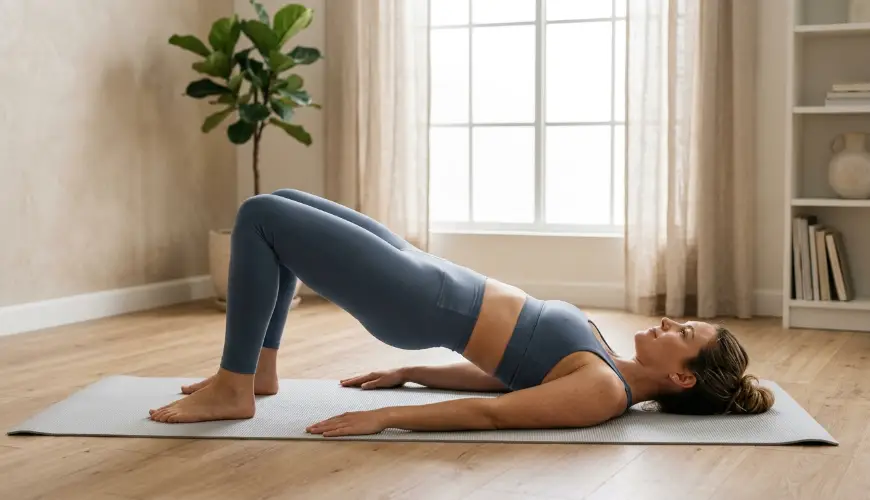
- Bridge (glute bridge) – lying on your back, knees bent, lifting the pelvis with conscious engagement of the pelvic floor on the exhale
- Squat with correct technique – a deep squat with a straight back activates the pelvic floor in a natural way, as the human body has done for thousands of years
- Breathing exercise with core activation – inhale into the belly, exhale with a gentle contraction of the pelvic floor and lower abdomen
- Side plank – strengthens the lateral stabilisers and indirectly engages the entire stabilisation system, including the pelvic floor
Take, for example, thirty-year-old Lucia, who began experiencing urine leakage while running after her second childbirth. She had to cut back on her favourite sport and felt frustrated. After visiting a physiotherapist specialising in the pelvic floor, she discovered that her muscles were not only weak, but also uncoordinated – they were unable to respond correctly to sudden increases in pressure. The therapist drew up an individual plan combining Kegel exercises, Pilates, and correct breathing technique. After three months of regular exercise, Lucia returned to running without any difficulties.
Lucia's story is not exceptional. Physiotherapist and pelvic floor specialist Kari Bø, whose research published in the British Journal of Sports Medicine is among the most cited in the field, has repeatedly demonstrated that regular pelvic floor exercise is more effective than many surgical procedures in treating stress incontinence. And yet these are exercises a woman can learn on her own at home.
An important part of pelvic floor care is also becoming aware of everyday habits that harm it. These include, for example, the habit of going to the toilet "just in case" – that is, urinating even when there is no urgent need. This seemingly harmless habit gradually trains the brain to respond to increasingly smaller amounts of urine in the bladder, leading to increased urgency. Equally harmful is holding your breath when lifting heavy objects, as this dramatically increases intra-abdominal pressure and strains the pelvic floor.
Nutrition and hydration also play a role. Adequate water intake (paradoxically) helps prevent bladder irritability, because overly concentrated urine irritates its walls more. Fibre and a healthy gut microbiome contribute to regular bowel movements and reduce the need for straining, which burdens the pelvic floor. In this sense, pelvic floor care goes hand in hand with an overall healthy lifestyle – and it is precisely this connection that makes this topic part of a broader approach to self-care.
But when should you seek professional help? If the exercises are not working, if the difficulties are significant or persist for more than a few weeks, visiting a physiotherapist specialising in the pelvic floor is the best step. These specialists can accurately assess the condition of the muscles, identify any dysfunctions, and draw up an individual plan. The number of physiotherapists with this specialisation in the Czech Republic is growing year on year, and interest in their services increases annually – which shows that women are ceasing to treat this topic as taboo.
The pelvic floor deserves the same attention as any other muscle in the body. Regular care for it is not a luxury or the preserve of women after childbirth – it is a fundamental part of women's health at every age. The sooner a woman starts, the better. And the more openly this topic is discussed, the fewer women will needlessly suffer in silence.