

# What is the glycemic index and why you don't need it
The glycemic index belongs to those concepts that have become so firmly embedded in nutritional discussions over recent decades that many people feel guilty if they don't track it. Tables, numbers, values from zero to one hundred – and suddenly food becomes a mathematical discipline rather than a natural part of life. Yet the vast majority of people who eat healthily and feel well never consciously calculate any glycemic index.
Before we get to why you can manage without it, however, it's worth understanding what this term actually means and why it has attracted such attention.
Try our natural products





What exactly is the glycemic index
The glycemic index, abbreviated as GI, is a numerical value that describes how quickly a specific food raises blood sugar levels after it is eaten. The reference point is pure glucose or white bread with a value of 100 – other foods are then compared against this baseline. High-GI foods (above 70) cause a rapid rise in blood glucose, while low-GI foods (below 55) raise it slowly and steadily. The middle range covers values between 55 and 70.
The concept originated in the 1980s at the University of Toronto, where it was first described by Dr. David Jenkins and his team. It was originally designed as a tool for patients with diabetes to help them better manage their blood sugar levels. This is important context – it was a clinical tool for a specific group of people, not a universal guideline for healthy eating across the entire population.
But as tends to happen in the field of nutrition, a good idea spreads quickly, gets simplified, and ultimately becomes dogma. The glycemic index began appearing in popular diets, healthy lifestyle magazines, and the marketing communications of food companies. An entire industry grew up around products labelled "low GI," without it always being clear whether this actually delivered health benefits.
Why the glycemic index is more complicated than it appears
The biggest problem with the glycemic index isn't that it's wrong – it's that it's imprecise in the real world. And for several reasons.
First, GI was measured on isolated foods consumed on an empty stomach. But nobody normally eats plain boiled potatoes with nothing else. The moment you add a little butter, vegetables, or meat to those potatoes, the entire glycemic profile of the meal changes fundamentally. Fats and proteins significantly slow the absorption of carbohydrates, so the actual effect on blood sugar is completely different from what the table value for an individual food's GI would suggest.
Second, the glycemic index depends on the method of preparation. Pasta cooked al dente has a lower GI than overcooked pasta. An unripe banana has a lower GI than a ripe one. Cold cooked rice has a lower GI than freshly cooked rice – the exact same rice from the exact same pot. These differences are real and scientifically documented, but in practice they are nearly impossible to track.
Third, and perhaps most crucially, the response to the same food varies from person to person. An Israeli study published in the journal Cell in 2015, conducted by the team of Eran Segal and Eran Elinav at the Weizmann Institute, revealed something surprising: the glycemic response to an identical meal varies dramatically between different people – even for such "standard" foods as bread or rice. Some people responded to a banana far more calmly than to biscuits, while for others it was exactly the opposite. The study's findings called into question the very foundation of the universal glycemic index as a practical tool for individual dietary recommendations.
There is yet another factor that is often overlooked in popular explanations of GI: glycemic load. This takes into account not only the speed but also the quantity of carbohydrates in a portion. Watermelon, for example, has a high glycemic index, but a realistic serving contains so few carbohydrates that its effect on blood sugar is minimal. Focusing solely on GI without the context of portion size is a bit like judging a car purely by its top speed without considering how the driver actually uses it.
All these complications lead to one conclusion: calculating the glycemic index in everyday life is unnecessarily complex for most people and does not deliver as many benefits as it might appear.
How to eat healthily without tables and numbers
There is a simpler path. In fact, it is so simple that many people overlook it precisely because they are searching for a more sophisticated solution.
Imagine Marie, a forty-year-old teacher from Brno, who spent several years trying to track the glycemic index of her diet. She carried tables to the shops, refused fruit with a "too high GI," and stressed every time she had rice instead of quinoa. Paradoxically, she felt worse than before – not only physically, but above all psychologically. Food had ceased to be a pleasure and had become a source of anxiety. Then she tried a different approach: she stopped counting and began following simple rules that required no calculator.
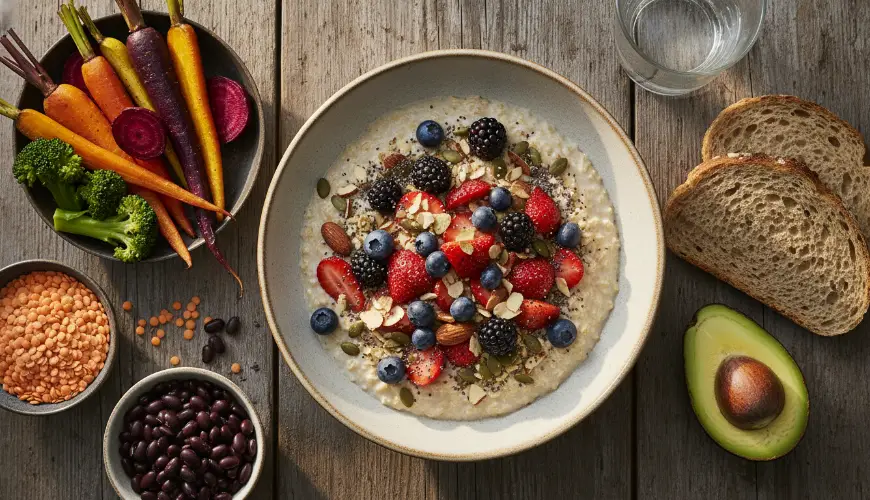
The fundamental rule is to prioritise natural, minimally processed foods. Vegetables, legumes, wholegrains, nuts, seeds, quality proteins, and healthy fats – these are foods that naturally lead to slower sugar absorption, greater satiety, and more stable energy throughout the day. Not because they have a low GI, but because they are rich in fibre, protein, and the nutrients the body needs.
Fibre is key in this regard. It slows digestion, feeds beneficial gut bacteria, and helps maintain stable blood sugar levels – all without any need to know what the glycemic index is. The World Health Organization recommends consuming at least 25 grams of fibre per day, while the average European consumes significantly less. Adding more vegetables, legumes, and wholegrains to one's diet naturally addresses this shortfall.
Equally important is the composition of the meal as a whole. Combining carbohydrates with proteins, fats, and fibre automatically slows the absorption of sugars – and all without any counting. A bowl of porridge with nuts and fruit will have a completely different effect on blood glucose than plain porridge without any additions, regardless of the table values for the individual ingredients.
Another natural guide is to pay attention to your own body. How do you feel an hour after eating? Do you have energy, or are you overcome by tiredness and a craving for more food? Energy, satiety, and wellbeing after a meal are the best indicators of whether food agrees with your body – and they are far more accurate than any general table, because they reflect your individual physiology.
As the writer Michael Pollan said in his book In Defense of Food: "Eat food. Not too much. Mostly plants." This seemingly simple sentence contains more practical wisdom than dozens of pages of nutritional tables.
It is of course true that for certain groups of people, tracking the glycemic index does make sense. People with type 2 diabetes, prediabetes, or insulin resistance may genuinely benefit from more detailed monitoring of their responses to carbohydrates – ideally in collaboration with a doctor or dietitian. Modern technologies such as continuous glucose monitors also make it possible to track individual glycemic responses in real time, which is far more precise than any general table. For these purposes, knowledge of GI is valuable. But this remains a specific clinical context, not a general guide for the healthy population.
For most people who simply want to eat more healthily, feel better, and have stable energy, there is a more direct path. More vegetables on the plate, fewer industrially processed foods, adequate protein and healthy fats, regular physical activity, and quality sleep – these are the factors that have a demonstrably greater impact on metabolic health than careful tracking of the glycemic index. And importantly, they are sustainable. Nobody keeps counting numbers for every bite year after year, but most people can gradually change the composition of their diet if that change makes intuitive sense and doesn't feel like a punishment.
Healthy eating does not have to be complicated. Nutritional science is complex, that is true – but the practical conclusions drawn from it are surprisingly straightforward. A varied diet rich in natural foods, sufficient physical activity, and attention paid to one's own feelings after eating are the foundations upon which every successful approach to a healthy lifestyle is built. The glycemic index is an interesting scientific concept with real limitations – and knowing about it can be useful for understanding nutrition. But calculating it daily? Most of us truly don't need to do that.