

Cossack squat trains hips better than most squats
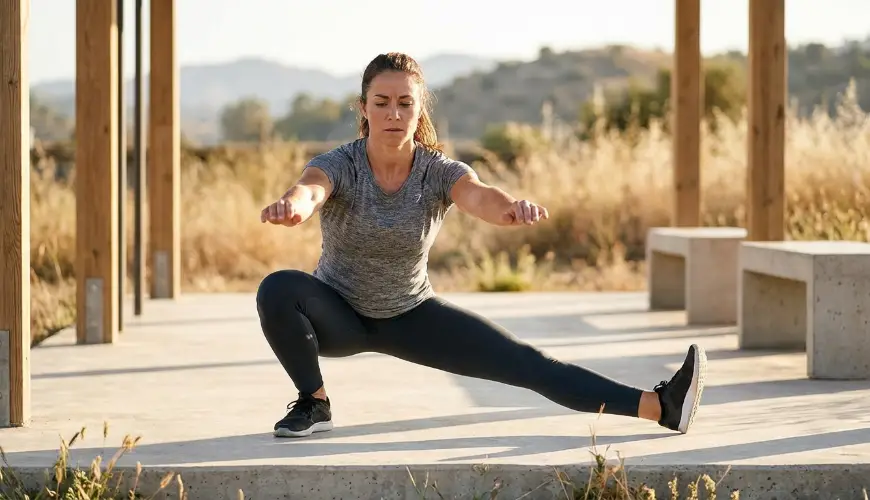
There is an exercise that most people in the fitness world have never heard of, yet people around the world have been practicing it for thousands of years. It's called the cossack squat – and if you have tight hips, limited range of motion, or are simply looking for an exercise that will take your body to a completely new level, this might be exactly what you've been looking for. It's not an exaggeration to say that it is one of the most effective movement patterns you can incorporate into your daily training.
The cossack squat originates – as the name suggests – from the traditions of Eastern European Cossacks, who used this movement not only as part of their war dance, but also as a natural way of moving in everyday life. Today it is being rediscovered by physiotherapists, movement system coaches, and competitive athletes who recognise how much the modern sedentary lifestyle damages the musculoskeletal system. The hip joints are the centrepiece of the entire body – they connect the upper and lower trunk, transferring force with every step, jump, or lift. And that is precisely why their stiffness causes problems far beyond the joint itself.
Try our natural products



What exactly is the cossack squat and how to perform it
Imagine a classic squat. Now turn it to the side. Simply put, the cossack squat is a deep lateral squat in which you lower yourself on one bent leg while the other leg remains extended to the side with the foot resting on the ground. The movement looks exotic at first glance, but its mechanics are surprisingly natural – similar to how children spontaneously move during play without even thinking about it.
The execution is not complicated, but it requires attention to detail. You start standing with your feet spread significantly wider than shoulder-width apart. You slowly shift your weight to one side, bending your knee and lowering your hips toward the ground, while the other leg remains straight. Your back should be as straight as possible, chest lifted, gaze directed forward. The toes of the extended leg can be pointed toward the ceiling or kept resting on the heel – both variations have their specifics and different levels of difficulty. At the lowest point of the movement, you should feel an intense stretch along the inner side of the extended leg and simultaneously feel activation of the entire bent leg, from the gluteal muscle through the quadriceps to the ankle stabilisers.
The key to safe execution is gradual progression. No one should expect a full range of motion right from the start. Physiotherapist and movement specialist Gray Cook, founder of the Functional Movement Screen system, has long pointed out that movement patterns must first be mastered within a limited range and only gradually increased in depth. This applies doubly to the cossack squat – progressing too quickly can lead to overloading of the knee joint or spine.
A practical example is easy to imagine: Jana, a thirty-four-year-old accountant who spends eight hours a day at a computer, started doing the cossack squat on the recommendation of her physiotherapist due to chronic lower back pain. In the first week, she could only manage a shallow version with support from a wall. After three weeks of regular exercise – ten repetitions on each side per day – she was able to perform the full movement and her back pain significantly decreased. Her story is not unique. Thousands of people who have incorporated this seemingly simple exercise into their day describe similar experiences.
Why hips are so important and what stiffness causes
Modern civilisation sits. We sit in cars, at desks, on sofas, in restaurants. The average adult in developed countries spends more than nine hours a day sitting, as research published in the academic journal Annals of Internal Medicine indicates. This position shortens the hip flexors – the muscles that draw the knee toward the chest – and weakens the gluteal muscles. The result is a muscular imbalance that manifests as pain in the back, knees, and hips themselves. And what is insidious about it is that this stiffness develops slowly and imperceptibly, so many people only become aware of it when it is causing them real problems.
The hip joint is a ball-and-socket joint – it allows movement in all planes. But if we don't regularly exercise it through its full range, we gradually lose the ability to perform these movements. Fascia – the connective tissue surrounding the muscles – stiffens, shortens, and restricts mobility. The cossack squat is one of the few exercises that loads the hip joint in multiple planes simultaneously – in the sagittal plane during flexion of the bent leg and in the frontal plane during abduction of the extended leg. This is precisely the kind of stimulation that hips need to remain functional and mobile.
It is interesting how this problem manifests in different cultures. In countries where sitting on the ground is natural – in many Asian or African communities – hip problems are significantly less common. People there perform movements similar to the cossack squat naturally every day, without calling it exercise. As anthropologist and movement scientist Katy Bowman once noted: "Movement is not something we do in addition to our lives. Movement is part of what we are." This thought perfectly captures why isolated exercise in a gym is not enough – the body needs varied movement throughout the entire day.
The benefits of the cossack squat extend far beyond the hips. Regular performance of this exercise strengthens the inner thighs (adductors), develops strength and stability of the ankles, trains balance and proprioception, and simultaneously serves as excellent preparation for heavier strength exercises such as deadlifts or Olympic lifting. Martial arts athletes, dancers, and ball sport players incorporate it into their preparation programmes because it helps them maintain the mobility essential for their performance.
It is also important to mention that the cossack squat has a direct impact on spinal health. Tight hips force the spine to compensate for their limited mobility – with every step, every forward bend, or turn, the spinal segment tries to replace the movement that should naturally come from the hip joint. This compensation is one of the most common causes of chronic back pain, as confirmed by expert sources such as the National Institute of Neurological Disorders and Stroke. By restoring hip mobility through the cossack squat, the spine can return to its natural function.
For those who want to start, a few practical recommendations apply. No equipment is needed, no gym, no special footwear. All you need is enough space and the willingness to dedicate a few minutes each day to movement that the body truly needs. The best results come from regularity – even five minutes a day is significantly better than an hour once a week. The exercise can be incorporated as part of a morning warm-up, a work break, or an evening stretch before bed.
In terms of progressions, beginners can use support – simply holding onto a door frame or a pole allows them to maintain balance and focus on correct body position. A more advanced variation involves adding weight – a kettlebell held in front of the body helps maintain an upright trunk while also increasing the strength demands of the exercise. There are also assisted variations for people with limited ankle mobility, where a small wedge is placed under the heel of the bent leg, making execution easier without losing proper technique.
The fitness world is full of passing trends that come and go. The cossack squat does not belong among them. It is a movement pattern proven by centuries of practical use, whose effectiveness is confirmed by both traditional practice and modern sports science. At a time when more and more people suffer from movement deficiency and its consequences, this exercise offers an elegant and accessible solution. You don't need to be an athlete or have years of training experience – you just need to start, be patient, and give your body time to adapt.
The hips are the foundation of human movement. Caring for them is not a luxury, but an investment in the quality of everyday life – in how we move, how we feel, and how we manage the demands that the modern world places on us each day. And if there is one exercise that can return this investment with interest, it is the cossack squat.