

# How to Achieve a Confident Squat Through Mobility
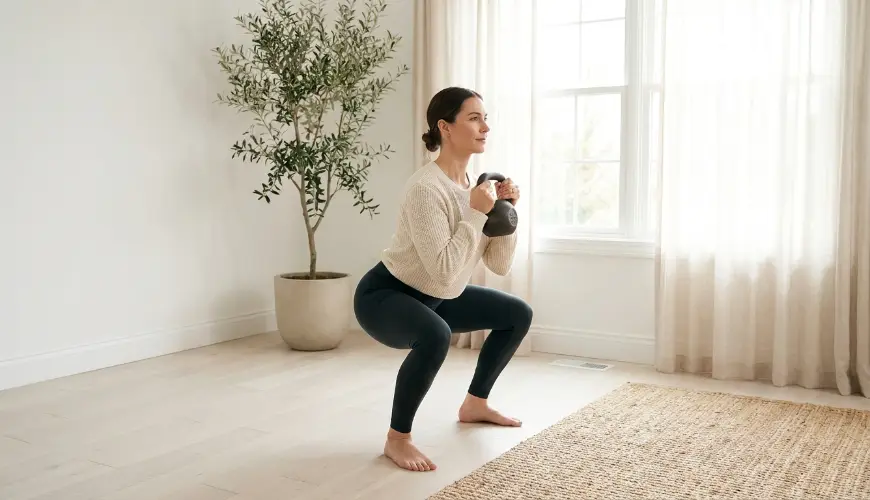
The squat is one of the most natural movements of the human body. Small children perform it without thinking – with straight backs, heels firmly on the ground, and knees tracking over their toes. But somewhere between childhood and adulthood, this natural skill fades away. Hours spent sitting in chairs, shortened muscles, and stiff joints gradually transform what was once effortless into a movement that causes pain, uncertainty, or outright failure. As a result, many people either skip the squat entirely or perform it in a way that does more harm than good.
Yet a deep, technically correct squat is one of the best indicators of overall mobility and functional musculoskeletal health. It's not just a strength exercise for bodybuilders – it's a movement pattern we use when sitting on the ground, picking objects up off the floor, or working in the garden. When we master it well, the reward is stronger legs, a healthy back, and stable knees. The key to success lies not primarily in strength, but in mobility – the ability of joints to move through their full range of motion.
Try our natural products




Why mobility matters more than strength
Many people try to improve their squat by adding weight or repetitions. But that approach is built on shaky foundations. If the body lacks sufficient mobility in the ankle joint, hips, or thoracic spine, it will seek compensation elsewhere – most often at the expense of the knees or lumbar spine. And that is precisely where overloads and injuries arise, which then put people off exercising for months.
Mobility is not the same as flexibility. A flexible person can be passively stretched into a large range of motion, for example during stretching. A mobile person, however, can actively control movement throughout the full range – and that is a crucial distinction when it comes to squatting. As physiotherapist and popular FRC system author Andreo Spina points out, "mobility is flexibility plus strength" – meaning the ability of a joint to move consciously and safely throughout its entire range of motion.
The good news is that mobility can be trained. And you don't need a gym or expensive equipment to do it. All it takes is regular work with your body, patience, and knowledge of the right exercises. This article focuses on the four most effective ones.
Take Martin, for example – a forty-year-old office worker who decided to start exercising after years of sitting at a computer. The squat was a nightmare for him – his heels lifted off the ground, his knees caved inward, and his back rounded before he was even halfway through the movement. Instead of adding weight or trying to force his way through his limitations, he began working on mobility. After six weeks of regular practice, his squat was unrecognisable. No magic – just systematic work with the right exercises.
4 mobility exercises for a confident squat
1. Ankle joint mobilisation at the wall
The ankle joint is absolutely critical for the squat, yet it is the most commonly overlooked link in the entire chain. If the ankle doesn't allow sufficient dorsiflexion – the movement in which the toes approach the shin – the body compensates by lifting the heels or leaning the torso forward. Both disrupt technique and overload the back.
The exercise is simple: stand about 10 cm from a wall, place your toes against it, and slowly push your knee towards the wall so that it touches the surface. The heel must remain on the ground throughout. If the knee doesn't reach the wall, shorten the distance. If it touches easily, increase the distance. Work each side for 2 minutes, performing the movement rhythmically – not statically, but in a repeated back-and-forth motion. This dynamic mobilisation releases the soft tissues around the ankle more effectively than simply holding a position.
Research published in the Journal of Strength and Conditioning Research confirms that limited ankle dorsiflexion directly correlates with impaired squat technique and an increased risk of knee injury. Paying attention to the ankles is therefore not an optional add-on – it is a fundamental requirement.
2. Hip 90/90 stretch
The hips are the second major "limiting factor" in the deep squat. Shortened hip flexors, restricted external rotation, or tight hip adductors – all of these prevent the hip joint from reaching the full flexion required for a deep squat. The exercise known as 90/90 is popular among physiotherapists precisely because it addresses multiple aspects of hip mobility simultaneously in a single position.
Sit on the floor with your front leg bent at a 90-degree angle in front of you and your rear leg bent at a 90-degree angle behind you – both knees forming right angles. Keep your torso upright. In the first phase, lean forward over the front leg; in the second phase, rotate over the rear leg. The key is to keep your torso upright and your hips as close to the ground as possible. Start with 30 seconds on each side and gradually increase the duration.
This exercise improves both internal and external rotation of the hip – both of which are essential for a stable and deep squat. It is also a movement that forms a natural part of sitting in many Asian and African cultures, where the deep squat is a daily occurrence and problems with knees or backs are significantly less common than in countries with sedentary lifestyles.
3. Thoracic rotation in kneeling
The thoracic spine – the area between the shoulder blades – plays a perhaps less obvious but equally important role in the squat. If it is stiff and doesn't allow sufficient rotation and extension, the body "borrows" mobility from the lumbar spine, which is not designed for that purpose. The result is chronic back pain, which many people mistakenly attribute to the squat itself, even though the true cause lies higher up.
The exercise is performed on all fours. Place one hand behind your head with the elbow pointing towards the ground. Then slowly rotate through the thoracic spine so that the elbow points towards the ceiling – the movement originates from the thoracic spine, not the lower back. Repeat 10 times on each side, pausing briefly at the end range. The movement should be smooth and controlled, not jerky.
Regular thoracic spine work produces results quickly – many people feel relief and greater freedom of movement after just the first week of regular practice. An upright torso in the squat then ceases to be the result of sheer willpower and becomes the natural consequence of a mobile spine.
4. Deep squat hold with support (goblet squat hold)
The fourth exercise is effectively a transition from mobilisation to the squat itself – and it may be the most practical of all. The goblet squat hold combines mobilisation of the hips, ankles, and spine in a single functional position.
Take a kettlebell, a heavy water bottle, or another object and hold it in front of your chest. Slowly lower yourself into as deep a squat as possible, keeping your heels on the ground and pushing your knees out with your elbows. Hold the bottom position for 30 to 60 seconds. The weight acts as a counterbalance that allows you to stay upright while naturally pulling you deeper into the squat. The elbows pressed against the insides of the knees then actively push the knees into the correct position.
This exercise is recommended by physiotherapists and conditioning coaches around the world as one of the most effective ways to improve squat technique while simultaneously mobilising all the relevant joints at once. Regularly spending time in the bottom position of the squat gradually releases tissues that have been shortened by years of sitting, and the brain relearns that this position is safe and natural.
How to incorporate the exercises into your daily routine
Knowing the right exercises is one thing – incorporating them into your daily routine is another. The good news is that mobility work doesn't require hours in the gym. Ten to fifteen minutes a day is sufficient, ideally in the morning or before a training session. Include each of the exercises described above as a set and give it proper attention – rushing from one exercise to the next yields only a fraction of the results compared to focused, mindful practice.
Many musculoskeletal health experts, such as the team behind the MobilityWOD project led by Kelly Starrett, recommend devoting the same attention to mobility as to strength training itself. Mobility is not preparation for "real" exercise – it is itself real exercise. And the results will be evident not only in your squat, but in the overall quality of your movement and how your body feels.
Interestingly, improvements in mobility extend beyond the gym. People who regularly work on joint mobility report less back pain when sitting, better posture, and greater overall energy throughout the day. A body that knows how to move, moves willingly – and that is a motivation that lasts far longer than the pursuit of aesthetic results.
The path to a confident squat therefore does not lie in ignoring your limitations or in forcefully pushing through pain. It lies in patient, systematic work on mobility – of the ankles, hips, and spine. The four exercises described above are neither a shortcut nor a miraculous solution. They are, however, a proven, functional foundation on which to build. And anyone who has ever experienced the feeling of a deep, controlled squat with heels firmly on the ground and an upright torso will understand why the work is worth it.