
# Why to Have Seeds at Home and How to Use Them
There are things that take up just a little space in the kitchen, cost next to nothing, and yet have the potential to fundamentally transform what we eat every day. Seeds are exactly such an example. Unassuming, tiny, sometimes overlooked – and yet they rank among the most nutrient-dense foods you can possibly find. It's no wonder that in recent years they have become a firm fixture in modern cooking, not only among health enthusiasts but also among ordinary people looking for a simple way to eat better without dramatic changes.
Just imagine Markéta, a thirty-three-year-old teacher from Brno, who two years ago started adding a spoonful of flaxseeds to her morning porridge. She changed nothing else. She didn't switch to a special diet, she didn't buy expensive supplements. Just that one small change – and after a few months she noticed she had more energy, her digestion was working better, and she felt hungry less often. Stories like this are not the exception. They are proof that big changes don't have to begin with a big revolution.
Try our natural products


What's hidden in such a small package?
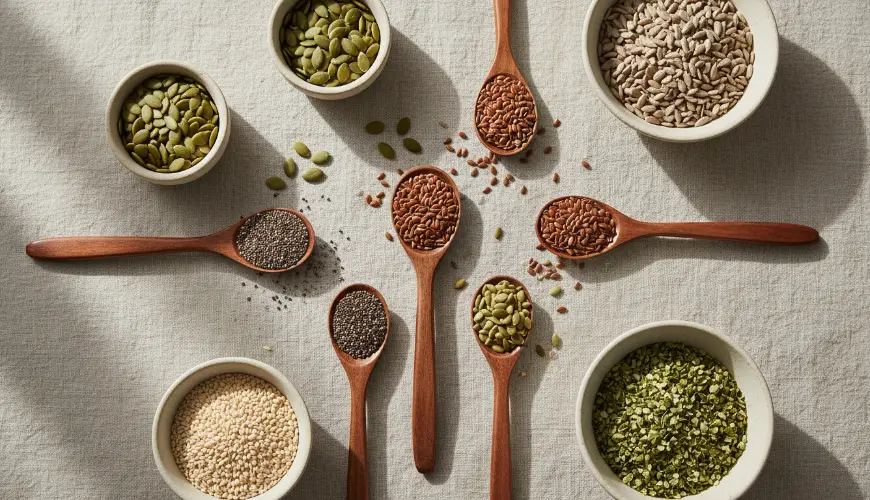
Seeds are an evolutionary miracle. Every single seed contains everything needed to grow an entire plant – concentrated energy, nutrients, fats, proteins, and protective compounds. That is precisely why they are so exceptionally nutritious. Chia seeds, flaxseeds, hemp seeds, pumpkin seeds, sunflower seeds, or sesame – each of these varieties offers a slightly different nutritional profile, but they all have one thing in common: they are densely packed with substances that the body truly needs.
Take chia seeds, for example, which in recent years have become almost a symbol of healthy eating. According to data from the U.S. Department of Agriculture, just 28 grams of chia seeds contain approximately 11 grams of fibre, 4 grams of protein, and healthy omega-3 fatty acids. That is an exceptional amount of nutrients for such a small volume of food. Flaxseeds are similarly impressive – they are one of the richest plant-based sources of omega-3 fatty acids available – as are pumpkin seeds, which are high in zinc, magnesium, and iron.
Hemp seeds stand out for containing all essential amino acids – those that the human body cannot produce on its own and must obtain through diet. This makes them a valuable source of plant-based protein, particularly appreciated by people who are reducing their meat consumption or eating a vegan diet. And sesame? It is rich in calcium and healthy fats, and people across various cultures have been consuming it for thousands of years – so it is no passing trend, but a food with a deep history.
A natural question arises: if seeds are so nutritious, why do so many people overlook them in their diet?
The answer is probably straightforward. Seeds don't look particularly appealing. They aren't colourful, they don't have a strong flavour, and no one actively advertises them the way protein bars or energy drinks are marketed. Yet it is precisely their unassuming nature that is their strength – they can easily be added to meals without significantly altering the taste, while substantially increasing their nutritional value.
How to incorporate seeds into everyday life?
The biggest obstacle when introducing new foods into one's diet is usually the feeling that it will be complicated or time-consuming. Fortunately, with seeds, this fear is entirely unfounded. Very little is truly enough – and that is their greatest advantage.
A tablespoon of ground flaxseeds in morning porridge or yoghurt is so unobtrusive that many people won't even notice it, but the body certainly will. Chia seeds can be soaked overnight in plant-based milk and eaten in the morning as a so-called chia pudding – simple preparation, zero cooking, excellent results. Pumpkin seeds work wonderfully as a crunchy topping on soup or salad. Sesame suits Asian-inspired dishes, but works just as well sprinkled on homemade bread or wholegrain baked goods.
As British nutritionist and author of books on healthy eating Michael Pollan noted: "Eat food. Not too much. Mostly plants." Seeds are one of the simplest ways to put this advice into practice – they are real, minimally processed foods that come directly from nature.
For those who want to be a little more systematic, it can help to keep a stock of several types of seeds at home and rotate them depending on mood or dish. There's no need to buy everything at once – it's enough to start with one variety and gradually experiment. A good starting point might look something like this:
- Flaxseeds – ideal in porridge, smoothies, or baked goods, preferably ground for better absorption
- Chia seeds – great in puddings, yoghurts, or as a thickener in cooking
- Pumpkin seeds – excellent as a snack or sprinkled on soups and salads
- Hemp seeds – mild, slightly nutty flavour, suitable for smoothies and muesli
- Sesame – a classic in Asian dishes, hummus, or homemade baked goods
- Sunflower seeds – versatile, tasty on their own or in a wide variety of combinations
One practical detail is worth mentioning: flaxseeds are best consumed ground, not whole. The human digestive system is unable to fully break down whole flaxseeds, meaning the nutrients would pass through the body unused. A coffee grinder can grind flaxseeds in seconds, or you can simply buy the pre-ground variety.
Another tip for those who care about the quality of what they eat is to reach for organically sourced seeds. Organic seeds are grown without synthetic pesticides and herbicides, which affects not only their purity but also the sustainability of agricultural production as a whole. Research suggests that organically grown foods may have a higher content of certain antioxidants, although the scientific debate on this topic is still ongoing – as noted, for example, in a review study published in the British Journal of Nutrition.
Seeds are also not just a matter of food. Hemp seeds and their oil are used in cosmetics, and linseed oil has its place both in the kitchen and in skincare. Pumpkin seed oil is a traditional part of both the cuisine and folk medicine in some regions of Central Europe. Seeds have permeated human culture across centuries and continents – from sesame seeds in Middle Eastern cuisine to flaxseeds in Central European baked goods and chia seeds, which were a staple food of Aztec civilisation.
Seeds and sustainability – a small choice with a big impact
It is interesting that seeds are beneficial not only for human health but also for the health of the planet. Seed cultivation is generally among the less resource-intensive agricultural activities in terms of water and land use compared to animal production. Incorporating seeds into the diet as a source of protein and healthy fats in place of some animal products can therefore be a small but meaningful step towards a more sustainable way of eating.
The United Nations Food and Agriculture Organization (FAO) has long been highlighting that nutrient-rich plant foods, such as seeds and legumes, play a key role in the future of a sustainable food system. This is not a call for absolute veganism or radical lifestyle change – it is rather a reminder that every small choice on the plate has a broader impact.
And this is where the circle closes. Seeds are a small thing – physically, financially, and logistically. They fit in a drawer, in a handbag, in a morning routine. They require no special preparation, no special equipment, and no expensive recipes. And yet they can transform what we eat, how we feel, and – on a small scale – the impact our lifestyle has on the world around us.
When Markéta from Brno was asked after a year what she had changed about her diet, she answered simply: "Just the seeds." And that perhaps says everything that needs to be said. It's not about a perfect diet, expensive ingredients, or complicated recipes. It's about starting – perhaps with a spoonful of flaxseeds in morning porridge – and letting small things do big work.