

# Most Common Beginner Mistakes When Exercising at Home
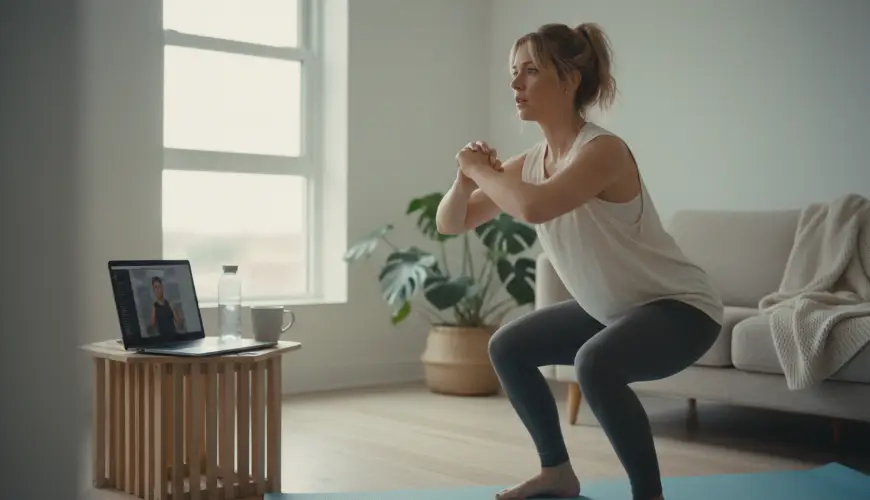
Home exercise has been experiencing a huge boom in recent years. All you need is to roll out a mat in the living room, play a YouTube video, and seemingly nothing stands in the way of getting in shape without paying for an expensive gym membership. But this apparent simplicity is deceptive in many ways. Without a trainer's supervision, proper equipment, and basic knowledge, it's easy for enthusiasm to quickly fade, results to fail to appear, or – in the worst case – injury to occur. Most beginners make the same mistakes when exercising at home without even being aware of it.
It's not a question of laziness or lack of willpower. It's more that physical training has its own rules, which apply regardless of whether a person exercises in a professional fitness centre or in their own flat. And it is precisely knowledge of these rules that determines whether home exercise becomes a lasting habit that delivers results, or merely a brief episode interrupted by the first disappointment.
Try our natural products





Skipping the Warm-Up and Underestimating Recovery
One of the most common mistakes beginners make is jumping straight into the main workout without any preparation. A warm-up can seem like a waste of time, especially when you only have thirty minutes and want to use them as effectively as possible. The opposite is true, however. Warming up muscles and joints before physical exertion reduces the risk of injury while also improving performance during the workout itself. According to recommendations from the American Heart Association, a warm-up should last at least five to ten minutes and include movements that gradually activate the entire body.
The same problem arises at the other end of the workout. Many beginners simply stop exercising, take a shower, and get on with their day. Skipping the cool-down stretching and allowing the body to calm down can, however, lead to muscle tension, soreness, and slower recovery. Recovery is not just about stretching – it also includes adequate sleep, hydration, and proper post-workout nutrition. The body needs time to repair muscle fibres, and if we don't allow it this time, results paradoxically come more slowly, not more quickly.
Take Markéta, a thirty-year-old accountant from Brno, who decided to start exercising at home after the birth of her second child. In the first week she exercised every day with full commitment, skipped the warm-up to save time, and after two weeks had to stop due to knee pain. It was only after consulting a physiotherapist that she understood the problem was not the intensity of the training, but her approach to it. After introducing a warm-up and regular stretching, the pain disappeared, and Markéta has now been exercising regularly for over a year.
This story is not exceptional. Physiotherapists and trainers encounter similar cases very frequently, and yet it would be enough to follow basic rules that are freely available in any solid guide to physical training.
Poor Technique and Progressing Too Quickly
The second major category of mistakes concerns the actual execution of exercises. Without a trainer present to immediately correct poor posture or an incorrect movement pattern, beginners can easily develop habits that are not only ineffective but also dangerous. Poor squat, push-up, or deadlift technique can strain the wrong muscle groups and gradually lead to chronic back, knee, or shoulder pain.
The problem is compounded by the fact that many online videos and apps emphasise speed and intensity rather than correct form. Watching an instructor on a screen is also limited – you cannot see yourself from the side or from behind and have no opportunity for immediate feedback. A solution may be to record your own training on a phone and then compare it with a demonstration, or at least to occasionally consult a specialist, even if only online.
Closely related to technique is also increasing load or intensity too quickly. Beginners are often motivated to see results as soon as possible, and so they add weight, shorten rest periods, or move on to advanced exercise variations before their body is ready. This approach is a direct path to injury. Sports medicine experts recommend following the so-called ten percent rule – that is, not increasing weekly training volume or intensity by more than ten percent at a time. The body needs time to adapt, and this process cannot be accelerated by willpower alone.
Hand in hand with this goes the selection of exercises that are unsuitable for the current level of fitness. Many popular videos online are intended for advanced exercisers, and beginners try to imitate them without the necessary foundation. The result is overworked muscles, soreness, and disappointment. A far more sensible approach is to start from the basics – learning to correctly perform fundamental movement patterns such as the squat, lunge, push-up, and plank – and only then to progress further.
As leading Czech physiotherapist Pavel Kolář says: "Movement quality always precedes movement quantity. Those who master a movement correctly can then perform it in any amount." This idea is key for anyone who wants to exercise long-term and without injury.
Unrealistic Expectations and the Absence of a Plan
The third major issue concerns the approach to planning and goal-setting. Home exercise offers tremendous freedom, but this very freedom can be a trap. Without a clear plan, it is easy to exercise randomly, without structure, and after a few weeks to see no results – because no consistent stimulus has been given to the body.
The absence of a training plan is one of the main reasons why most people stop home exercising after a few weeks. Effective training requires progressive overload, alternating different types of exertion, and sufficient rest between sessions. All of this is difficult to ensure without a pre-prepared plan that takes into account individual goals, fitness level, and available time.
Closely linked to planning are also unrealistic expectations. Social media is full of photographs of perfect bodies and stories of incredible transformations in eight weeks. These portrayals are, however, highly distorted and rarely reflect reality. Visible changes in physique require months of regular work, not weeks. Those who do not understand this and see no dramatic result after six weeks easily conclude that exercise "doesn't work" – and give up.
Realistic goals should be specific, measurable, and time-bound. Instead of "I want to lose weight," it is better to say "I want to exercise three times a week for at least thirty minutes and be able to do ten push-ups in a row within three months." Such a goal is achievable, verifiable, and motivating.
Another aspect that beginners underestimate is the impact of nutrition on exercise results. Home training without adequate diet is like a car without fuel. This doesn't mean it's necessary to count every calorie or follow a strict diet, but the basic principles of a balanced diet – sufficient protein for muscle recovery, complex carbohydrates as an energy source, and healthy fats – have a fundamental influence on how a person feels while exercising and how quickly they achieve results. According to the World Health Organization, a balanced diet should include a wide variety of foods from different groups, with industrially processed foods kept to a minimum.
Let us add one more factor that tends to be overlooked: choosing a suitable environment and equipment. Exercising on a slippery carpet without a mat, in an unventilated room, or in unsuitable footwear are seemingly minor details that can, however, have a significant impact on both the quality of training and safety. A good non-slip yoga or exercise mat is a basic investment that quickly pays off – not only in the form of better performance, but also as a precaution against unnecessary falls and injuries. It is equally important to have enough space to move and to ensure that there is no risk of tripping over toys, furniture, or pets during the workout.
Finally, one more thing closely related to home exercise is worth mentioning: motivation and consistency. A gym has one great advantage – the very fact that a person has paid for membership and physically come to the location motivates them to exercise. At home, this external motivation is absent and everything depends purely on internal discipline. It is therefore important to create a ritual – a specific time, place, and routine that builds exercise into daily life as a natural part of the day, rather than yet another item on a to-do list. Finding a community can also help – whether an online group, a workout partner, or following a particular trainer whose approach resonates with your personal values.
Home exercise can be just as effective as training in a gym – and for many people even more so, because barriers such as commuting, waiting for equipment, or social anxiety are removed. The key, however, is to approach it with respect for your own body, with realistic expectations, and with a willingness to learn. Mistakes are a natural part of every beginning – what matters is recognising them early and not allowing them to grow into habits or injuries that then prevent you from continuing.