

A spring salad that satisfies can be easily made by adding proteins and healthy fats.
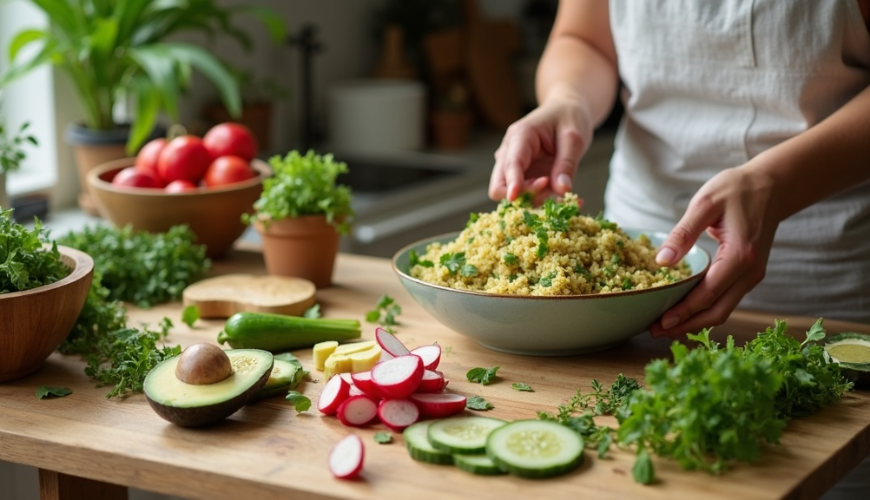
Spring has a peculiar ability to change one's appetite. After winter, when one often relies on hearty soups, roasted dishes, and "something warm to hold," the first bundles of radishes, tender salads, and herbs that smell like a freshly opened window suddenly arrive. Yet, with the lightness of spring, an old myth sometimes follows: a salad is supposedly just a side dish or "rabbit food" that leaves you hungry after an hour. Does spring salad really have to be synonymous with not feeling full? A small change in thinking is all it takes to turn a crunchy bowl into a salad that is a full and balanced meal that satisfies—all while remaining fresh, seasonal, and versatile.
The key is simple: a salad is not just leaves. It's a composition. When you combine proteins, quality carbohydrates, healthy fats, and a substantial portion of vegetables, you create a meal that keeps energy stable, tastes "on a fork," and doesn't leave you feeling like you need to finish with a bread roll. And spring is ideal for this—not only because of fresh ingredients but also because the body often naturally craves lighter yet nutritious combinations.
Try our natural products






Why some spring salads satisfy and others don't: a small map of satiety
To satisfy doesn't mean to fill the stomach for half an hour but to give the body a composition that digests slowly and supports a feeling of satisfaction. In practice, this is the most common problem with "quick salads": lots of leaves, a few tomatoes, a bit of cucumber, and done. It tastes fresh, but energetically, it's often a meal that acts more like a snack. For spring salads that truly satisfy to work, it's good to compose them as a main course.
Proteins play the biggest role here. It doesn't always have to be meat—legumes, eggs, fish, tofu, tempeh, or quality fermented products work excellently. Proteins are "building material" and at the same time keep the feeling of fullness longer. Naturally, they are complemented by fats, ideally in reasonable amounts: olive oil, avocado, seeds, nuts, or tahini. Fat is not the enemy; on the contrary, it helps absorb fat-soluble vitamins and gives the salad roundness and flavor.
The third pillar is often underestimated: carbohydrates, but the right ones. If the salad relies only on vegetables, it often lacks "fuel" for the brain and muscles. Yet, it's enough to add a handful of cooked potatoes, buckwheat, quinoa, bulgur, whole-grain pasta, or even a piece of quality bread as part of the plate. The result is immediately different—and you don't feel the need to raid the treat drawer.
And finally, fiber and volume: vegetables, leaves, herbs, crunchy radishes, spring onions, cucumbers, kohlrabi. Fiber supports digestion and also helps with satiety. For basic orientation, a simple rule appears in the recommendations of many nutritional institutions: try to have a mix of macronutrients and a variety of vegetables on the plate. For context on a balanced plate, you can refer to clear recommendations from public health organizations, such as general healthy eating recommendations from the World Health Organization (WHO).
And one more thing that makes the difference between a "diet" and a "full" salad: taste. If the food doesn't taste good, the brain won't settle with it. A good dressing, acidity (lemon, vinegar), a pinch of salt, herbs, and something crunchy often make a bigger difference than complicated combinations.
Tips and recipes for spring salads that truly satisfy
A spring salad can be constructed like a building kit. The base consists of leaves (romaine lettuce, lamb's lettuce, arugula, spinach), to which you add the "body" (proteins + side dish), then vegetables for color and crunch, and finally a dressing that ties everything together. To ensure it's not just theory, here are tips and recipes for spring salads that can be prepared even during a typical workweek and have one common characteristic: after finishing, the hunger alarm doesn't go off.
Potato-radish salad with egg and mustard dressing
Potatoes have a special charm in salads: they are simple, accessible, and can satisfy without making the dish feel heavy. Cooked and cooled potatoes also hold their shape and pair well with acidity.
The base consists of cooked potatoes in their skins (cut into pieces), a bunch of radishes, spring onions, and a handful of lamb's lettuce or tender romaine lettuce. Add hard-boiled eggs (even two per serving if the salad is to be the main course) and a dressing of Dijon mustard, lemon juice, olive oil, salt, and pepper. Adding a spoonful of yogurt or a plant-based alternative makes the dressing milder and "creamier" while staying fresh.
This salad is a typical example where simplicity wins. In one bowl, there is protein (egg), carbohydrate (potato), fat (oil), and a heap of vegetables. Plus, it tastes like spring at a cottage.
Spring salad with chickpeas, roasted carrots, and tahini lemon
Legumes are a safe bet when a salad is meant to function as lunch. Chickpeas are gentle, absorb flavors well, and can be prepared in advance.
Carrots (or even parsley root) are cut into sticks, mixed with olive oil, a pinch of salt and cumin, and roasted until soft and lightly caramelized. Then add arugula or spinach, diced cucumber, chickpeas (cooked or well-rinsed from a can), and warm roasted vegetables. Dressing: tahini, lemon juice, a bit of water to thin, garlic (just half a clove), salt. Those who want can add sesame or pumpkin seeds.
The result is a salad that is filling yet still fresh. Tahini provides healthy fats, and chickpeas offer protein and fiber. And if more energy is needed, a slice of sourdough bread goes well with it.
Quinoa with spring vegetables, herbs, and feta (or tofu)
Quinoa is often considered a "fit" ingredient, but its biggest advantage is practicality: it cooks quickly and maintains its structure in a salad. In spring, it pairs beautifully with herbs.
Let cooked quinoa cool, add thinly sliced cucumber, radishes, peas (even frozen briefly blanched), spring onions, and a large handful of herbs—parsley, chives, mint. Flavoring is done with lemon, olive oil, salt, and pepper. On top, add feta or marinated tofu. For extra crunch, add toasted sunflower seeds.
This salad works excellently in a lunchbox. And packing lunches is often a moment for many people to test if the salad can stand as a main meal: if hunger doesn't strike after two hours at work, it's a win.
Salmon (or sardines) with leaves, avocado, and lemon
Fish are quick and nutritious, and they give the salad a "main course" character. It doesn't always have to be a fresh fillet—quality canned sardines in olive oil are often a surprisingly good choice.
Base: a mix of leaves, cucumber, tomatoes (if they already have flavor), spring onions. Add avocado and fish. The dressing can be minimalist: lemon juice, a bit of olive oil (or just oil from the can), salt, pepper. Those who like a more pronounced flavor can add capers or Dijon mustard.
This is a salad that satisfies thanks to the combination of proteins and fats, yet it doesn't feel heavy. Additionally, fish are a significant source of omega-3 fatty acids; for a general overview of their role in the diet, you can refer to information from Harvard T.H. Chan School of Public Health.
Warm spring salad with lentils, spinach, and roasted beetroot
When it's still cold outside, a warm component in the salad works wonders. Lentils (ideally beluga or green) hold their shape, are nutritious, and beautifully "ground" the leaves and herbs.
Mix cooked lentils with a bit of olive oil, vinegar (apple or balsamic), salt, and pepper. Add roasted beetroot cut into cubes (even pre-cooked vacuum-packed if there's no time) and fresh baby spinach, which wilts slightly from the heat. On top, add goat cheese or a plant-based alternative and a handful of walnuts.
This is a salad that almost feels like a "sautéed dish" but still maintains its lightness. And mainly: hunger usually doesn't just come after it.
Salad as a full and balanced meal that satisfies: what it looks like in a typical day
The idea of a "salad for lunch" often breaks against the reality of a workday. At noon, there's hunger, little time, and if the salad isn't well-composed, it ends up with a cookie at the computer or a late-night raid on the fridge. Yet, it can be done differently, and it takes little: think of the salad in advance as a main course, not as a supplement.
An example from real life? A typical scenario: on Sunday, one cooks a larger batch of quinoa or lentils and roasts a tray of vegetables (carrots, beetroot, broccoli). In the fridge, there's a base waiting that can be turned into various versions in five minutes. On Monday, add feta and lemon, on Tuesday chickpeas and tahini, on Wednesday eggs and mustard. From the outside, it looks like "always salad," but inside, it's a different dish each time. And mainly—when there's protein, fat, and a side dish in the lunchbox, there's no need to catch up on energy with sweets in the afternoon.
A simple texture trick works well too: always add something crunchy and something creamy to the salad. Crunchy can be radishes, seeds, cucumber, or roasted chickpea balls; creamy is avocado, tahini dressing, or yogurt. The taste, thanks to this, seems "complete," and the brain feels like it received a full meal, not just a bowl of greens.
And when the salad still seems not "meal-like" enough, a psychological tweak often helps: serve it on a large plate, add a warm component (roasted vegetables, potatoes, warm grains), and don't fear salt and acidity. This perfectly captures a simple sentence that chefs repeat over and over: "A salad is only as good as its dressing." It just needs to be balanced—slightly acidic, slightly salty, with quality fat—and even ordinary leaves start to make sense.
In the context of sustainability and a healthy lifestyle, spring salads naturally lead to more mindful choices: more seasonal vegetables, more legumes, less highly processed foods. And if consideration in the kitchen is added (such as using radish tops for pesto or soup), it's exactly the type of small change that adds up—in the wallet, in waste, and in how one feels after eating.
Spring doesn't have to be just about "lighter" food. It can be about food that is easy to digest but solid in what it provides to the body. And that's the magic: spring salads that truly satisfy aren't an exception or a discipline for the chosen ones. They are just well-composed ingredients, a bit of flavor, and the willingness to take salads seriously—as a full and balanced meal that satisfies, while leaving room in the kitchen for joy and simplicity.