

# Why We Fall Asleep in Front of the TV, But Then Can't Sleep in Bed
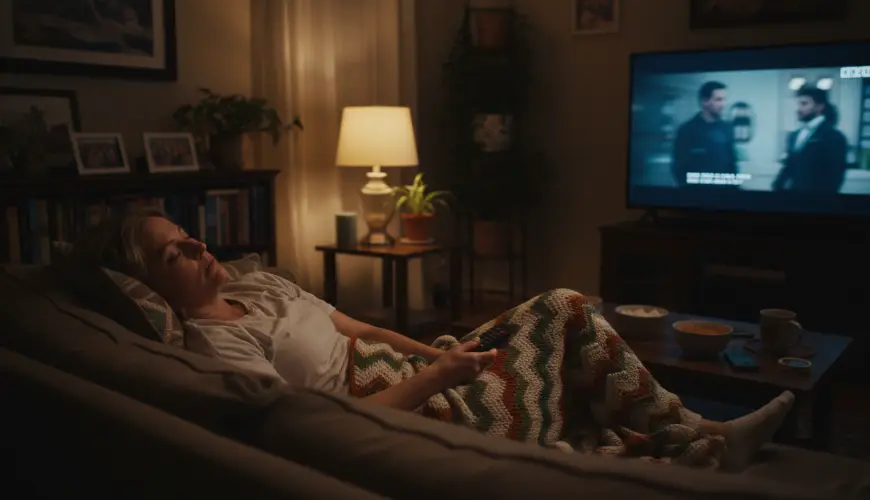
Almost everyone knows it. In the evening, you settle comfortably on the couch, turn on your favourite series, and after twenty minutes your head starts to droop. But as soon as you move to bed, sleep seems to evaporate. You lie there, tossing from side to side, and instead of rest, frustration sets in. What is actually happening? Why does the body fall asleep where it shouldn't, and wake up at precisely the moment when it should finally drift off?
The answer is not as simple as it might seem. It involves an interplay of biological mechanisms, psychological habits, and a modern lifestyle that confuses our bodies somewhat. And understanding this paradox can be the first step towards truly quality sleep.
Try our natural products

What happens in the brain when we fall asleep in front of the television
The human brain is accustomed to responding to stimuli from its surroundings. When a person sits in a warm room, in a comfortable chair, in dim light, watching something they enjoy but which requires no active engagement, the nervous system naturally calms down. Heart rate drops, muscles relax, and the brain shifts into a state resembling light sleep. This phenomenon is called passive falling asleep – the body simply succumbs to the monotony of the situation.
Television is particularly insidious in this regard. The sound is continuous, the image changes at a regular rhythm, and you don't have to do anything at all. There is no need to react, make decisions, or think. The brain enters a kind of neutral mode, where accumulated fatigue from the day overwhelms it. This is known as sleep pressure – the longer a person stays awake, the stronger the need for sleep becomes, and the television simply releases the last brake.
But then comes the move to bed. And with it comes something scientists call hyperarousal – a state of nervous system hypersensitivity. Instead of continuing to fall asleep, the brain suddenly activates. Thoughts begin to arrive about tomorrow's meeting, a list of unfinished tasks, the memory of an unpleasant conversation. The bed, which should be synonymous with rest, becomes a place where the mind works overtime.
This mechanism is also described by the American Academy of Sleep Medicine, which points out that insomnia is largely learned behaviour. The brain gradually associates the bed with wakefulness and anxiety, while the couch remains a place free of pressure and expectation.
Blue light, melatonin, and a little chemistry
Another piece of the puzzle is light – specifically blue light emitted by television screens, phones, and computers. The human body is set up to be guided by the natural cycle of light and darkness. At dusk, the pineal gland in the brain begins producing melatonin – the hormone that tells the body it is time to sleep.
Blue light from screens disrupts this process. The brain interprets it similarly to daylight and slows or completely halts melatonin production. Research published in journals such as the Journal of Clinical Endocrinology & Metabolism shows that exposure to blue light in the evening can delay the onset of melatonin by two hours or more.
The paradox, however, is that we still fall asleep in front of the television. Why? Because sleep pressure – that accumulated fatigue – can be so powerful that it overrides even disrupted melatonin production. The body simply succumbs to exhaustion. But the quality of such sleep is poor. It is more of a light doze than deep, restorative sleep, which is why, upon moving to bed, the brain wakes up again, as if saying: "That wasn't enough – now we need to make up for it."
The situation is well illustrated by an everyday example. Imagine someone who works at a computer all day, puts on a series in the evening, and falls asleep on the couch around ten. Their partner wakes them and they move to bed. Suddenly they are lying there unable to sleep. They toss and turn for an hour, then pick up their phone to "just check the news", and the screen light makes things even worse. In the morning they wake up tired and the whole cycle repeats. This is not an exception – for millions of people, it is everyday reality.
The psychology of the bed and the power of the conditioned reflex
Russian physiologist Ivan Pavlov made the concept of the conditioned reflex famous through dogs that salivated at the sound of a bell. The human brain works on the same principle. If a person spends hours in bed tossing and turning, reading the news, watching videos, or thinking about problems, the brain stops associating the bed with sleep and begins to perceive it as a place of activity.
This is one of the reasons why sleep medicine specialists recommend restricting bed use exclusively to sleep (and intimacy). When the brain receives a clear signal – bed equals sleep – it automates the response just like Pavlov's dogs. But in the age of smartphones, streaming services, and working from home, this principle is becoming increasingly difficult to maintain.
A psychological factor of expectation adds to this. Once a person begins having trouble falling asleep, anxiety develops about not being able to fall asleep again. And it is precisely this anxiety that is the greatest enemy. "Trying to fall asleep is one of the surest ways to ensure you cannot," wrote Matthew Walker, neuroscientist and author of Why We Sleep, which became a global bestseller and fundamentally changed the public's understanding of sleep.

What to do about it? Small changes with a big impact
Understanding the causes is important, but it is not enough on its own. The good news is that sleep habits can be retrained – and no radical lifestyle change is required. A few consistently maintained principles are sufficient.
One of the most effective tools is a regular wake-up time – even at weekends. The brain loves predictability. When a person wakes up at the same time every day, the biological clock sets itself and falling asleep comes more naturally. Staying up late at weekends and then enduring a painful Monday morning disrupts this rhythm and creates what scientists call "social jet lag".
Another step is consciously winding down in the evening. Instead of flicking between apps or watching gripping series right before bed, it helps to incorporate calmer activities – reading a physical book, light stretching, a warm bath, or a short meditation. A warm bath also has a direct physiological effect: after the body heats up, a reflexive cooling occurs that mimics the natural drop in body temperature during the onset of sleep.
The bedroom environment also plays a role. Darkness, coolness (ideally around 18°C), and quiet are conditions the body needs for quality sleep. Blackout curtains, earplugs, or white noise can make a surprisingly large difference. And when it comes to the materials on which a person sleeps and under which they rest, natural fabrics such as organic cotton, bamboo, or linen help regulate body temperature better than synthetic fibres – and this genuinely shows in sleep quality.
It is also worth mentioning that diet and exercise play a greater role in the sleep equation than most people realise. Heavy meals right before bed, caffeine in the afternoon, or alcohol in the evening (which may seemingly make falling asleep easier but significantly disrupts deep sleep) – all of these affect how the body behaves at night. Regular physical activity, on the other hand, increases sleep pressure and makes falling asleep easier, though ideally not immediately before bed.
If problems persist for weeks or months, it is worth consulting a specialist. Cognitive behavioural therapy for insomnia (CBT-I) is today considered the most effective long-term treatment for chronic insomnia – more effective than medication, without side effects, and with lasting results. More information about this method is available from, for example, the US National Institutes of Health (NIH), where review studies confirming its effectiveness are also accessible.
The paradox of falling asleep in front of the television and lying awake in bed is therefore primarily a signal – the body and brain are sending a message that something in the daily rhythm or evening habits is not working as it should. It is not a failure of willpower or an inexplicable mystery, but a predictable result of a modern lifestyle that often works against human biology. And precisely because these are learned patterns of behaviour, the good news also holds: what has been learned can be unlearned. The bed can once again become a place of genuine rest – you simply need to give the brain a chance to believe it.