

# Why digestion worsens on vacation and how to help yourself effectively
Everyone knows it. You arrive at your dream vacation, check into an all-inclusive hotel, look forward to relaxing – and instead, on the second or third day, you're hit with a bloated stomach, constipation, or diarrhea. Your mood drops, time by the pool becomes complicated, and you wonder why this is happening right now. You're not alone. Digestive problems on vacation are such a widespread phenomenon that doctors call it "traveler's constipation" or, in the English-speaking world, simply traveler's constipation. But why does it actually happen, and what can be done about it?
The human body is a creature of habit. We wake up at roughly the same time, eat at similar intervals, move around in familiar places, and the digestive system becomes so accustomed to this rhythm that it works almost like clockwork. But as soon as we board a plane or get into a car heading to a distant destination, this finely tuned system takes a hit. Suddenly we sleep differently, eat differently, drink different water, move less – or more – and the body needs time to adapt. This adaptation process manifests most clearly in the digestive tract.
Try our natural products

What disrupts digestion while traveling
One of the biggest culprits is changes in time zones and disruption of the circadian rhythm. Research shows that the gut microbiome has its own biological clock synchronized with the sleep-wake cycle. When we fly across several time zones, the intestines find themselves in a similar state of confusion as our brain during jet lag. A study published in the journal Cell demonstrated that disruption of the circadian rhythm directly affects the composition of the gut microbiome and can lead to an imbalance that manifests as digestive problems.
Alongside jet lag, stress plays an enormous role. Even the pleasant kind. Preparing for a vacation, packing, worrying about the journey, keeping track of documents and luggage – all of this activates the nervous system in a way that slows digestion. The intestines are closely connected to the brain through the so-called gut-brain axis, meaning that psychological state directly influences how quickly or slowly food moves through the digestive tract. It's no coincidence that many people suffer from constipation in the first days of a vacation, when they haven't yet fully switched off.
Another factor is changes in diet. On vacation we eat differently – more richly, more fattily, sweeter, at different hours and in different combinations. All-inclusive hotels offer an endless array of food whose composition differs significantly from what our digestion is used to. Add local spices, exotic fruits, or dishes prepared in oils we don't use at home, and you have a recipe for digestive chaos. The body simply needs time to deal with new stimuli.
Fluid intake is also not to be overlooked. In hot climates, the body loses more fluids through sweating, but tourists often forget to replenish water adequately – especially when spending hours on the beach while drinking alcohol or sugary drinks instead. Dehydration is one of the most common causes of constipation in general. The intestine needs water to move its contents along smoothly. Without adequate hydration, stools harden and movement slows.
And then there is physical activity – or rather its absence. Many people spend their vacation lying on a sun lounger, which is a well-deserved rest, but provides too little movement for the intestines. Physical activity mechanically stimulates peristalsis – the wave-like movements of the intestines that push food forward. Without it, digestion naturally slows down.
Traveler's diarrhea is a separate chapter, affecting travelers in tropical or less hygienically secured destinations. This has a different origin – most commonly bacterial or viral contamination of food and water. The World Health Organization estimates that traveler's diarrhea affects 20 to 50 percent of international travelers, with the highest risk when visiting countries in Asia, Africa, or Latin America.
How to support digestion before departure
Prevention is always easier than treatment, and this is doubly true for digestive problems while traveling. Experienced travelers know that preparing the digestive system for a trip begins several days before departure.
Probiotics play a key role. Regular intake of live bacterial cultures helps strengthen the gut microbiome and increases its resilience to sudden changes in environment, diet, and time zones. Ideally, you should start taking probiotics about a week before the trip and continue throughout your stay. You should choose products with a sufficient number of live cultures and verified composition – available on the market both in capsule form and in fermented foods such as kefir, kimchi, or kombucha.
Fiber is equally important. Adequate intake of fiber in the period before and during travel helps maintain regular bowel movements and nourishes beneficial gut bacteria. There's no need to reach for supplements – simply ensuring enough vegetables, whole grains, legumes, and fruit is sufficient. However, if you know your diet on vacation will be less varied, psyllium or another natural source of fiber can be a practical addition to your travel first-aid kit.
As gastroenterologist and gut health expert Justin Sonnenburg once said: "The gut microbiome is like a garden – what matters is what you plant in it long before you expect a harvest." And this metaphor applies to travel as well. Caring for your gut in everyday life pays off precisely when the body is exposed to unusual conditions.
Before traveling to high-risk destinations, it is advisable to find out about the quality of local drinking water. In many countries, a simple rule applies – drink only bottled water, avoid ice in drinks, and be cautious with food from street stalls, especially in the first days of your stay, when the body is still getting used to the local bacterial environment.
Practical tips for healthy digestion while on vacation
Once you're there, there are several simple habits that can help significantly. Above all, regularity. Even on vacation, it pays to wake up at roughly the same time and maintain at least approximately regular mealtimes. The body thus receives a signal that the rhythm, while not exactly the same as at home, still exists – and the digestive system can adapt more easily.
Hydration on vacation is absolutely essential, especially in hot climates. Daily fluid intake should be higher than at home – at temperatures above 30 degrees and when spending time in the sun, you can easily need two to three liters of water per day, while alcohol and coffee reduce hydration, so they need to be compensated for with additional intake of plain water. A practical aid is a water bottle you keep with you at all times.
Movement doesn't have to mean anything strenuous. A morning walk on the beach, swimming, an excursion to the surrounding area – all of this naturally stimulates intestinal peristalsis and helps prevent constipation. Conversely, lying around all day without movement demonstrably slows digestion.
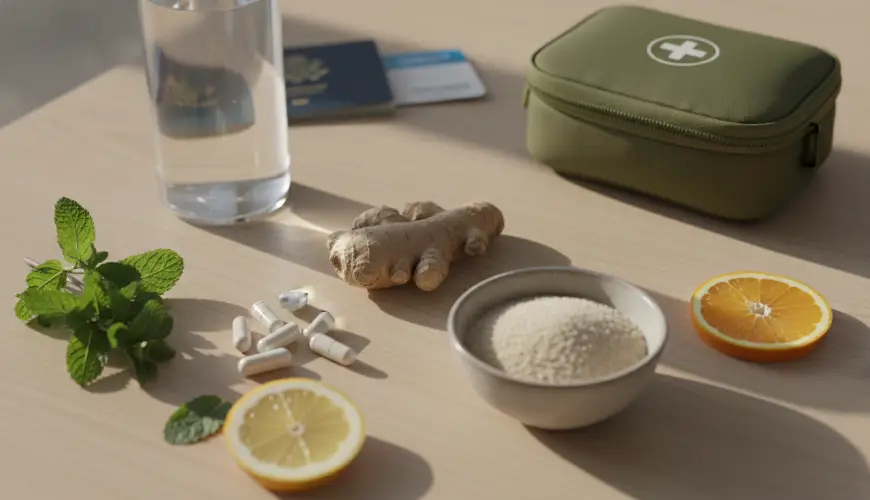
In addition to probiotics and fiber, a travel first-aid kit should also contain enzyme preparations, which help the body process unfamiliar foods, and activated charcoal or natural preparations for cases of diarrhea. Ginger is a well-established natural remedy for nausea and digestive problems – whether in the form of tea, capsules, or simply as a spice in food. Peppermint works similarly, relaxing spasms in the digestive tract and relieving bloating.
Let's take a real-life example: Jana, a thirty-four-year-old teacher from Brno, suffered from constipation on every foreign vacation, which ruined the first week of her stay. Following her doctor's recommendation, she began taking probiotics two weeks before the trip, increased her fiber intake, and carefully monitored her fluid intake on vacation. The result? For the first time in years, she spent an entire vacation without digestive problems. A small change in habits was able to significantly improve the quality of her rest.
It's also important to resist the temptation to overeat just because food is included in the price of the stay. All-inclusive buffets are tempting, but an overfull stomach won't speed up digestion – quite the opposite. Smaller portions at regular intervals are far more friendly to the digestive system than two enormous feasts per day.
If diarrhea does occur, the priority is preventing dehydration – replenishing fluids and electrolytes, ideally using rehydration solutions available at a pharmacy. If symptoms persist or blood appears in the stool, medical attention is necessary. Most traveler's diarrhea, however, resolves on its own within two to three days with adequate hydration and a light diet.
Digestion on vacation doesn't have to be an inevitable problem. With a little foresight, proper preparation, and a few simple habits, a large proportion of difficulties can be prevented or significantly reduced. Your body deserves the same care as your travel itinerary – and the reward will be a vacation you'll remember for all the right reasons.