

# Why Deadlifts for Women Belong in Every Training Plan
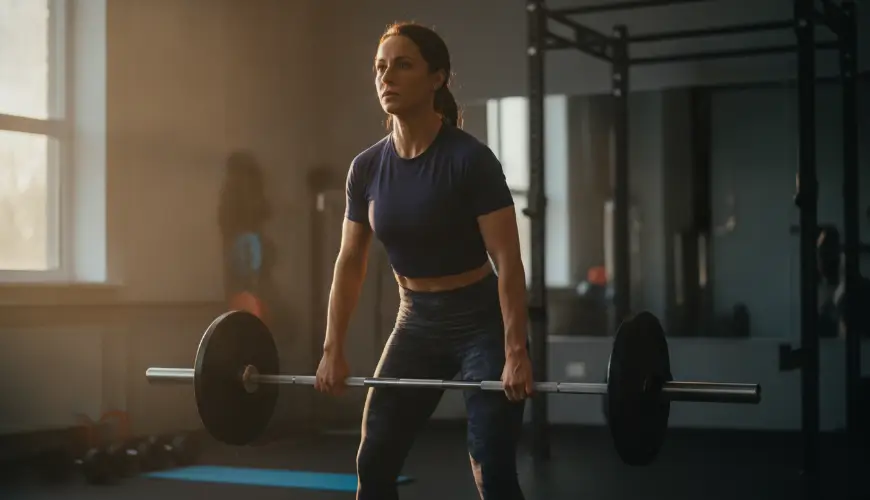
Imagine a woman walking into a gym for the first time in her life. She looks around, sees men lifting heavy barbells, and instinctively heads toward the light dumbbells or the stretching area. Lifting a heavy barbell loaded with plates? That's not for her. This is a story that repeats itself in gyms every day – and at the same time, it's a story that can be changed. The deadlift is one of the most natural movements the human body knows, and women who learn to perform it correctly typically describe it as the exercise that transformed their entire approach to training.
Fear of heavy weights among women is not irrational. We grew up in a culture that told us for decades that strength training would make us "bulky," that heavy weights were a man's domain, and that proper women's exercise was yoga, pilates, or cardio. But science says otherwise. According to research published in the Journal of Strength and Conditioning Research, strength training in women does not cause muscle mass gains comparable to male hypertrophy – simply because women naturally have significantly lower testosterone levels. What strength training does offer women, however, is improved body composition, stronger bones, a higher metabolism, and – perhaps surprisingly – confidence that spills over into everyday life.
Try our natural products





Why the deadlift specifically?
Among all strength exercises, the deadlift holds a unique position. It is not an isolation exercise targeting a single muscle – it is a compound movement engaging virtually the entire body simultaneously. Glutes, hamstrings, lower back, core, trapezius, forearms – all working in synchrony within one fluid movement. And crucially: the deadlift mirrors a movement we perform every day. Picking up a bag from the floor, lifting a child, raising a box – these are all variations of the deadlift. Learning to do it correctly therefore means not only being stronger in the gym, but moving more safely and efficiently in real life.
Consider a specific example: Jana, a thirty-three-year-old accountant and mother of two, started deadlifting two years ago with an empty twenty-kilogram barbell. She had never trained with weights before, was afraid of injury, and frankly, the whole idea of heavy barbells terrified her. Today she pulls over fifty kilograms, the back pain that had troubled her for years from sitting at a computer has virtually disappeared, and she herself says she feels stronger in her body than ever before – including her twenties. There are thousands of stories exactly like this, and they all begin in the same place: with the decision to try.
The natural question, then, is: where does one actually start when they have no experience with strength training and the idea of lifting forty kilograms seems as distant as summiting Everest?
The answer is surprisingly simple: start with bodyweight or minimal load and make technique an absolute priority. Proper form in the deadlift is everything. Poor technique with a light weight is more dangerous than proper technique with a heavier weight – and this is especially true for the lower back, which is most at risk when the movement is performed incorrectly.
The journey from zero to forty kilograms, step by step
Progression in strength training is not a sprint – it is a marathon. And the deadlift for beginners – especially for those who have been afraid of barbells – requires patience and a systematic approach. The good news is that a woman's body responds to strength training very quickly, particularly in the first few months, when the nervous system is learning to activate the correct muscle groups. The so-called "beginner effect" means that initial progress comes quickly and is visible even at relatively low weights.
The first phase lasts approximately four to six weeks, and its goal has nothing to do with weight – it is the movement pattern. In practice, this means practising the so-called hip hinge: a forward lean with a straight back and a "hinge" at the hips. This can be trained literally against a wall: stand with your back to it, slightly bend your knees, and slowly push your hips backward until they touch the wall, keeping your back straight and your chest facing forward. This movement is then transferred to work with a light barbell or even just a bamboo pole weighing only a few kilograms.
The second phase, roughly from the second to the fourth month, adds weight gradually and systematically. A typical approach involves adding 2.5 kilograms every other session. Does that sound slow? Yet over twelve weeks of such progression, a beginner adds thirty kilograms to her starting weight – while maintaining proper technique and avoiding overload. In this phase, the key is learning to listen to your body: distinguishing between healthy muscle fatigue and pain that signals a problem.
The third phase, from the fourth month onward, focuses on consolidating strength and refining technique. It is precisely during this period that most women reach a weight of around forty kilograms or more, and what is fascinating is that the movement, which at the beginning required full concentration and conscious control of every detail, becomes natural and fluid. The body has memorised the pattern.
Alongside the training itself, recovery plays a crucial role. The deadlift is a demanding exercise and the body needs time to recover – which is why it is recommended to include it no more than twice a week with adequate rest between sessions. Sleep, hydration, and sufficient protein intake are not optional extras, but fundamental conditions for progression to work.
A particularly valuable perspective on women's strength training was offered by pioneer in the field Bret Contreras, whose research focuses on biomechanics and functional strength: "Women are biologically suited to strength training just as men are – the only difference is the cultural conditioning that discourages them from picking up a barbell." This conditioning is precisely what needs to be consciously overcome.
A mirror, training footage, or – ideally – at least a few sessions with a qualified trainer can be practical aids in finding proper form. Investing in a good start pays back many times over in the form of faster progress and minimised injury risk. When looking for reliable information on deadlift technique, a dependable resource is the exercise and training protocol database at ExRx.net, which offers a detailed biomechanical breakdown of the movement.
Another aspect that women often underestimate in the deadlift is grip – that is, grip strength. At higher weights, the hands fatigue before the legs and back, which limits progress. The solution is either specialised wrist straps that transfer part of the load, or systematic forearm strengthening through supplementary exercises. Many women also discover that working with a barbell requires a different grip than they are accustomed to from everyday life, and even this seemingly minor detail takes time and practice.
As for equipment, a beginner needs nothing special. Firm footwear with a flat sole – ideally without thick cushioning insoles, which are excellent for running but reduce stability during the deadlift – is the foundation. Comfortable clothing that does not restrict movement. And of course a barbell set, whether at the gym or at home. For home training, a set of adjustable dumbbells or an Olympic barbell with plates is an investment that pays for itself quickly with regular use.
It is also worth noting that the deadlift comes in several variations, and not every one suits every body equally. The Romanian deadlift, in which the knees remain nearly straight and the movement occurs primarily from the hips, is excellent for targeting the hamstrings and glutes, and many women find it more intuitive than the conventional deadlift. The sumo variation, with a wider stance and toes turned outward, suits women with wider hips better. Experimenting with variations is not only permitted but actively encouraged – the goal is to find the movement that works for a specific body and anatomy.
Fear of the barbell is understandable, but it is not fixed. Every woman who today lifts forty or fifty kilograms once stood where a beginner stands today – at an empty bar or bamboo pole, with uncertainty in her eyes and a question mark over whether it was even worth trying. The answer is unequivocal: it is. The deadlift is not an exercise for the elite or for those with an athletic background. It is a movement for anyone willing to start slowly, dedicate time to technique, and trust the process. And the reward – a stronger body, healthier back, stronger bones, and the confidence that comes from achieving something you once considered impossible – is absolutely worth the patience.