
# Storing food without plastic pays off
Plastic is everywhere. In the fridge, in kitchen cupboards, in the drawer full of cling film and bags – and if you look around an average Czech household, you'll find that plastic packaging is almost impossible to avoid. Yet the kitchen is precisely the place where the most can be done. Transitioning to plastic-free food storage doesn't mean a dramatic overnight overhaul or spending thousands of crowns on trendy products from an organic shop. It means a gradual, thoughtful change of habits – and that's exactly what this guide is about.
Before we get into specific alternatives and tips, however, it's worth understanding why any of this matters. It's not just about environmental activism or trendy hashtags on social media. It's about health, about food quality, and about what happens to plastic after we toss it into the yellow recycling bin.
Try our natural products


Why plastic in the kitchen isn't as harmless as it seems
You may have come across discussions about microplastics – those invisible particles produced by the breakdown of plastic products that make their way into soil, water, and the human body. According to research published in the journal Environmental Science & Technology, the average person ingests approximately five grams of microplastics every week – roughly the weight of a credit card. Some of these come from the plastic packaging in which food is stored, particularly when that packaging is exposed to heat or fatty foods.
This doesn't mean, of course, that every plastic container immediately poses a health risk. But it is a good reason to pause and reflect. Beyond the health aspect, there's also the question of food quality itself. Anyone who has ever stored bread in a plastic bag and then compared it to bread wrapped in a linen cloth knows the difference is noticeable – not just in taste, but in how long it stays fresh. Plastic retains moisture in a way that can actually be detrimental to certain foods.
And then, of course, there's the environmental dimension. The Czech Republic is among the European countries with a relatively high consumption of plastic household packaging. Despite recycling schemes, a large proportion of plastics ends up in landfills or incinerators – and only a fraction is genuinely transformed into new material. As American writer and ecologist Wendell Berry once observed: "Eating is an agricultural act." We might add that it is also an environmental act – from the field all the way to how we store food at home.
Switching to plastic-free storage is therefore not merely a gesture. It is a practical decision with real consequences.
Glass, stainless steel, beeswax and linen: what actually works
The most common question people ask when starting out is: what do you actually replace plastic with? There's no single universal answer, because different foods require different conditions. But there are several basic categories of alternatives that will cover the vast majority of needs in an average household.
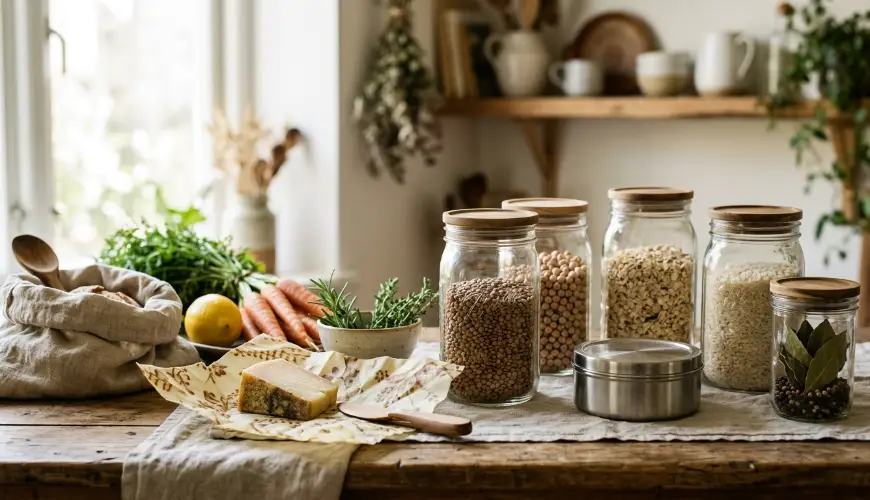
Glass jars and containers are probably the most versatile option. Glass is an inert material – it doesn't react with food, doesn't absorb odours, is dishwasher-safe, and with proper care can last literally decades. Preserving jars in various sizes are ideal; they can be used for dry goods such as pulses, cereals or spices, as well as for storing leftovers in the fridge. The downsides are greater weight and fragility, but these are trade-offs that are easy to live with.
Stainless steel containers are lighter than glass and virtually indestructible. They are particularly well suited for transporting food – packed lunches for work, meals on the go, or picnics. They can't go in the microwave, but otherwise they are highly versatile. A stainless steel box with a well-sealing lid will replace a plastic container in most situations without any difficulty.
Slightly different in nature are beeswax wraps – a fabric alternative to cling film. They are impregnated with a blend of beeswax, jojoba oil and resin, which makes them slightly tacky and mouldable with the warmth of your hands. They work wonderfully for wrapping cheese, vegetables and baked goods, or for covering a bowl. They're not suitable for raw meat or very wet foods, but for everyday use they are a reliable choice. After use, they can simply be rinsed in cold water and used again – a single wrap can easily last a year or more.
Linen and cotton bags are ideal for bread, fruit or vegetables. Unlike plastic bags, they allow food to breathe, which means bread, for example, is far less likely to go mouldy. They are also washable and practically everlasting. Think of your grandmother's kitchen – bread wrapped in a cloth stayed fresh far longer than bread sealed away in a plastic bag.
There are plenty of other alternatives too – ceramic containers with lids, bamboo boxes, or silicone bags, which, while still made from a polymer, are reusable and don't shed microplastics the way single-use plastic does. Every household will ultimately find its own combination that works best.
How to get started – without stress and without unnecessary expense
The biggest mistake people make when transitioning to plastic-free food storage is trying to change everything at once. They throw out all their plastic containers, buy new glass sets, beeswax wraps and stainless steel boxes – and after two weeks find they miss the convenience they were used to and slip back into old habits.
A far more sustainable approach is a gradual one. Take the example of Markéta, a thirty-year-old teacher from Brno who began changing her kitchen habits two years ago. She didn't start by buying expensive products; she started by simply stopping buying single-use zip-lock plastic bags. Instead, she began using glass preserving jars she already had at home from jam-making. Gradually she added more things – she bought two beeswax wraps, then linen bags for bread. Within a year, her household was almost free of single-use kitchen plastic, without spending a great deal of money or experiencing the frustration of a system that didn't work.
In practical terms, a good starting point looks something like this: first, use up or give away any food you have stored in plastic packaging. Then stop buying single-use plastic bags and cling film – this is both the biggest saving and the greatest environmental benefit in one. Instead, get a few glass containers in different sizes (empty jars from preserves or mustard work brilliantly) and one or two beeswax wraps. Then, gradually, as your plastic containers wear out or break, replace them with glass or stainless steel.
It's also worth rethinking the way you shop. Buying in paper or fabric bags, choosing products with no packaging or minimal packaging, and favouring local markets and farmers' markets – all of this naturally reduces the amount of plastic that enters the home in the first place. The organisation Zero Waste Czech Republic offers a wealth of practical tips tailored to the Czech context, from package-free shops to maps of markets where you can buy without packaging.
Another helpful step is to think carefully about how leftovers are handled in your household. Instead of covering a plate with cling film, simply place another plate on top, or use a beeswax wrap. Leftover soup or sauce can go into a glass jar with a lid. A cut lemon can be stored in a small jar with a little water, or wrapped in a beeswax wrap. Most situations where we habitually reach for plastic have simple, natural solutions.
One thing worth mentioning: plastic-free food storage is not about perfection. There are situations where plastic simply makes sense – when travelling, for instance, or for specific foods where no other alternative works as well. The goal is not zero tolerance for plastic at any cost, but a conscious reduction in its use wherever that is realistic and meaningful.
It's also worth knowing that switching to alternatives pays off financially in the long run. A glass jar costing thirty crowns that lasts twenty years is more economical than buying plastic bags and cling film every year. A beeswax wrap costing a hundred crowns will, over a year of use, replace hundreds of metres of cling film. The investment pays for itself – both in monetary terms and in the form of less waste in the home.
A kitchen without plastic may sound utopian, but in reality it's simply a return to the way people preserved food for centuries – in earthenware, in cloth, in glass. Modern alternatives are more convenient, more hygienic and more accessible than ever before. All it takes is a first step – and it doesn't need to be a big one.